"Willie" Watson:
pp. 35-36 · Read in the full issue
40 Years An
Island Trader
One of the Cook Islands’ most successful citizens, and one of Rarotonga’s oldest identities is
cheerful, optimistic William H.
Watson.
“11HLLIE”, as he is known to his ** European friends (and “Viri Vokotini” to his Maori friends) was born in Scotland. In Rarotonga, he worked his way up from near-sub sistence level during the depression of the 30’s to become one of the Cook Islands’ most prominent citizens.
These days “Willie”, and his charming wife, Marie, keep two homes, one in Cambridge, New Zealand, and one in Avarua, Raro tonga. They spend New Zealand summers in Cambridge, and the Cook Islands’ cool seasons in Rarotonga.
In an interview in Avarua recently, “Willie” told our Cook Islands cor respondent, W. H. Percival, how he had come to settle in the Cooks, “As a boy in Scotland I read every book I could get about the South Sea Islands. I developed an irresist ible urge to reach the Islands and become an Islands trader. So I came here in 1928,” he said.
But “Willie” didn’t go directly to the Cooks from Scotland.
After being demobilised from the Argyll and Sutherland Highlanders after World War I, he had spent several years working in the coal mines in New Zealand and Australia.
However, he never lost his urge to settle in the Islands. In New Zealand, in 1928, he met a Captain “Topsail” Jack Williams who “sold” the Cooks to him. A week after that
meeting “Willie” was on board the SS Makura bound for Rarotonga.
For two years “Willie” worked for a firm on Rarotonga. Then, on May Day, 1930, he took out his first trading licence.
With modest capital (and faith and determination), he opened a small general store in Avarua. He worked alone from 6.30 am to 9.30 pm, and sometimes had to work on Sundays.
About a year later he bought a billiards table and opened a billiards saloon. This increased his income, but also his hours of work.
In 1933 he married Marie Peyroux, the daughter of Jean Peyroux, a Frenchman, and his Polynesian wife.
Marie cheerfully helped “Willie” in the store, and also made cakes and bedspreads which sold quickly.
The next milestone in “Willie’s” career was when he bought out W.
H. Grove and Sons store in Raro tonga.
Partnership
He began to buy and export copra, mother-of-pearl shell, cowry shell, hula skirts, shell necklaces, dried fish, tomatoes, citrus fruit, and locally-made hats and mats. All this was in addition to his regular busi ness in groceries, hardware, drapery and fancy goods.
In 1943, when the bottom fell out of the trade in pearl shell brooches and similar items “Willie” Watson went into partnership with Harry Scott and established a small clothing factory on Rarotonga. ( PIM, Oct., 1962, p. 39). Many setbacks and difficulties had to be overcome, but the business prospered and expanded.
“Willie” became a member of Rarotonga’s Island Council, and was the mover for a Cook Islands Legislative Council.
For nine years he served the Cooks, first Island Council, then on the
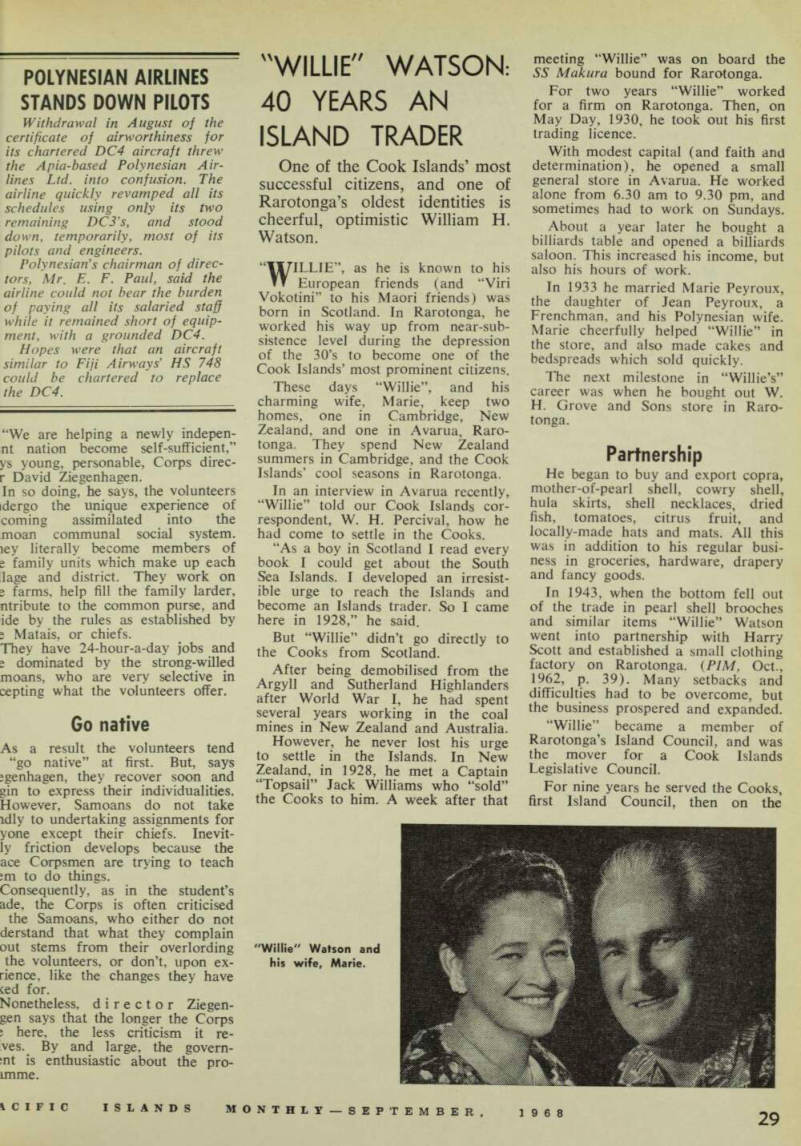
"Willie" Watson and his wife, Marie.
Legislative Council and finally on the Legislative Assembly.
In October, 1958, “Willie” Watson stood as a native member against 15 Polynesians. Old hands scoffed at his chances, but many Cook Islanders remembered what he had done for them in the depression and the lean years of World War 11. They stood behind him solidly and, without looking for votes, he romped home an easy winner with 1,609 votes — 884 votes ahead of his nearest rival.
More schools
From the outset of his political career “Willie” Watson stressed the need for secondary schooling in the Cook Islands. As a result, Rarotonga’s Tereora College was opened on February 18, 1954, and Junior High Schools were built on Aitutaki, Atiu and Mangaia some years later.
He was one of the first to battle for a pure water supply for Raro tonga, and big improvements, at great expense, have been carried out during recent years. In January, 1967, Mr. George L. Chan, a public health engineer with the South Pacific Com mission, demonstrated how a plenti ful supply of pure water can be obtained cheaply on Rarotonga by means of water galleries. (P/M, May, P- 67).
“Willie” campaigned successfully for improved medical service and internal self government for the Cook Islands. (The Cook Islands became internally self-governing in August, 1965). And, it was “Willie” who, in 1951 helped found the Cook Islands Crippled Children’s Society.
Destroyed by fire
Fire completely destroyed “Willie’s” store in Avarua in Nov ember, 1957. Undaunted, he im mediately began to build a much larger one.
It was opened in December, 1958, and it is the largest store in the Cook Islands. The 6,000 sq. ft. supermarket was constructed almost entirely by local labour. Today, the permanent staff of United Island Traders is 48 and 10 extra staff are employed on busy Saturdays.
In 1955, “Willie” took his wife and their two children, Betty and Jean, on a tour of Europe which lasted 14 months. Five years later “Willie” and his wife toured Europe, Russia and the US and, in 1965, took a combined business and pleasure trip to Australia, the Philippines, Hong Kong and Japan.