Adrift For Nearly Three Months
pp. 31-32 · Read in the full issue
Nearly three months after the Nationalist Chinese fishing boat Hsienchin burned and sank off Rotuma on June 5, the South Pacific gave up the last of the boat’s survivors—7oo miles from Rotuma in the Solomon Islands.
)uring July and August, the rageous story of the survivors, of their dead shipmates, reached outside world from Honiara, ital of the Solomons.
'he story of the privations of the Chinese seamen adrift on the enchin’s three rafts has two corn able “castaway” sagas in recent rs—the Minerva Reef Tongans, sing for four months in 1962, and Cook Islands drifters, missing two months in 1963, he Hsienchin’s 11 survivors were overed clinging to tiny rafts in ote Solomon Islands weeks after j had been presumed dead, dter treatment in Honiara’s pital, the survivors told reporters it had happened when the enchin had gone down.
Search abandoned
•f Hsienchin’s 20-man crew, one vned soon after abandoning ship. remaining 19 boarded three s built of glass fishing floats, iboo and 44-gallon drums, aft One, with six men under tain Chi Son Chin, took 39 days drift more than 700 miles until cached a small beach near Taipe age, on remote Santa Cruz. /hen news of these survivors Led Honiara, Australian and NZ
aircraft scoured the entire area for six days.
During the search Raft Two turned up, on the opposite side of Santa Cruz. Of the four men aboard, one died shortly after landing. His three shipmates rested for several days on Santa Cruz before being taken to Honiara hospital.
On July 29 the air search was abandoned, and most people con sidered that Raft Three containing nine men, was lost.
Then, in the early hours of August 11, the raft was spotted off the coast of San Cristobal by the inter island trader, Vula. On board were two brothers, Lee Ah-wong and Lee Ah-yung. They were starved, sun burnt and almost lifeless. They had been at sea for 69 days. Their seven shipmates were dead.
With the three rafts accounted for, Hsienchin's crew list read; one drowned, eight dead from privations and 11 alive.
In late August, after a couple of days rest as guests of Honiara’s Chinese community, Captain Chin told how he and the five men aboard his raft endured their 39 days at sea.
For the first nine days the three
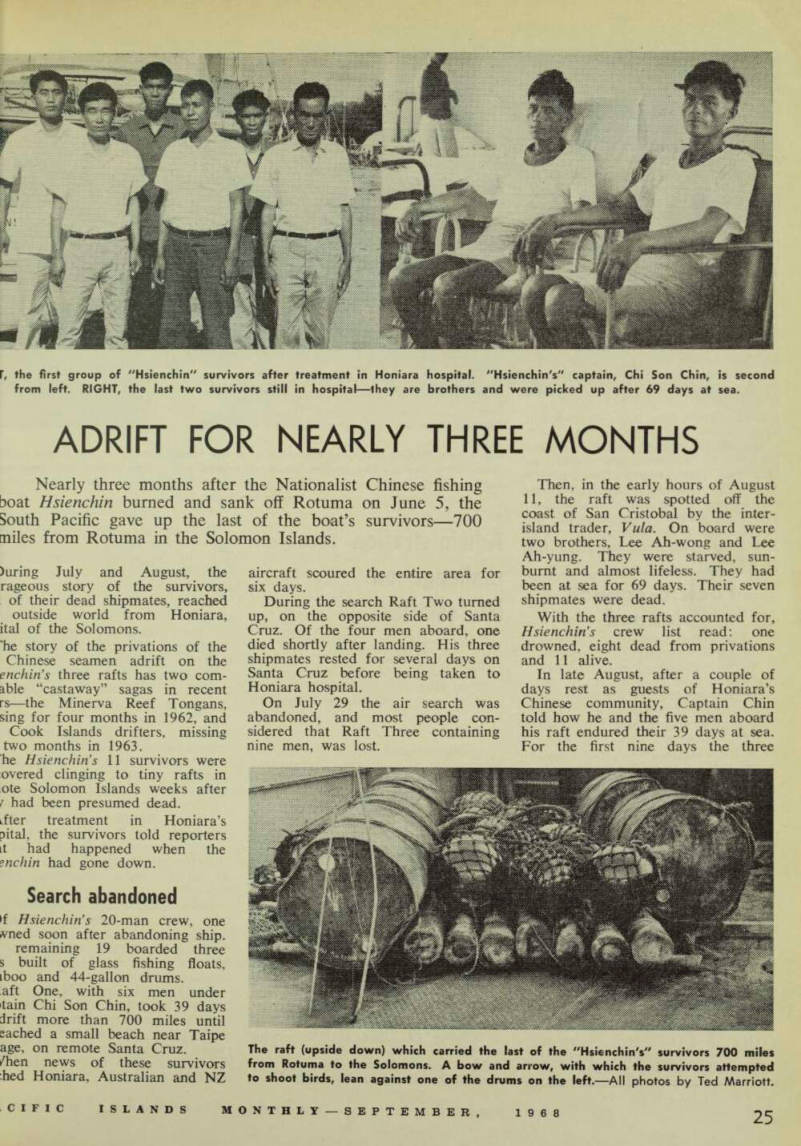
the first group of "Hsienchin" survivors after treatment in Honiara hospital. "Hsienchin's" captain, Chi Son Chin, is second from left. RIGHT, the last two survivors still in hospital—they are brothers and were picked up after 69 days at sea.
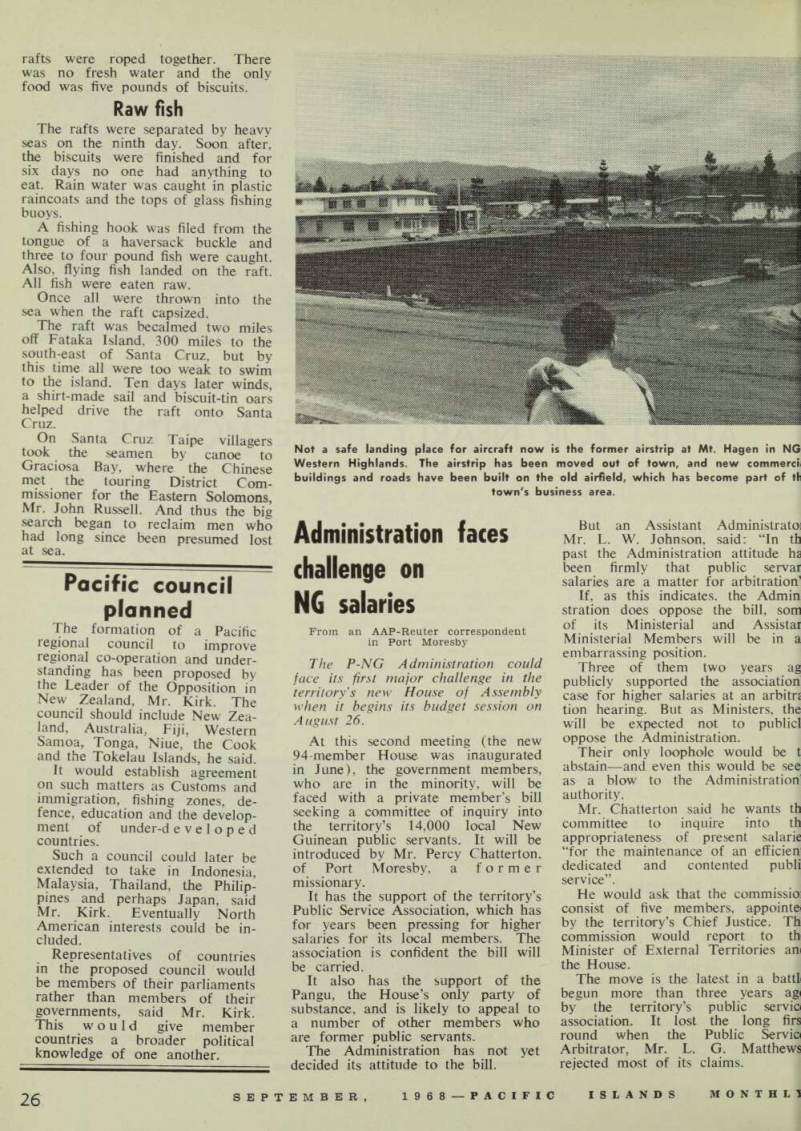
The raft (upside down) which carried the last of the "Hsienchin's" survivors 700 miles from Rotuma to the Solomons. A bow and arrow, with which the survivors attempted to shoot birds, lean against one of the drums on the left.— All photos by Ted Marriott.
rafts were roped together. There was no fresh water and the only food was five pounds of biscuits.
Raw fish
The rafts were separated by heavy seas on the ninth day. Soon after, the biscuits were finished and for six days no one had anything to eat. Rain water was caught in plastic raincoats and the tops of glass fishing buoys.
A fishing hook was filed from the tongue of a haversack buckle and three to four pound fish were caught.
Also, flying fish landed on the raft.
All fish were eaten raw.
Once all were thrown into the sea when the raft capsized.
The raft was becalmed two miles off Fataka Island, 300 miles to the south-east of Santa Cruz, but by this time all were too weak to swim to the island. Ten days later winds, a shirt-made sail and biscuit-tin oars helped drive the raft onto Santa Cruz.
On Santa Cruz Taipe villagers took the seamen by canoe to Graciosa Bay, where the Chinese met the touring District Com missioner for the Eastern Solomons, Mr. John Russell. And thus the big search began to reclaim men who had long since been presumed lost at sea.