change migrant policy
pp. 29-30 · Read in the full issue
Pressure on NZ to change migrant policy and Fiji watches with Interest
By Kathleen Hancock, in Auckland
Recent pressure has been put on the New Zealand Govern ment for an increase in the rate of assisted migration to New Zealand. The NZ Manufacturers’ Federation, which supports an increase, has reported that there are vacancies for skilled workers in many manufacturing industries and has said that if these vacancies were filled jobs would be created for semi skilled and unskilled workers.
Any change in New Zealand’s imigration policy will be closely atched in the Pacific, especially in 'ercrowded, under-developed Fiji.
Last year New Zealand placed a tal ban on the three month working :rmit so popular with citizens of ji, both Fijian and Indian. And rmanent immigration into New :aland from Fiji is so difficult as be just about impossible.
If an increase in the rate of NZ imigration is granted, will this san a continuation of the old iropean/Polynesian bias?
Limitations
Cook Islanders, as New Zealand izens by right, may enter the untry freely. Samoans receive /curable treatment and immigrants >m Northern and Western Europe ve little difficulty in becoming new tiers. But there are strict limita ns on the entry of citizens from n-European countries, even if they ; British citizens.
The New Zealand Immigration :partment operates on no formal otas and entry is largely at the cretion of the official concerned each individual transaction. The eration of the system leads to a »picion on the part of non ropeans and non-Polynesian inders that the immigration laws : racist. They certainly give scope • the exercise of prejudice. [n Fijian eyes, New Zealand is
beginning to look a bit like those two-faced figures with a smiling countenance to the fore and a nasty grimace to the rear. She is generous with aid to Fiji—willing to send scarce teachers to help raise the colony’s educational standards—and the donor of a magnificent gift of buildings and amenities to Fiji’s new University of the South Pacific.
But to Fijian and Indian, Kiwiland is beginning to take on something of the aspect of the old-time lady bountiful, who was always willing to take hot soup to the needy villagers, but would have fainted if any of them had presumed to enter her drawing-room.
Nevertheless, during the period when the temporary labour permit system was operating between New Zealand and Fiji, immigrants crowded in great numbers into small houses and flats. Housing conditions deteriorated fast and caused values to drop in the areas affected.
Both Fijian and Indian had high standards of cleanliness at home; but temporarily transplanted into an un familiar environment, they tended to get slack. This was partly due to all-male households.
There were several contributing factors to this state of affairs.
The air fare to New Zealand was high. Rents were also higher than the immigrants had expected. Ex pensive, warm clothing often had to be bought. And all these out
goings, combined with the short period of the work permit, forced workers to pack the greatest possible number into the smallest possible space. Only by these means could they hope to save enough to be able to take money home, which was the whole object of the exercise.
Ordinary, tolerant New Zealanders began to regard all short term workers from the Islands as a threat to living standards.
When this became evident, some of the companies that engaged regu lar batches of labour, especially from Fiji, set up a kind of private welfare service for their temporary workers.
Personnel officers kept an eye on living conditions.
The men were helped to find accommodation at a reasonable rent.
And both Indian and Fijian em ployees were counselled on the necessity of turning a hand to “women’s work”, if they wanted to keep healthy themselves and remain on friendly terms with their fellow citizens.
Highly regarded
When they could still enter New Zealand on working holidays, Fijians and Indians were highly regarded in factories and assembly plants. The personnel manager of one large plant told me he’d like to see the scheme reinstated, with the permit covering a longer period—say, six months or a year.
“They’ve just got the hang of things when they’ve got to leave,” he said.
But even on the old terms, he’d
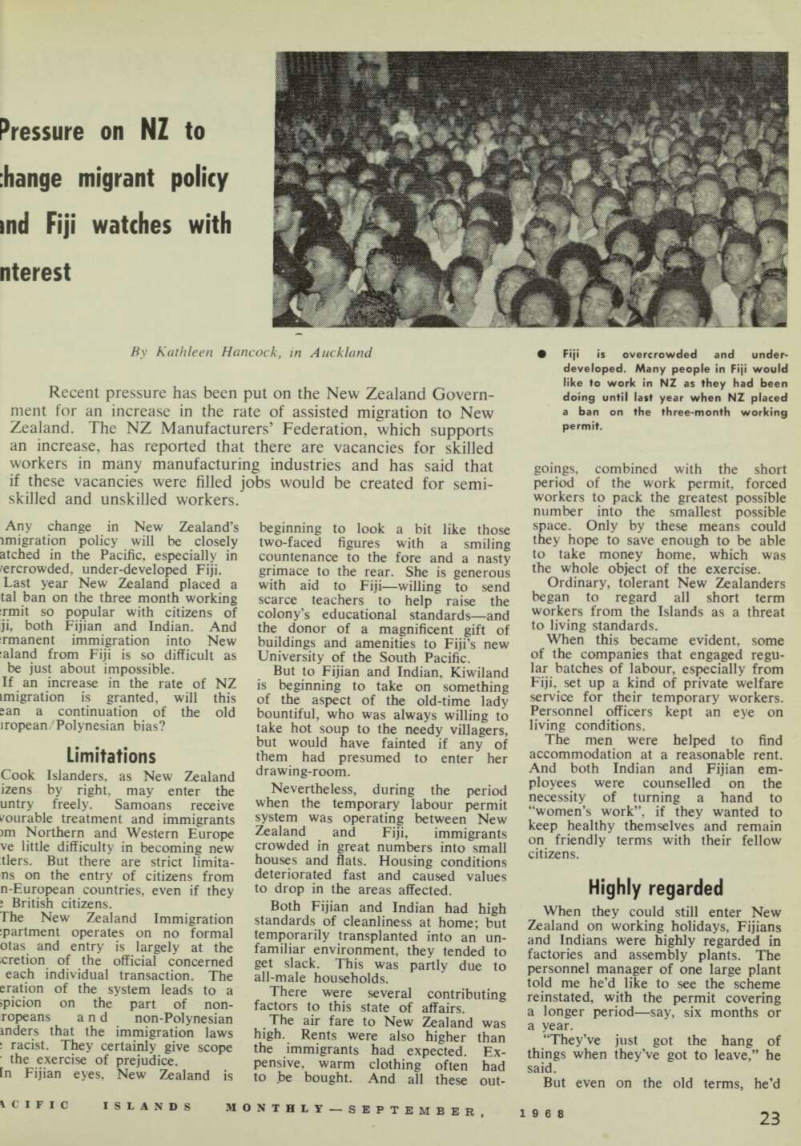
• Fiji is overcrowded and under developed. Many people in Fiji would like to work in NZ as they had been doing until last year when NZ placed a ban on the three-month working permit.
like to see them back. “We’re still putting men on,” he said. “We don’t advertise these days, but we take men on through relatives or friends, or even off the street.”
As far as New Zealand’s farming community is concerned, many farmers would welcome back Indian scrub-cutters, in spite of the fall in farm prices. Generally farmers praise both the output and the outlook of the Indian farmers they formerly employed on a temporary basis.
“They did a darn good day’s work,” one farmer told me. “They were always willing and cheerful— not like the lot we’re getting now.”
The unemployment bogey has always been made good use of by the opponents of multi-racial immigration into New Zealand, especially the Federation of Labour.
Economy now healthier
Rising unemployment figures were given as the reason for banning the work permits issued to Fiji. But New Zealand’s internal economic situa tion is widely considered healthier these days than it was when over-full employment was helping to create a work force with more than its fair share of drifters.
New Zealand, as part of S-E Asia, is anxious to get together in the areas of trade and defence with India, Thailand, Singapore and Malaysia, not to mention her nearer Islands neighbours. It’s hard to see how she can look her fellow negotiators in the eye over the conference table while her immigration laws dis criminate against their nationals.
And with her experience of the enemy drive towards Fii during the Pacific War, it would seem obvious that good relations with this neighbouring island group, eventually to become independent, are very important.
No Fijian, Indian, Singapore Chinese or Thai expects New Zealand to open her doors at random to all comers. But they would like to see the same criteria applied to all immigrants, regardless of race or colour.
Insistence on a certain standard of education would be understood.
But a screening according to race is likely to be misinterpreted. In the US the old quota system discrimina ted harshly against Asians in particu lar. But recently the “national origin” provisions in the US immigra tion laws were wiped out completely.
If New Zealand expects her Pacific neighbours to co-operate with her in trade and stand with her against possible aggression, she needs to look to her social attitudes.