There's progress in the New Hebrides
pp. 25-159 · Read in the full issue
but it's not political
From a Vila correspondent The condominium of the New Hebrides has made some progress since Kathleen Woodburn published 20 years ago her book called, Backwash of Empire. When she published that, Whitehall showed little interest in the territory that was shared by Britain and France under a protocol proclaimed at the turn of the century. But the progress that has been made has not been political.
Economic progress came with the ippointment of Mr. J, S. (later Sir ohn) Rennie as Resident Commis ioner after World War 11. With his irrival the British Government at ong last acknowledged its respon ibility in education; activities of the oluntary agencies were correlated nd a college for the training of New lebridean teachers was built.
The progress which Sir John com lenced continued, and two years ago Tr. Fred Lee, British Secretary for he Colonies, gave an assurance in n address inaugurating Radio Vila lat Britain had no intention of with rawing from the New Hebrides.
Tiis was a statement which was heard dth relief by French as well as ritish residents of the Condominium.
There has been material growth nd expansion in both the British and rench sectors of the economy since ien. Burns Philp has erected a ne new store in Vila; an equally npressive Condominium office block ill soon be ready for occupation aht beside it, and new administra rative offices have been built by the Tnch administration.
Buoyant economy
With this material growth and :pansion there has been further idence of a buoyant economy with e substantial surplus announced by e Condominium Treasurer at the id of last year.
Politically, the Protocol is still e yardstick by which every proposed )litical change must be measured, nd when two administrations share e government there must be com omise, which prevents decisions ing made quickly. While both (ministrations may strive to find the ghest common factor, the result more often the lowest common nominator. Thus constitutional welopment has been bogged down.
There was a major step in 1958, hen the first meeting of the New
Hebrides Advisory Council was inaugurated with 12 unofficial members (four French, four British and four New Hebridean, all nominated by the two Resident Com missioners) and two Condominium officers as official members, plus the two Resident Commissioners as co presidents.
The number of unofficial members has increased since then, with a pro portion of the members elected. But new plans for a further constitutional step, which was expected by 1966, have not been formulated because of lack of agreement between the two metropolitan governments.
The life of the Advisory Council has had to be extended and we have now got to the stage when some
decision must be made for the future.
The Local Government council system, inaugurated 10 years ago with so much promise, has been bogged down like the Advisory Council.
No enthusiasm
The first councils, complete with a chairman, secretary, and a built-in taxation system, were created to fill an administrative vacuum left by the decline in authority of the village chiefs. But today they function merely after a fashion, with no great enthusiasm on the part of the elected members; in some areas the people have expressed definite opposition to them. The town council for Luganville
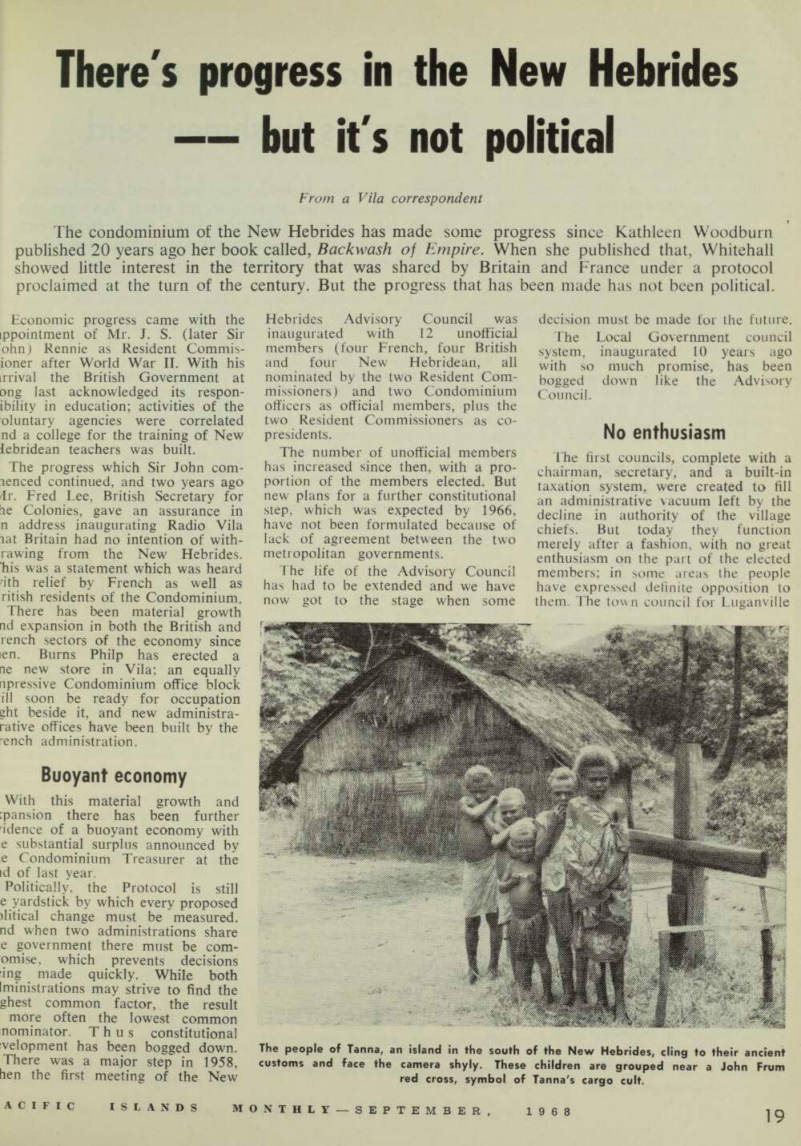
The people of Tanna, an island In the south of the New Hebrides, cling to their ancient customs and face the camera shyly. These children are grouped near a John Frum red cross, symbol of Tanna's cargo cult.
has met with the same attitude, because it is only an advisory body.
Local councils would have more opportunity to function if they had more work to do, and if they had officers who could guide their activity.
Certainly sections of the Condo minium have made progress in talk ing together over these past 10 years, but they have made no progress in acting together. The Advisory Council has not become a body which is representative of the citizens of the New Hebrides, and the two national administrations have not conceded authority and responsibility to a single Condominium administration.
Probably the only Condominium department which is a true Condo minium service is the Postal Depart ment, which provides facilities which everyone needs. All its officers are paid entirely from Condominium revenue, and it is responsible for earning a considerable proportion of Condominium funds. But there is no unity in the other departments.
Separate marine services
There is not, for instance, a Con dominium Medical Department as such, but there are three medical services—a Condominium one and national medical services for Britain and France, Yet there would be great advantages if all these services were to come under one unified direction.
The same applies to the marine service, of which there are three separate ones. How much more effectively could manpower be used if these were made into one depart ment (for one thing, there would be a more efficient distribution of surface mail to the outer islands!).
The New Hebrides constabulary, concerned with the maintenance of law and order in the Condominium, is still divided in to two sections.
They get together when guards-of honour are required to welcome visiting VIPs.
Education problem
There is still no Condominium Educational Department, even though the Advisory Council agrees to a subsidy of £Stg.6l,ooo to be divided between the two national administra tions.
With the experience gained after all these years there should be evidence of common action with education. The two administrations should surely place a proportion of their subsidies in the hands of a joint service instead of dispersing them to their own nationals.
It is all very well for the national
(Continued on p. 151)
linistrations to talk about the ments they themselves make— ch they do —but a great amount this money obviously goes in the ntenance of separate, expensive unnecessary national administra s. Individual New Hebrideans do see much of it, and have no say iow it should be spent. >ne success in the last decade has i with the co-operative movement, sties have sprung up everywhere :h are in the main loyally and /ely supported by their members, the end of the year stores show mdsome profit. et the co-operatives do not ititute a Condominium depart t, and two national officers inister separately a service strictly New Hebrideans, which could be ed for the common good. he great trouble in the New rides is still that there is no such on as a New Hebridean. The f Hebrides is still comprised of ish and French, and not New rideans. he local people cannot be ects of either power, or of both, ravel overseas, they are furnished an inadequate document, ough a new document is now g prepared, and will in ap ance be similar to a passport, it still not give the holder any is in a foreign country, would not be difficult to amend ocol so that a passport could the holder the right to claim sction from the consulate of ;r or both powers, yet the New ridean appears not to count for hing.
What of the future?
r hat is the political future of the tory? How strong is the desire independence? tnong the younger educated group, pendence is sometimes discussed is no more than an ideal for the re, for they know that indepen e in itself would not increase the >nal pay packet. here is, however, a growing New rides national consciousness, and ’sire to support the things which ribute to that development. this bilingual, multi-racial com ity, there is an abundance of aal goodwill which is evident, for iple, in athletic contests. Now is time for action, and the future he Condominium will take care self. But where is the action?