Tropicalities
pp. 4-6 · Read in the full issue
Is it The Bomb? Undoutedly any unnatural happening in the South Pacific during the next few months will be blamed on the French nuclear tests —and one such happening was the mysterious haze over Fiji and Western Samoa in August. It produced brilliant sunsets and sunrises, turned the sun to blood-red and reduced visibility in Fiji to five to 10 miles.
At the same time people in Port Moresby were complaining about a haze which had hovered about southeastern Papua for more than a week in August. At one stage visibility at Port Moresby airport was reduced to one mile.
There were no hard and fast explanations for either phenomenon.
However, a random check of atmospheric radiation made at Apia Meteorological Observatory early m August showed radiation to be twice the normal background level.
Some suggested that the cause might be volcanic ash from the New- Hebndes, but the Nadi Meteorological Office had not been notified of any eruptions
thm^because
dust from the French tests could reach Fiji only by travelling east around the world—and there had not been enough time for it to do this.
And in Port Moresby, the Meteoro-
Well, Is It
The Bomb?
logical Office said that the Papuan haze was caused by industrial smoke (i.e., smog) from the cities of Aus tralia. According to the Met Office, the smog had moved in an arc through the Coral Sea and the Solo mons to Papua.
Could this arc have extended as far as Fiji and Western Samoa?
Could it be that the idyllic South Seas are becoming the victims, not of The Bomb, but of smog?
There is probably some very ordinary explanation, but, like our maiden aunt, we prefer to suspect the bomb.
How to put your
foot in it and win
AUGUST’S international fishing contest at Korolevu, Fiji, had its fair share of minor disasters, not the least being the Fiji team’s forced withdrawal on the opening day of the contest.
Fiji team - members, Mr. D.
Ellerton, Mr. George Rawnsley, the Australian Commissioner, Mr. R. N.
Birch, and Mr. Syd Gould, had to return to Suva after the windscreen on their launch, Inez, was smashed.
Their opponents, a team of enthusiastic New Zealanders, took home the Air New Zealand Trophy for the winning team, plus the Prouds Trophy, the Gokal Trophy, the Burns Philp Trophy, the Millers Ltd. Trophy, the Tip-Top Trophy and the K. Witherington Trophy.
The Tip-Top Trophy (for the heaviest billfish) went to New Zealander Mr. C. Shields, who brought in a 128 lb sailfish —a new Fiji record.
The contest had its humorous ! moments, including the time a 70 lb wahoo revenged itself on Mr. Ken Wiles, 38, of Papatoetoe, Auckland.
Mr. Wiles, who took the Prouds Trophy with a 79 lb wahoo, trod on the smaller fish while it was lying in the cockpit of the Sere-ni-Wai.
“When 1 stepped over it my foot slipped into its mouth —which it promptly closed,” explained Mr.
Wiles, who went home with an additional trophy—three stitches and a bandaged left foot.
“Not me, a couple
of other fellows”
CAPTAIN Fred Ladd did not have a narrow shave while flying in the Solomons about two months ago, as we reported on page 41 of August
Pim.
According to Fred himself he was out fishing on the reef that day. It all happened to another pilot who was taking a load of Solomon Islander passengers from Henderson Field on Guadalcanal to a Mission strip at Avu Avu. We quote Fred: “On approach to the airstrip, the pilot had under-carriage selection trouble and landed wheels up—a perfect landing for this mode of arriving back on earth. The aircraft was not badly damaged and the passengers were not aware that any thing untoward had occurred until they were vacating the aircraft and found it unnecessary to use the steps.”
We hope this sets the record straight. Captain Ladd was one of the late Harold Gatty’s pioneer pilots on Fiji Airways. He now runs his own charter air service in New Zealand and went to the BSIP earlier this year on a three months’ contract to relieve a pilot on leave from the local air company.
They died because
they ate their dead
THE fatal disease, kuru, peculiar to the Fore people near Goroka, New Guinea, for at least 70 years, is caused by ritual cannibalism, practised by these Highlanders up till the mid-1950’5.
This fact has been suspected tor several years now but in Sydney in August, a New Zealand doctor, Dr, R. W. Hornabrook, put firmly on the record, his view that the brain disease among the Fore Highlanders stemmed from their former flesh eating days. .
“Kuru is the first chronic disease of the nervous system in man which
has been shown to be caused by an infective agent cannibalism,” said Dr. Hornabrook.
He was speaking at the Australian Medical Association congress, held at Sydney University. Dr. Hornabrook returned to Wellington Hospital before the congress ended but he was expected in Port Moresby in late August to take up his new appoint ment—Director of the P-NG Uni versity’s planned Institute of Human Biology.
The doctor said that kuru, an organic disease of the nervous system, was confined to the Fore linguistic group of the central NG Highlands.
“Kuru is a common disorder in the Okapa sub-district and has come to be a dominant factor in the culture of the local people,” he said. A kuru sufferer would lie down and die six nonths to three years after develop ing the disease.
Dr. Hornabrook said that Drs. R. and Shirley Glasse in 1963 first drew attention to the fact that Fore in formants agreed that kuru was not mown to their ancestors and at first nade its appearance in one village it the turn of this century.
“They also drew attention to the ;enerally-held description of the pread of kuru among the Fore over he next 50 years. By 1957 kuru ; ases were occurring over an area of ,000 square miles; between 100 and 00 people were succumbing each ear.
“In the last 10 years there has een a gradual reduction in the total umber of cases. There have also een changes in the age and sex icidence.
“Children are no longer affected nd although young women still omprise the bulk of the cases, there re now a significant number of adult lale patients.”
Dr. Hornabrook said that chim anzees inoculated with tissue taken om dead human kuru victims had the disease themselves, esearch on the chimpanzees lowed that kuru was a virus, he Ided.
The phenomenon of kuru was first corded after the war by anthro >logists and in 1957 Drs. Vincent gas and D. C. Gajdusek identified as a disease and described the cidence of it in a combined medical iper.
Following this publication the sease received world publicity and as popularly known (but not to >ctors, who objected to the term) the laughing death” because ctims were unable to control their tions in the last stages and their ovements, and sometimes their jghter, appeared exaggerated.
The Fore people had a history, until recent years, of ritually eating portions of their own dead—as a gesture to the departed.
They’re smuggling
in corned beef
Western Samoan farmers are in a big flap, mostly over mutton flaps.
They want a ban on importation of mutton, canned fish, eggs and poultry.
They have already succeeded in ex cluding “Pisoupo” canned corned beef. (PIM, Aug., p. 118).
But they are vigorously opposed by householders and merchants. The first want competition to keep prices down and the second want to retain a pro fitable business.
Prime Minister Fiame Mata’afa supports the proposed ban on the grounds that the price of mutton flaps (rib and belly portions) is out of proportion to their food value. But the Legislative Assembly is sharply divided. There will be many a lengthy “fono” before the matter is settled.
Meat imports into Samoa last year totalled 700 tons, 80 per cent, of which was mutton flaps. To provide the same weight in local beef at an average of 500 lb per animal would require 3,500 additional animals a year.
Last year the commercial beef slaughter was only 1,351 head. The first three months of this year 606 head were marketed as meat. But even at this rapid rate of increase, critics point out that it will be several years before local production can meet present demand, let alone the demand of an increasing population.
The imported mutton, 95 per cent, of which comes from New Zealand, is landed for 9 Samoan cents a pound, wholesaled for 10c and retailed at between 13c and 15c. Local beef wholesales for 13c and retails for 20c for stewcuts and 40c for steaks.
Beef from New Zealand and Aus tralia sells for the same prices.
The controversy over the proposed ban inflated demand for mutton so greatly that when a shipment of a ton of it missed the boat in New Zealand recently, its Samoan con signee had it air-freighted.
Retailers and Samoan Customs De partment report that canned fish such as sardines and mackerel have rocketed in consumption since the corned beef ban last year. New Zea land corned beef had been landed for 9c a lb and sold over the counter for 40c.
The sardines and mackerel are only 15c a lb, and fresh marlin and other seafish can be bought at the two canneries in nearby American Samoa for the same price.
Even so, the demand for the more expensive corned beef is so great it is being smuggled into Apia. Re cently Customs officers caught a taxi driver leaving the wharf area with his car’s luggage compartment full of large cans of it, just as a New Zealand ship was departing.
To alleviate the problem, the gov
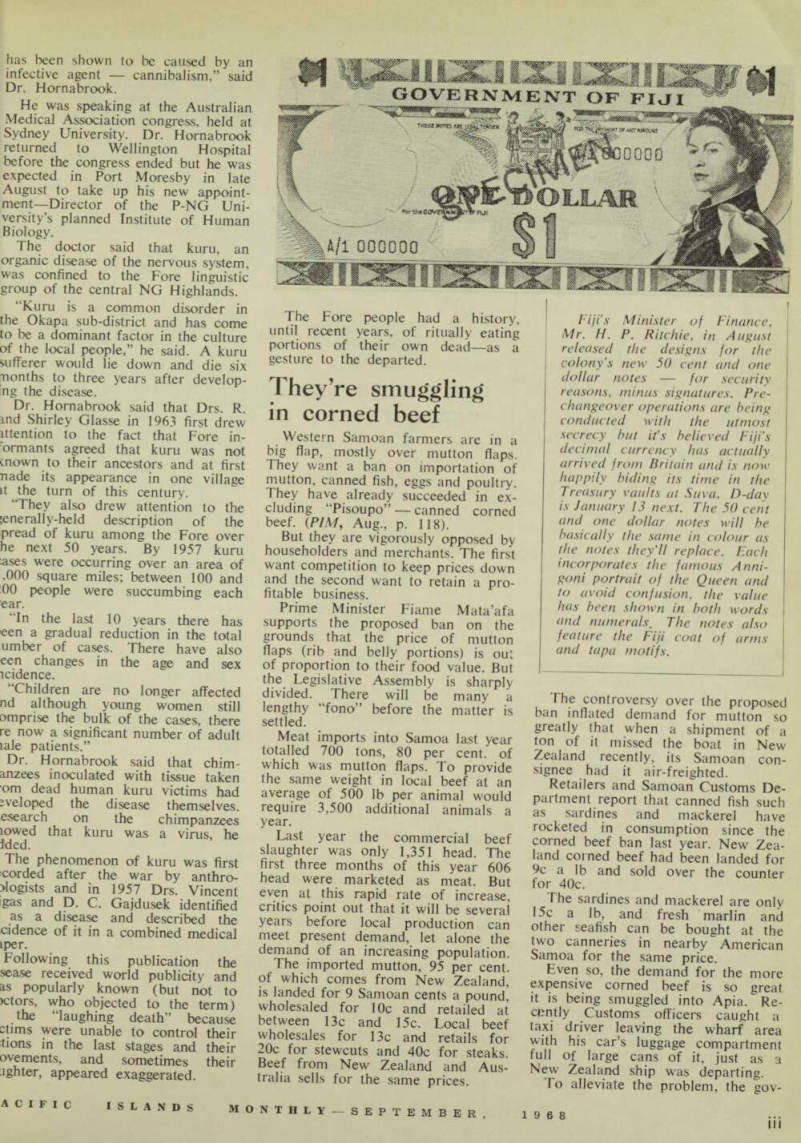
Fiji’s Minister of Finance, Mr. H. P. Ritchie, in August released the designs for the colony’s new 50 cent and one dollar notes for security reasons, minus signatures. Pre changeover operations are being conducted with the utmost secrecy hut it’s believed Fiji’s decimal currency has actually arrived from Britain and is now happily biding its time in the Treasury vaults at Suva. D-day is January 13 next. The 50 cent and one dollar notes will he basically the same in colour as the notes they’ll replace. Each incorporates the famous Anni goni portrait of the Queen and to avoid confusion, the value has been shown in both words and numerals . The notes also feature the Fiji coat of arms and tapa motifs.
ernment is encouraging the raising of rabbits and poultry, both of which thrive in Samoa, but without much success.
One poultry farmer has 5,000 hens producing up to 180 dozen eggs daily, but complains that he cannot sell them all because eggs are being im ported from Australia and New Zea land. The current price of eggs is 70c a dozen, grade A large.
The same goes for chickens. Large quantities of frozen poultry come in from the United States each month at 40c a lb in preference to the local supply at the same or lesser price, despite protests of government agri cultural officers.
It’s Australian
(Republican) Rules
FIJI may boast its Rugby prowess, and Australians of the southern states may deplore the lack of competition from overseas in their version of the national sport, but Nauru has the answer to them both.
A by-product of the Nauruan invasion of Victorian secondary schools over the last decade or so is a growing band of dedicated Aus tralian Rules players in the island republic.
Although Australian administra tion of Nauru ceased last January, football is one part of Australian life that seems certain to remain a permanent feature of Nauru. Nauru has special links with Geelong, the chief port for ships plying from Nauru.
President Deßoburt recently watched a Geelong match from a special Presidential box. and is re ported to have invited the Geelong team to visit Nauru. If they did, they might find the ground and the temperature a little rougher than they are used to, but one thing they would find for sure—a mightly wel come.
For the second successive year, a full season of Australian football is being played in Nauru, concurrent with the Victorian League season.
Every Saturday afternoon at four o’clock the Nauru airstrip takes on the appearance of any southern Aus tralian town where the community is small enough to permit car parking around the ground.
A large section of the population rings the oval, which is marked by a line of sand poured on the darker ground, with cars, trucks, Jeeps and Land-Rovers and an odd assortment of other vehicles becoming grand stands and sun shelters for the big game. t , Onto the field trot two husky teams of 18, booted and clad like
any « ,iV H Austra t lian sid , es ’ de xhe leL S B^wl ree re P departments and enterprils such as the Nauru Co-operative Society and the British Phosphate Commissioners, play under names like Panser, Elco and Hawks The Hawks are the Police team, last year’s champions and current fnvnnritM ‘ Most of the players are Nauruan, but the field umpire is always an Australian. He bounces the ball, and a mighty leap and a punch sends
the ball well out to a team mate waiting for a kick. Plenty of boisterous rivalry for a mark leads to some scrappy fumbling as players mix it willingly, striving for possession.
The play goes back and forth until a long ranging kick finds its way safely into the hands of the full forward right in front, who kicks be tween the portable steel posts for a goal. The posts have to be portable an aeroplane has to land here next day!
Around the outskirts of the crowd cruises a Land-Rover with a sign proclaiming “Iced Drinks”. Players can wilt, but spectators appreciate a cool orange cordial, so the vehicle stops now and then while members of the Apex Club sell (for charity) drinks to the thirsty crowd.
The hard ground provides a few grazes, the keenness of the game will perhaps bring on some fisticuffs that the umpire quickly quashes, but on into the sunset they slog out the final tally of points. A goal brings an excited round of tooting car horns, and some teams even have their band of feminine supporters dressed in the team colours, cheering wildly at every forward movement.
The pressure is perhaps not up to that on the Melbourne Cricket Ground or the Adelaide Oval—for one thing there is only one game each week, so that teams play about once in three weeks. But there is practice three times a week all the same, and when the semi-final and final rounds are played, the excitement grows high. 1967’s Grand Final, played on the same day as Melbourne’s, produced a thrilling match, followed by all the celebrations, including a Grand Ball, that such an auspicious occasion warrants.
The third rib
of the law
YET another masculine stronghold will topple in Fiji before the year is out. The Suva Police Force is to be invaded —for the first time — by women police officers.
This enlightened move was an nounced in the Legislative Council by the Chief Secretary, Mr. G. P.
Lloyd, who said finance had recently been made available for the establish ment this year of a section of women police in Suva. Further funds will cater for a similar section at Lautoka in 1969. . t .
It is intended to start with six women in Suva, employed on the basis of a 36-hour duty week at special constabulary rates.