Vanilla, The Orchid Spice
pp. 141-148 · Read in the full issue


The Practical Planter
How To Plant And Market
Vanilla is no newcomer to the Pacific Islands. For many years it has been grown on Tahiti, nd now Tonga—where the spice has been cultivated experimentally for several years—hopes to produce vanilla on a commercial scale. This article on vanilla, the fourth in a series on spices, is >ased on information supplied by the British Government's Tropical Products Institute.
he principal commercial varieties Manilla are Vanilla planifolia, the ce of the Mexican, Bourbon and l vanillas, and V. tahitensis, the ce of Tahiti vanilla. In the West es, chiefly the French Colonies, lompons is cultivated, but yields nferior form of vanilla, he plant, a climbing orchid, lires a moist tropical climate, and ers a light, friable soil, rich in ius. It is grown in partial shade, where trees cannot be used for tort, posts or trellises must be ted for the purpose.
Ithough vanilla can be grown i seed, cuttings are almost in ably used. They are taken from thy, vigorous plants, and vary ngth from 1 ft to 12 ft according ocal custom. Those raised from cuttings, planted at the beginning he rainy season, come into bear in one or two years, while those i short cuttings take three or years. he ground at the foot of the •ort is heavily dressed with vege j mulch and levelled; several ;s of the cutting are laid on it covered with soil or leaf manure, he remainder of the cutting, con ng at least two nodes, is tied in ral places to the support—any end being turned back and tied n similarly. le plant begins to grow within a weeks. The supports are usually id 9 ft apart, one vanilla plant g grown on each support, ice established the plants have s trained to grow to a convenient ht, and new growths must be in. The soil, especially over the i of the plant, must be kept red with a mulch, and nine or months before the flowering m the growing tip of the vine
is cut off—to encourage the produc tion of flowering shoots.
Essential
Daily attention is essential when the plants are in flower, since, except in Mexico (the natural habitat of the plant), the flowers are not visited by bees, and it is therefore necessary to fertilise them by hand. To produce long pods, which fetch the highest prices, the number of flowers to be fertilised is usually reduced by hand picking a certain proportion from each plant.
After harvesting, the vines must be pruned of the old flowering stems.
Constant watch for pests and diseases is necessary throughout the season,
and support trees, where these are used, also require attention.
The curing and drying of the pods of vanilla are of much practical importance, since they have a great effect on the value of the final product.
If left to ripen on the plant, the pod, which is at first green, gradually turns yellow (beginning at the lower end) and splits open. It continues to darken, changing through brown to black, and takes about a month to ripen fully. The characteristic vanilla odour, which is not present in the freshly ripened pod, develops as the pods darken. If left to them selves the pods dry up and become brittle and odourless.
Mexican vanilla: Sun curing is the
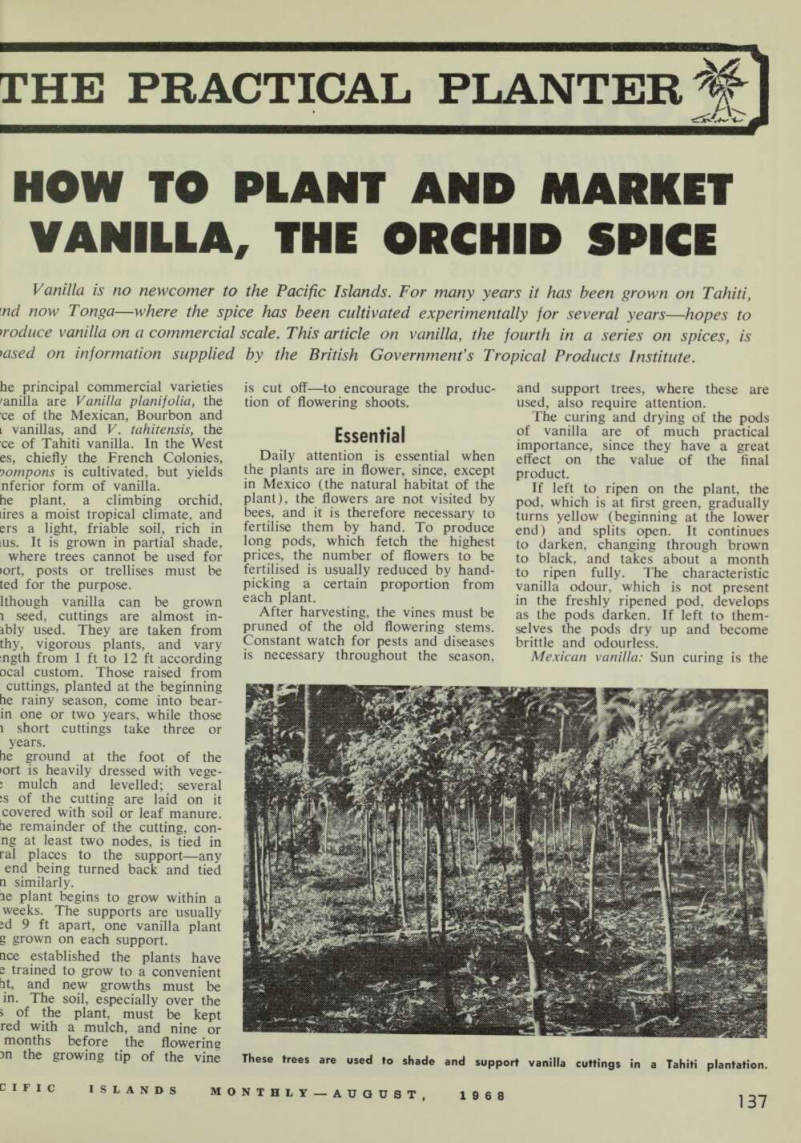
These trees are used to shade and support vanilla cuttings in a Tahiti plantation.
linary method of curing adopted Mexico. The pods are picked when y are just beginning to turn yellow the end; if allowed to remain on plant beyond this stage there is isk that they may split. The pods then spread out in single layers shelves (“Camillas”) in a clean ze which is well ventilated and tected from rain. They are left 24 hours during which time they ; moisture and shrivel. During stage they are sorted according heir degrees of ripeness. The pods ch show a tendency to blacken are lared thinly with castor oil.
Spread in the sun
he next day the pods are spread on tables in the sun, preferably igside a whitened wall facing th. The tables are covered with dng on which are placed woollen ikets of a dark colour (to con re the heat), and on these the s are spread out, singly, with r thick ends towards the sun. tefore sunset, the pods, which are ' very hot, are placed in boxes ch have stood all day in the sun. boxes are lined with blanket erial that has also been exposed the sun. The pods are piled in boxes with their thick ends in centre of the box, and the blanket ig is folded over the top of the In this condition, with every :aution to conserve the heat, the
pods undergo the process known as “sweating”.
After 16-22 hours they have usually acquired a dark brown colour and are removed from the boxes.
Any pods that have remained green are set aside and treated in ovens (see below).
The pods are then allowed to dry for a period which may last from 20 to 30 days, according to the weather. During this period they are placed on the “Camillas”. On fine days pods are exposed to the sun for one or two hours at the hottest part of the day. They are also subjected again during this period to the sweating process some four or five times; this number should not be exceeded or the pods may become soft and discoloured.
If the weather is unfavourable for sun curing, oven curing is used. The oven process requires close attention and skill in order to avoid loss of material through faulty curing.
Tied up
The pods are tied up in bundles, of flat rather than cylindrical shape, each consisting of from 100 to 400 pods. Each bundle is wrapped in a woollen covering, then enclosed in sacking, and tied up with cord. The bundles are then placed in an oven.
The oven has been previously
heated, and the fire removed. The temperature at which the treatment commences is between 89 deg. Cent, and 125 deg. Cent., according to the number of bundles to be treated (the larger the number the higher the temperature).
An average number of bundles to be treated at a time is from 16 to 20, for which the commencing tem perature would be 111 deg. Cent, to 115 deg. Cent. The oven should first be heated to a higher tempera ture than that at which it is to be used, and then allowed to cool to the required temperature.
When the oven is at the correct temperature, the bundles are placed in it by means of a rod with a hook at the end, and the oven is closed.
Depends on weather
After 16-22 hours the pods have generally acquired the proper colour, though it is a common practice after about 12 to 14 hours to remove and examine one bundle in order to dis cover how much more treatment is necessary. Should the temperature have become too low, the bundles are temporarily removed and the oven is re-heated.
When the bundles are finally re moved from the oven they are wrapped in blankets in order that they may cool very slowly. The
Healthy specimen of a vanilla plant in Pueu, Tahiti.
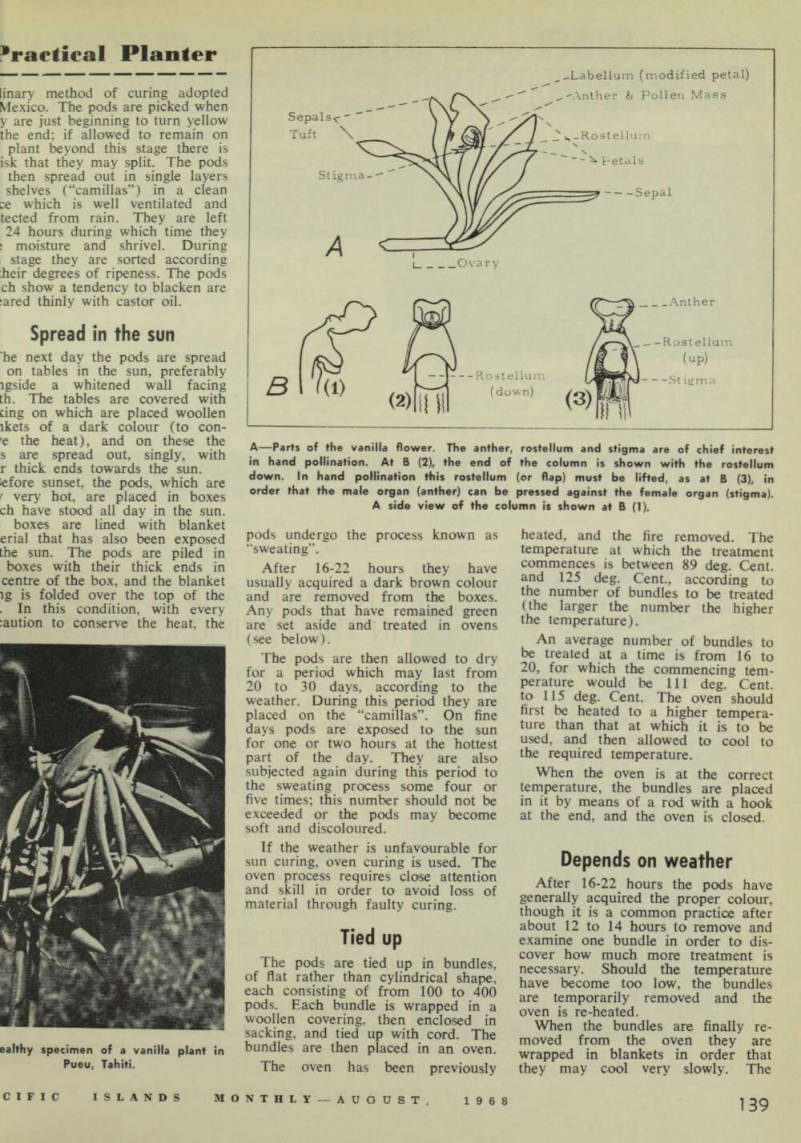
A —Parts of the vanilla flower. The anther, rostellum and stigma are of chief interest in hand pollination. At B (2), the end of the column is shown with the rostellum down. In hand pollination this rostellum (or flap) must be lifted, as at B (3), in order that the male organ (anther) can be pressed against the female organ (stigma).
A side view of the column is shown at B (1).
tt day they are exposed in the i or on the “Camillas”, according the weather.
For the next 20 to 30 days the Is are dried in the same way as ; sun-cured pods, and are “sweated” ir or five times.
During the drying process the pods carefully inspected, and any that mis-shapen or unripe, or that re split open, or show mould or lormal crystallisation, are separa and placed in different classes ording to their particular defects, finally the pods are graded ac ding to colour, firmness and gth. They are made up into :kets of 50, and packed in tin [es, each box containing 60 packets of the same grade, Methods used in other countries'.
Madagascar and Reunion a pro s that is commonly employed is itment with hot water. This is iwn as the “boiling water” process ause when it was introduced water r boiling point was used. Today jmperature of 60 deg. Cent, to 65 . Cent, is regarded as more satis ;ory.
'he pods are placed in baskets ording to grades, and the baskets dipped into a cauldron of hot er for two to three minutes ac ting to the grade—the larger pods longer the treatment. Alter vely the pods can be exposed to m. With this method the pods placed on a perforated shelf over er near boiling point.
Tter treatment the pods are dried a few moments, and, while still are transferred to “sweating” es. They are then exposed in the for six to eight days until they :h the proper condition, and are lly allowed to dry slowly in the ie in a well ventilated drying se.
Less elaborate
ess elaborate methods are used >ther countries. Thus in Peru the s are immersed in boiling water hung up to dry in the open air. ;r drying for some 20 days they smeared with castor oil and tied in bundles. tell prepared vanilla pods should long, fleshy, supple, very dark vn to black in colour, somewhat in appearance, strongly aromatic free from scars and blemishes. r quality beans are usually hard, thin and brown or reddish-brown colour. Split beans should be keted separately and are regarded
as somewhat inferior to whole bea] of the same grade. The moisture co tent may be as high as 45 per cei in the top grades and as low as ' per cent, in the poorest grades.
Commercial supplies of vanilla a graded primarily on a geographic basis as follows: • Tahiti vanilla. Tahiti vanilla prepared similarly to the Mexia vanilla. The Tahitian plantations we developed from stock obtained fro Mexico, and this stock, in its ne environment, has gradually develop* a flavour reminiscent of coumari Tahiti vanilla is characterised by en ties only, and it is marketed in s grades. The first four grades consi of sound unsplit beans of varyii lengths, the fifth grade includes bea: of all lengths, and split or scam beans, and the sixth (and most i ferior) grade consists of damag* beans.
Mexico its home
• Mexican vanilla. Mexico w the original source of vanilla and st produces the finest quality, althouj the quantity is relatively small relation to total supplies. Mexicj beans are marketed in seven grade ranging from beans of exception quality to the most inferior. Moistu content of Mexican vanilla vari from about 40 per cent, down about 20 per cent. Whole pods a sold either in bulk or in neat bundl of 50 to 90 each. • Bourbon vanilla. This vanil includes all the beans grown Madagascar, the Comoros, Reunio the Seychelles and Uganda. Mad gascar is by far the largest produc of vanilla. Bourbon vanilla from R union, Madagascar and the Comor is usually produced in five qualiti —extra, first, second, third ai fourth. Split beans are market* separately in corresponding qualitie The beans are tied only in tl middle. The bundles are packed tins lined with grease-proof pape containing 16 to 22 lb each. • Java vanilla. Java produc vanilla of the Bourbon type, b current production is much reduce owing to the destruction of mar of the plantations during World W, II and the subsequent political di turbances. In the US, Java vanil is used for extraction purposes, as is said to give higher yields thj other forms of vanilla; in Franc however, Bourbon vanilla is pr ferred. Java vanilla is classified in
“prime”, both whole and split, “re also whole and split, and “secc quality”. ® Other varieties. A number other countries prod u c e sm quantities of vanilla, but the oi ones of any commercial importai are Dominica and Guadeloupe.
Dominica (and in St. Lucia and Vincent), in the British West Indi V. planifolia is cultivated, while French West Indian territori Guadeloupe and Martinique, prodi an inferior form of vanilla kno as “vanillons”, derived from pompons. The methods of prepa tion used in these West Indian Islai generally resemble the Mexican.