Book Reviews
pp. 91-92 · Read in the full issue
Behind The October
Revolution
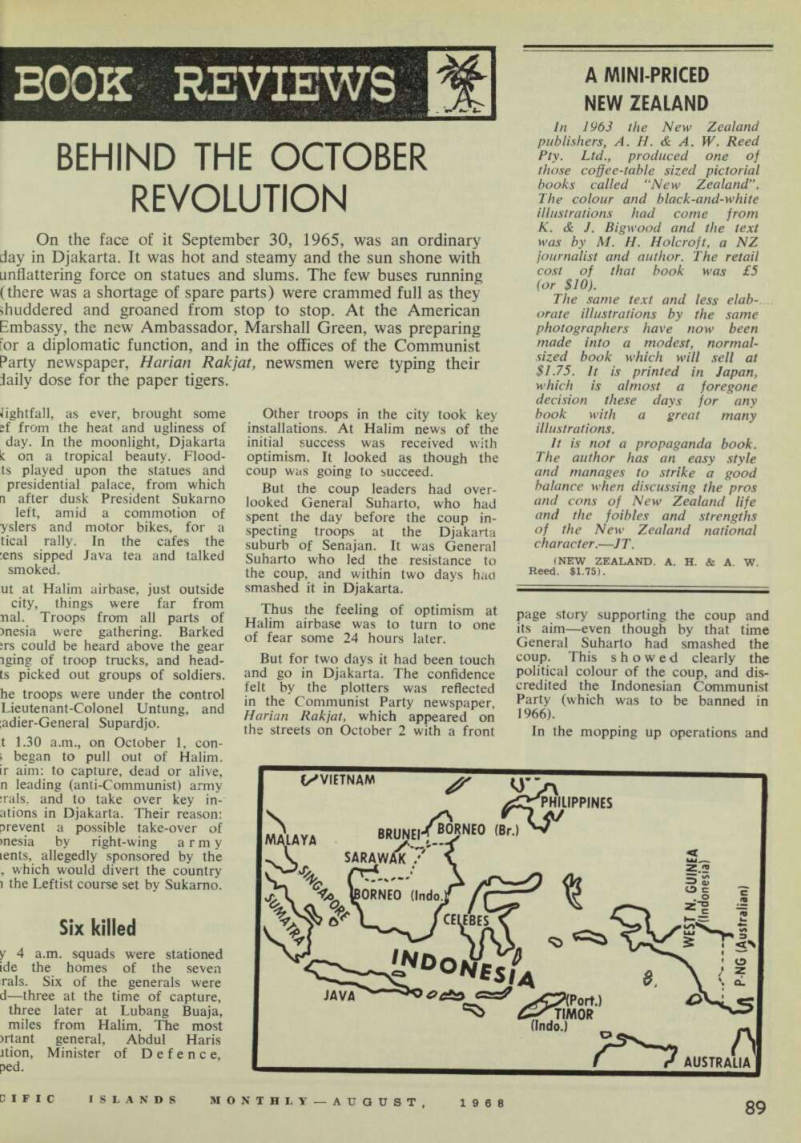
On the face of it September 30, 1965, was an ordinary day in Djakarta. It was hot and steamy and the sun shone with unflattering force on statues and slums. The few buses running (there was a shortage of spare parts) were crammed full as they shuddered and groaned from stop to stop. At the American Embassy, the new Ambassador, Marshall Green, was preparing for a diplomatic function, and in the offices of the Communist Party newspaper, Harian Rakjat, newsmen were typing their daily dose for the paper tigers.
Jightfall, as ever, brought some sf from the heat and ugliness of day. In the moonlight, Djakarta k on a tropical beauty. Flood ts played upon the statues and presidential palace, from which ti after dusk President Sukarno left, amid a commotion of yslers and motor bikes, for a tical rally. In the cafes the :ens sipped Java tea and talked smoked. ut at Halim airbase, just outside city, things were far from nal. Troops from all parts of mesia were gathering. Barked jrs could be heard above the gear iging of troop trucks, and head ts picked out groups of soldiers. he troops were under the control Lieutenant-Colonel Untung, and
;adier-General Supardjo.
t 1.30 a.m., on October 1, con i began to pull out of Halim, ir aim: to capture, dead or alive, n leading (anti-Communist) army :rals, and to take over key in ations in Djakarta. Their reason: prevent a possible take-over of mesia by right-wing army lents, allegedly sponsored by the , which would divert the country i the Leftist course set by Sukarno.
Six killed
y 4 a.m. squads were stationed ide the homes of the seven rals. Six of the generals were d —three at the time of capture, three later at Lubang Buaja, miles from Halim. The most )rtant general, Abdul Haris ition, Minister of Defence, ped.
Other troops in the city took key installations. At Halim news of the initial success was received with optimism. It looked as though the coup was going to succeed.
But the coup leaders had over looked General Suharto, who had spent the day before the coup in specting troops at the Djakarta suburb of Senajan. It was General Suharto who led the resistance to the coup, and within two days had smashed it in Djakarta.
Thus the feeling of optimism at Halim airbase was to turn to one of fear some 24 hours later.
But for two days it had been touch and go in Djakarta. The confidence felt by the plotters was reflected in the Communist Party newspaper, Marian Rakjat, which appeared on the streets on October 2 with a front
page story supporting the coup and its aim—even though by that time General Suharto had smashed the coup. This showed clearly the political colour of the coup, and dis credited the Indonesian Communist Party (which was to be banned in 1966).
In the mopping up operations and
purge which followed, the com munists and their sympathisers (almost to Their third-cousins re moved) were killed by the thousands.
Sukarno, the nation’s leader since independence, the man who, by an tagonising the west and leaning to wards Red China, had cut his country off from valuable aid and brought it to the verge of bankruptcy, was discredited. Although he was not directly implicated in the plot, there were some critics who later sug gested that he may have known what was going on at Halim airbase on the night of September 30-October 1, 1965.
Sukarno clung to office for another 18 months. After that Suharto took over.
With the failure of the coup, the costly confrontation with Malaysia was to end, and many people in non- Communist Asia heaved sighs of re lief. Indonesia no longer merited banner headlines in Australian news papers; it was Vietnam’s turn.
All that, of course, is history.
Sukarno and confrontation, like Eden and Suez before them, have passed through the political looking glass and they are now of interest only to historians, political scientists and the many earnest Alices who like to sit around a flagon and talk politics.
As an earnest Alice, I welcomed John Hughes’ The End of Sukarno.
Hughes’, as one would expect from a Pulitzer Prize winner (he picked his up in 1967), has written a racy, readable book.
It’s in the best documentary tradition (Hughes, bom in England, has adopted the American method of depth reporting as well as Ameri can nationality).
It presents the story behind the coup and the events which followed without demanding a great deal of intellectual effort on the part of the reader: a sure guarantee of success.
Attractive
The portrait Hughes paints of Sukarno is fascinating (equally fascin ating is his portrait of Suharto), and it confirms a feeling of mine about Sukarno—that though the man was a vain despot there was some thing attractive about him.
He had a grand sense of politics.
He hammed it up so much that I can’t help feeling that, at times, he
was laughing at himself and at tl buffoonery of politics. He had i impish sense of mischief. He w; an expert at playing on a worry For instance, before the coup, tl state of Sukarno’s kidneys had be< causing concern among foreij diplomats. If Sukarno’s kidneys wer what then would happen to Ind nesia? Which way would the count jump?
Hughes writes: “Sukarno himse undoubtedly aware of the stir 1 health was causing, did little dampen the speculation. On sevei occasions, while addressing lar rallies, he paused and ostentatious slipped off his shoes because, as ' confided to the crowds, his feet we hurting. The observers scuttled off the medical reference books, there discover that one of the symptom’s a kidney disease is swollen feet. . .
But then Sukarno had a pencha for taking off his shoes, Hughes te us. Once he took off his shoes at diplomatic dinner party and told t startled guests that he did so “to the electricity out of my body.”
At the time of going to press, I End of Sukarno is high on the be seller lists in Sydney—and deservec so. Anybody who cares for polit will cars for this book. —SR.
(The End Op Sukarno. Angus 2
Robertson Ltd. $4.95.)