Yesterday
p. 87 · Read in the full issue
The undetermined fate of the beautiful little island of Samarai, off the eastern tip of Papua, was one of the many items of news in PIM 20 years ago. Was it to continue as commercial and administrative centre for the Milne Bay district or was it too small? Nobody had decided. The result was very little rebuilding had taken place and while the “Big Firms” had recommenced trading in temporary buildings, Samarai hadn’t regained its pre-war importance. Today, 20 years later, Samarai is still there, and so are the Big Firms, but there are moves directed towards a mainland headquarters. Chances are that Samarai will be undisturbed for many years yet.
OTHER items in PIM for August, 1948, included: “VTO comment” was the word ll from Canberra on riots on Nauru by 1,500 Chinese phos phate workers in June. Due for repatriation after completing their two-year indenture contracts on the island the Chinese had rioted when a ship arrived to take them home. Four Chinese were killed in clashes with white residents and a state of emergency was declared by the then Admini strator, Mr. M. Ridgeway.
AFTER an absence of nine years, mostly on war duties around the Middle East, Africa and England, Burns Philp’s steamer Bulolo was scheduled to reappear on her Australia-New Guinea run. She was to leave Sydney on August 17 for major NG ports.
MR. Hubert Charles Reed, an old-time resident of Western Samoa, died in Apia on July 20, aged 65, An Englishman, Mr.
Reed had had an adventurous career before he settled in Apia shortly after 1914. He was known overseas as an expert on tropical agriculture and an authority on the various ruins on the Caroline Islands.
THE Isle of Pines was to be promoted as a tourist resort.
New Caledonia’s French Admini stration had agreed to subsidise a vessel Mollie Pas 111 to take visitors on the 30-mile trip to the island from Noumea. A venerable mariner, Captain Pons, owned the vessel.
Proposals were being examined in Canberra for the erection of a big copra crushing mill in New Guinea (it wasn’t set up until five years later, in 1953, at Rabaul). All NG copra had to
be shipped to Australia or Europe for crushing and many planters were anxious to have their products treated at their source.
IN 1948 there was an acute shortage of hotel accommodation in Suva. Fiji hosts were hard put to find beds for visiting hockey and football teams from overseas. One sidelight was that many Suva beds were taken up by “tenacious permanents” in the town’s hotels who could not get other accommodation.
ANEW Guinean mental patient was at large in Port Moresby and night life in the town was “continuing rather nervously”, PIM said. All houseboys lost their appetite for nocturnal “walkabouts” and many white residents were staying indoors.
WITH cocoa and copra production well up on the previous year’s figures, the Western Samoan economy was
booming. Export values, for the first time in Samoan history, ex ceeded the million pound mark in 1947 and two new export in dustries, desiccated coconut and dried bananas, had helped con siderably.
AMERICAN millionaires were reported to be paying up to $5,000 each for berths on the luxury yacht Corsair, which was to make a cruise of the South Seas out of Los Angeles later in the year. A brochure published on behalf of the cruise painted the Islands pretty much as they were in the days of Captain Cook, with semi-dressed girls peering out behind waving palms.
MR. and Mrs. Charles Bentley celebrated their golden wedding anniversary in Suva on July 17. Mr. Bentley’s father arrived in Fiji during the “cotton boom” of the late 1860’s and settled with his family under primitive conditions on the upper Rewa River. rE new Samoan flag was hoisted beside the New Zealand ensign at Mulinuu, near Apia, on June 1 to mark the granting of partial self-government for Western Samoa. Soon after a new Legislative Assembly opened with official and elected Europeans and Samoan members.
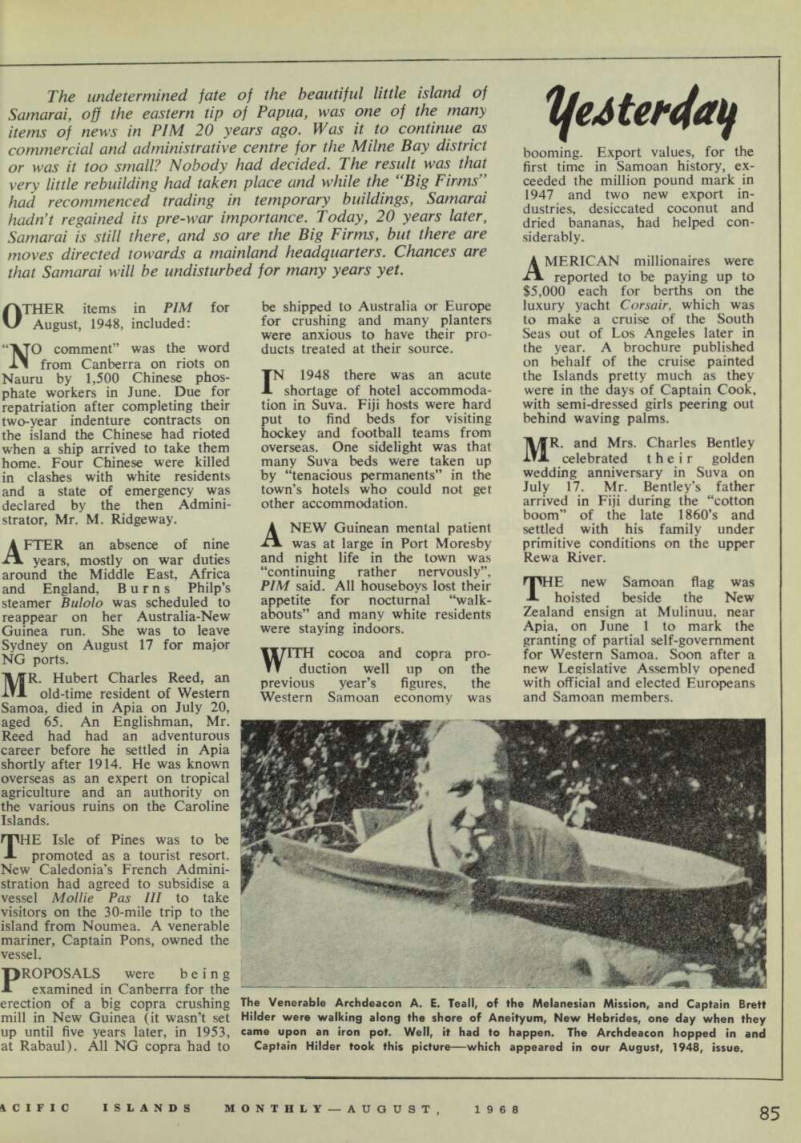
The Venerable Archdeacon A. E. Teall, of the Melanesian Mission, and Captain Brett Hilder were walking along the shore of Aneityum, New Hebrides, one day when they came upon an iron pot. Well, it had to happen. The Archdeacon hopped in and Captain Hilder took this picture —which appeared in our August, 1948, issue.