Micronesia has a South
pp. 67-139 · Read in the full issue


A Letter From Saipan
Micronesia has a South Seas spiri t, too
Sir.—My husband and I have enjoyed reading PIM (intro duced to us by an Australian friend working here) so much during the past year that we have decided to subscribe to it.
Your features are interesting, and the tidbits of information I’ve personally gleaned from the magazine about the rest of the Pacific make me a little humble. All of this area spelled “exotica” to us when we came to Micronesia three years ago, and I hope someday we’ll get to see the rest of what we’ve been reading about. There’s still so much to learn!
I’ve said “rest of” twice, but with a certain purpose. Things are hap pening in our part of the Pacific, too, all contributing to the future of a unique people who’ve been in flux for quite a while. With four rulers (Spanish, German, Japanese, we Americans) making up their history since the 1600’s, “change” isn’t a particularly traumatic concept for them.
Nevertheless, there are many Micronesians who feel that any more changes will bring negative results.
I’m an American and have my own views, but those are not the purpose of this letter. Here are three relatively new developments in Micronesia you might be interested in.
The article by Dr. Ron Crocombe (he was here in December, incident ally, and we enjoyed meeting him) about PCVs in Samoa, in your April issue, called to mind our own Peace Corps Volunteers. November, 1966, brought in the first two groups, which had been trained in Miami, Florida, and Molokai, respectively.
They’ve been effective and industrious, teachers comprising the largest per centage, but willing to fit in where ver they are most needed and in whatever way. (In Koror, Palau, last year, where we were living then, this sense of
community “spirit” was quite evident.
We had just been ravaged by a severe—it was so unexpected and no one was prepared—typhoon, and afterwards, a large number of PCVs in education and other fields were transferred to the “Community Development” department, which at the time, was almost exclusively con cerned with rehabilitation).
Fun to be a volunteer
They are scattered throughout the six Trust Territory districts, in pro portion to need and native popula tion. Most of them live in “their” villages—close enough to school or other job situation so they can walk, A few own bicycles; larger vehicles, privately owned, are against Peace Corps policy. Palau seemed to have a unique housing plan for its volunteers compared to the other districts.
It would have been fun to be single and to be a volunteer there, where one could live right in with a Palau family, and learn a great deal more about the culture, than by simply living in a rented local house, albeit surrounded completely by other local houses, local families, no Americans.
In a couple of instances we knew the volunteer had become so much a part of his or her family that he was treated as a relative—with all the privileges and nuisances in volved! One friend’s “parents” even insisted on supervising her dating habits—the boy-girl aspect is another fascinating story I won’t even go into here. Married couples, of course, lived in a separate house, as I imagine they do in the other dis tricts.
Language mastery was bound to suffer a little in such a close situation, with the younger generation of
(Continued on p. 135)
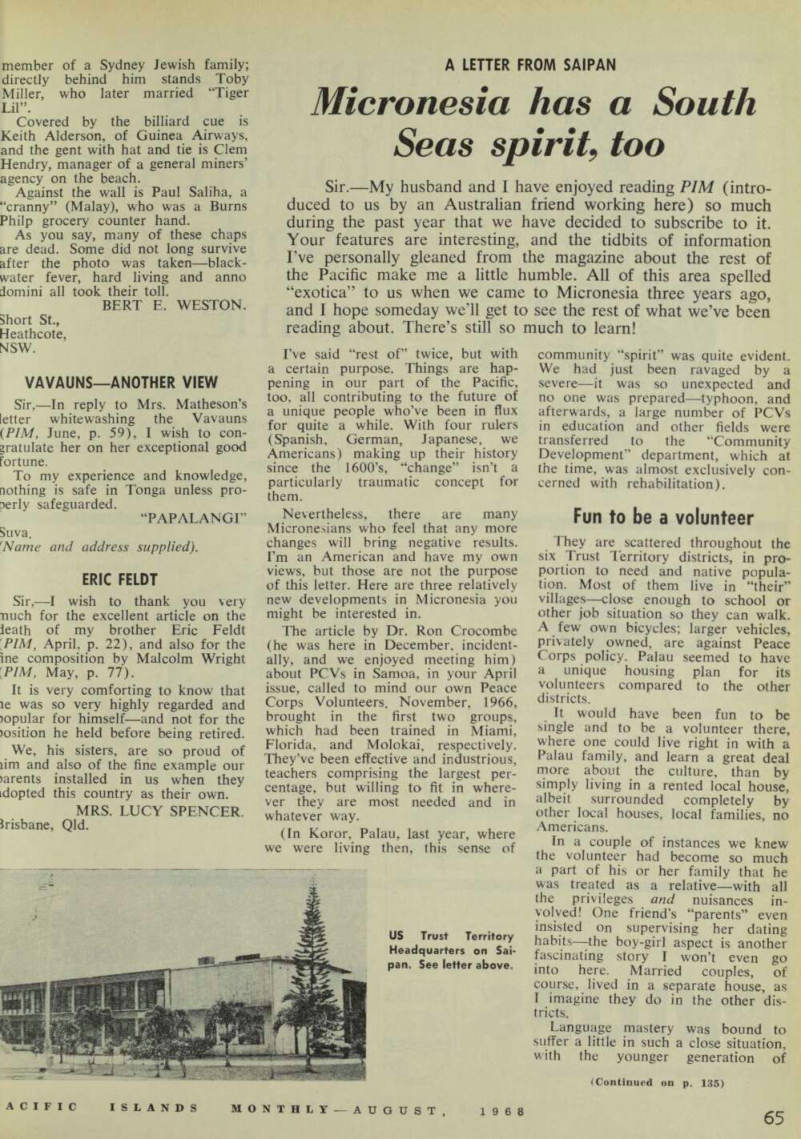
US Trust Territory Headquarters on Sai pan. See letter above.
lauans attempting to speak (or t-speak) a newly-memorised Eng i word for every Palauan word a lunter tried out. There are now wards of 750 volunteers, and staff, all of these districts, 70 in Saipan >ne. The trend, as Dr. Crocombe *gests re Samoa, will be an in :ase, and to quote his final para iph, “. . . being for them or against :m is of little relevance ... the portance is in getting the most ue from their presence”. \nother item which might help to ce us on the map out here (sure, ’re on the map. But the majority Americans have never heard of :ronesia; though places like Samoa, liti, Fiji, roll off the tongue horitatively, largely because there’s re fiction on the market about m) has been the building and npletion of Saipan’s newest—and only “modern-style”, on such a >e scale—hotel, the “Royal Taga”.
"his is, by anyone’s standard, a ury place, and derives its cyc ling name from history. Belief ghosts, either ancestor spirits, or i spirits, still goes on here, though Chamorro people are reluctant show it to Americans. One of these itaomonas” was the famous Taga Tinian (another Marianas island ;e to Saipan), a Giant gifted with erhuman abilities.
Air conditioned!
Tie “Taga” is where we go for an aing of glamour, for a rendezvous i Stateside standards (which we *t wish for, most of the time), food is good, but more important i that is atmosphere. Quite a trast to be sitting in an air-con med, candle-lit dining room i broiled lobster (one of a iber of good selections) in front you, gazing out at a swimming 1 decorated by night-lights . . . drive by, a few minutes later, :ack of tin and wood waiting to put to use for someone’s make t home. (We’ve been through (her typhoon recently—this one :h worse, and with more notice : damage). he hotel is full most of the time, mese tourists and other organisa s are the most frequent visitors. hotel was built by a private, tin-based firm, but has been an iration for ground plans in every
district. Continental Airlines will be the controlling force for future tourism.
This brings me to item three.
Continental Airlines, of California, has at last introduced us to the Jet age. On a sunny (as most mornings are here) Thursday morning, May 16, the first tell-tale streaks of jet power could be seen in the sky, a good distance away.
When the streamlined beauty, a 727 with “Air Micronesia” proudly emblazoned on its sides, had landed and its loud (extra-loud to our sensitive ears, used for so long to the muted grumbles of our DC4’s) engines had ceased fire, all those who had gathered at the airport here were given an inspection tour. Those plush bluish seats, four together!
Air-conditioning! Meals and snacks and magazines and pillows!
But it seems as if some sort of eulogy should be due . . . and none was made. The two DC4’s which served the Trust Territory for twenty some years won’t be forgotten easily.
They could be compared to old friends who, when nothing else is going on, are always good for a few laughs.
I feel safe in a homey sort of plane like the DC4. Jets are known for their crashes. Don’t think I’m some sort of crank. Progress is im portant, but so is reminiscing. The DC4’s have been put to pasture now; they will be sold in the United States to the highest bidders.
We enjoy living out here where the weather is always balmy, and where there’s a certain day-to-day excitement just in living here, at this point in history.
We’re watching the interior work ings of that vague word “Progress”, watching a small area exert itself to catch up to what the rest of the world had been doing more leisurely. Exert itself almost greedily, too.
Well, I’ve written this letter, not knowing anything about your pub lishing policy. Perhaps other issues we’ve missed have noted some of TTs developments. We could add a personal word or two about the four typhoons we’ve lived through, “eye witness”, as it were. All were in little more than a year, and three took place here on Saipan—since last November, 1967.
Thank you for a wonderful little magazine, and with continued interest.
Daphne (Mrs. James A.)
Stanton.
Saipan, Mariana Islands.