To The Point
pp. 54-55 · Read in the full issue
With
Percy
Chattertos
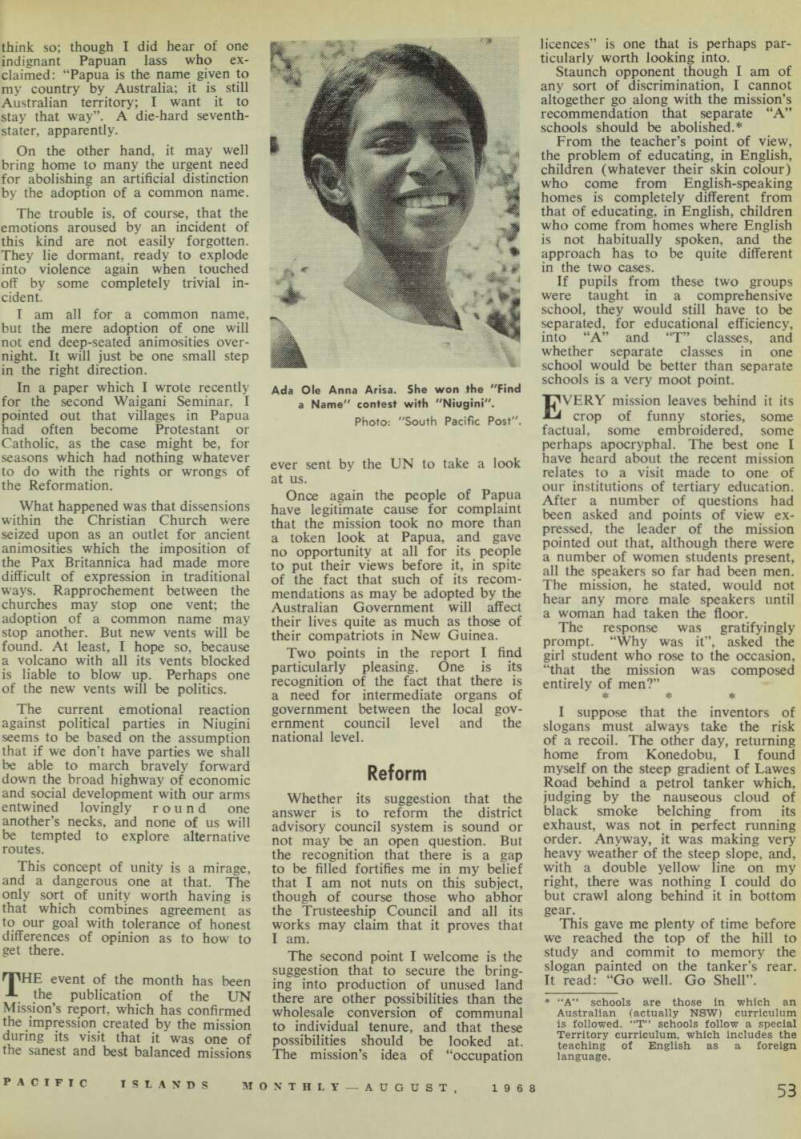
So congratulations to Ada Ole Anna Arisa, and loud cheers for Niugini, Mind you, I still hanker after “Island of Gold”, especially as I have been told that, as in English “island”, the “s” in Portuguese “isla” is silent.
“Ila del Oro”—a lovely name! How ever, it’s too late now.
It becomes tempting to suggest the coconut tree as a national emblem.
To placate the Highlanders and win over the die-hard Paradesians, we could depict a bird of paradise perch ing on one of the fronds.
From there we might go on to adopt the song “Papua” as our national anthem, changing “Papua” to “Niugini”, and providing alter native words in Pidgin and English for those who don’t want to sing it in Motu. 1 FORGET whether among the muses there was a Muse of Irony. If there was, she must have been working overtime during the weekend following the ceremonial opening of the second House of Assembly. A Papua v. New Guinea Rugby match touched off a brawl among the spectators which developed into a riot all over town —a riot in which noses were bloodied, women’s clothes torn off them, and weekend shoppers’ groceries snatched from their hands.
Great credit is due to our riot police, who handled the situation with more restraint and greater effective ness than some of their opposite numbers overseas have been exhibit ing of late.
The irony is fourfold. First, the fracas was touched off in the field of sport, the Great Unifier; and I don’t think that it’s a sufficient answer to say that it arose among the spectators not among the players, because this particular form of sport has been promoted as a spectator sport.
Second, it was all touched off, I understand, by a crack from a chit of a Papuan girl to the effect that New Guineans couldn’t be expected to play good football on a diet of sweet potatoes.
Third, it occurred at the end of a week in which more speeches had been made in praise of national unity than in any previous week in the history of the territory.
And lastly, it provided the sorry spectacle of Papuans and New Guineans bashing one another up over a “Papua v. New Guinea” match in which a majority of the players were neither Papuans nor New Guineans. Indeed, it has been queried whether some of them could properly be regarded as bona-fide residents of either territory.
Anyway, here’s a suggestion for the Rugby League. Why not make next year’s big match Expatriates v.
Niuginians, Only palefaces with not less than five years’ residence in Niugini to their credit to count as Niuginians. And no more cracks about kaukau, please!* Will this incident have any effect on the current campaign for “one name, one flag, one anthem”? I don’t * Kaukau is the pidgin name for sweet potato.
think so; though I did hear of one indignant Papuan lass who ex claimed: “Papua is the name given to my country by Australia; it is still Australian territory; I want it to stay that way”. A die-hard seventh stater, apparently.
On the other hand, it may well bring home to many the urgent need for abolishing an artificial distinction by the adoption of a common name.
The trouble is, of course, that the emotions aroused by an incident of this kind are not easily forgotten.
They lie dormant, ready to explode into violence again when touched off by some completely trivial in cident.
I am all for a common name, but the mere adoption of one will not end deep-seated animosities over night. It will just be one small step in the right direction.
In a paper which I wrote recently for the second Waigani Seminar. I pointed out that villages in Papua had often become Protestant or Catholic, as the case might be, for seasons which had nothing whatever to do with the rights or wrongs of the Reformation.
What happened was that dissensions within the Christian Church were seized upon as an outlet for ancient animosities which the imposition of the Pax Britannica had made more difficult of expression in traditional ways. Rapprochement between the churches may stop one vent; the adoption of a common name may stop another. But new vents will be found. At least, I hope so, because a volcano with all its vents blocked is liable to blow up. Perhaps one of the new vents will be politics.
The current emotional reaction against political parties in Niugini seems to be based on the assumption that if we don’t have parties we shall be able to march bravely forward down the broad highway of economic and social development with our arms entwined lovingly round one another’s necks, and none of us will be tempted to explore alternative routes.
This concept of unity is a mirage, and a dangerous one at that. The only sort of unity worth having is that which combines agreement as to our goal with tolerance of honest differences of opinion as to how to get there.
THE event of the month has been the publication of the UN Mission’s report, which has confirmed the impression created by the mission during its visit that it was one of the sanest and best balanced missions
ever sent by the UN to take a look at us.
Once again the people of Papua have legitimate cause for complaint that the mission took no more than a token look at Papua, and gave no opportunity at all for its people to put their views before it, in spite of the fact that such of its recom mendations as may be adopted by the Australian Government will affect their lives quite as much as those of their compatriots in New Guinea.
Two points in the report I find particularly pleasing. One is its recognition of the fact that there is a need for intermediate organs of government between the local gov ernment council level and the national level.
Reform
Whether its suggestion that the answer is to reform the district advisory council system is sound or not may be an open question. But the recognition that there is a gap to be filled fortifies me in my belief that I am not nuts on this subject, though of course those who abhor the Trusteeship Council and all its works may claim that it proves that I am.
The second point I welcome is the suggestion that to secure the bring ing into production of unused land there are other possibilities than the wholesale conversion of communal to individual tenure, and that these possibilities should be looked at.
The mission’s idea of “occupation
licences” is one that is perhaps par ticularly worth looking into.
Staunch opponent though I am of any sort of discrimination, I cannot altogether go along with the mission’s recommendation that separate “A” schools should be abolished.* From the teacher’s point of view, the problem of educating, in English, children (whatever their skin colour) who come from English-speaking homes is completely different from that of educating, in English, children who come from homes where English is not habitually spoken, and the approach has to be quite different in the two cases.
If pupils from these two groups were taught in a comprehensive school, they would still have to be separated, for educational efficiency, into “A” and “T” classes, and whether separate classes in one school would be better than separate schools is a very moot point.
EVERY mission leaves behind it its crop of funny stories, some factual, some embroidered, some perhaps apocryphal. The best one I have heard about the recent mission relates to a visit made to one of our institutions of tertiary education.
After a number of questions had been asked and points of view ex pressed, the leader of the mission pointed out that, although there were a number of women students present, all the speakers so far had been men.
The mission, he stated, would not hear any more male speakers until a woman had taken the floor.
The response was gratifyingly prompt. “Why was it”, asked the girl student who rose to the occasion, “that the mission was composed entirely of men?” * * ♦ I suppose that the inventors of slogans must always take the risk of a recoil. The other day, returning home from Konedobu, I found myself on the steep gradient of Lawes Road behind a petrol tanker which, judging by the nauseous cloud of black smoke belching from its exhaust, was not in perfect running order. Anyway, it was making very heavy weather of the steep slope, and, with a double yellow line on my right, there was nothing I could do but crawl along behind it in bottom gear.
This gave me plenty of time before we reached the top of the hill to study and commit to memory the slogan painted on the tanker’s rear.
It read: “Go well. Go Shell”.
Ada Ole Anna Arisa. She won the "Find a Name" contest with "Niugini".
Photo: "South Pacific Post".