They're Getting
p. 53 · Read in the full issue
Hip Now On
Niue
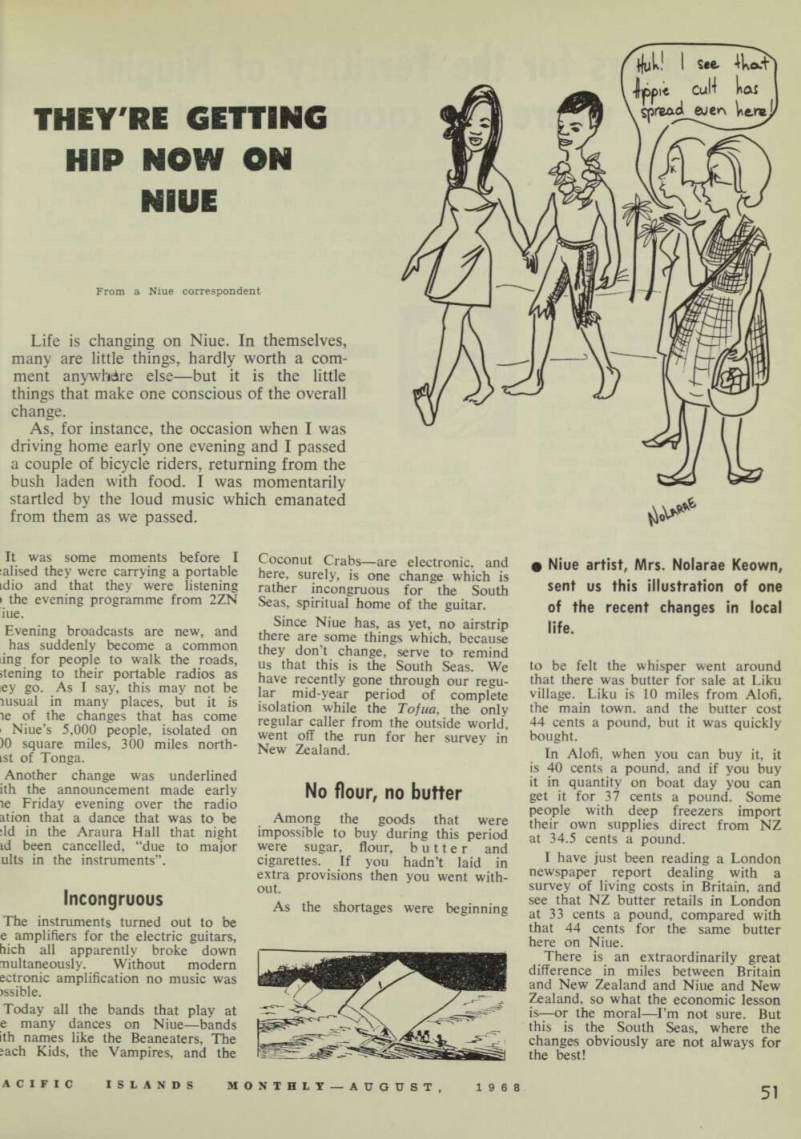
From a Niue correspondent Life is changing on Niue. In themselves, many are little things, hardly worth a com ment anywhdre else—but it is the little things that make one conscious of the overall change.
As, for instance, the occasion when I was driving home early one evening and I passed a couple of bicycle riders, returning from the bush laden with food. I was momentarily startled by the loud music which emanated from them as we passed.
It was some moments before I :alised they were carrying a portable idio and that they were listening ► the evening programme from 2ZN iue.
Evening broadcasts are new, and has suddenly become a common ing for people to walk the roads, itening to their portable radios as iey go. As I say, this may not be lusual in many places, but it is le of the changes that has come • Niue’s 5,000 people, isolated on )0 square miles, 300 miles north ist of Tonga.
Another change was underlined ith the announcement made early le Friday evening over the radio ation that a dance that was to be dd in the Araura Hall that night id been cancelled, “due to major ults in the instruments”.
Incongruous
The instruments turned out to be e amplifiers for the electric guitars, hich all apparently broke down inultaneously. Without modern ectronic amplification no music was >ssible.
Today all the bands that play at e many dances on Niue—bands ith names like the Beaneaters, The jach Kids, the Vampires, and the
Coconut Crabs—are electronic, and here, surely, is one change which is rather incongruous for the South Seas, spiritual home of the guitar.
Since Niue has, as yet, no airstrip there are some things which, because they don’t change, serve to remind us that this is the South Seas. We have recently gone through our regu lar mid-year period of complete isolation while the Tofua, the only regular caller from the outside world, went off the run for her survey in New Zealand.
No flour, no butter
Among the goods that were impossible to buy during this period were sugar, flour, butter and cigarettes. If you hadn’t laid in extra provisions then you went with out.
As the shortages were beginning
to be felt the whisper went around that there was butter for sale at Liku village. Liku is 10 miles from Alofi, the main town, and the butter cost 44 cents a pound, but it was quickly bought.
In Alofi, when you can buy it, it is 40 cents a pound, and if you buy it in quantity on boat day you can get it for 37 cents a pound. Some people with deep freezers import their own supplies direct from NZ at 34.5 cents a pound.
I have just been reading a London newspaper report dealing with a survey of living costs in Britain, and see that NZ butter retails in London at 33 cents a pound, compared with that 44 cents for the same butter here on Niue.
There is an extraordinarily great difference in miles between Britain and New Zealand and Niue and New Zealand, so what the economic lesson is—or the moral—l’m not sure. But this is the South Seas, where the changes obviously are not always for the best!
• Niue artist, Mrs. Nolarae Keown, sent us this illustration of one of the recent changes in local life.