Tahiti's rugged interior
p. 51 · Read in the full issue
They'll build a road through Tahiti's rugged interior
From a Papeete correspondent
Fwo Sikorsky H 34 helicopters
>vided by the French Army
re considerably eased the
iblem of surveying a route for first road through Tahiti’s
midably rugged and moun
ious interior.
Tie building of the road will be of the most difficult engineering s ever undertaken in the Pacific nds. resident de Gaulle, who an nced the road-building plan ing a visit to Tahiti in September, 6, said it would “commemorate ever” the nuclear testing project Mururoa Atoll (PIM, Oct., 1966, 11).
Three base camps
he present proposal is to link the ey of the Papenoo River, which i north and south, with the aruu River, which runs east and :. The total length of road needed this route is about 35 miles, he terrain in the two river valleys so difficult that survey teams king on the ground had covered ’7i miles between last December, n work began, and the beginning June, when the Sikorsky heli ers went into action, he helicopters enabled a further Miles of route to be surveyed in next two weeks. he survey work is being carried from three base camps in the
mountains. Each base is headed by an engineer from Societe Ingeroute, who is assisted by a dozen or so soldiers and several civilians from Tahiti’s Public Works Department.
An example of the difficulty of their work was given recently by a Papeete newspaper when it described how at one stage it was necessary to survey more than li miles of route to advance the road 500 yards.
Only half of the route—the outer ends—will be surveyed this year, leaving the most difficult parts still to be done.
After the survey has been com pleted, the choice of route will be checked in Paris by computer, then checked again on the ground before the actual work begins.
Tahiti’s trans-island road therefore seems unlikely to be completed before the early 1970’5. But when it is, it will open up some spectacular vistas to motorists that only a few hardy souls have hitherto seen from the ground.
Among the mountains skirted by the route are two of the highest in Tahiti—7,32l ft Mt. Orohena and 6,773 ft Mt. Aorai.
Orohena, which is less than nine miles from Papeete as the crow flies, was not climbed until the early 1950’5. It is the highest mountain in the South Seas outside New Guinea.
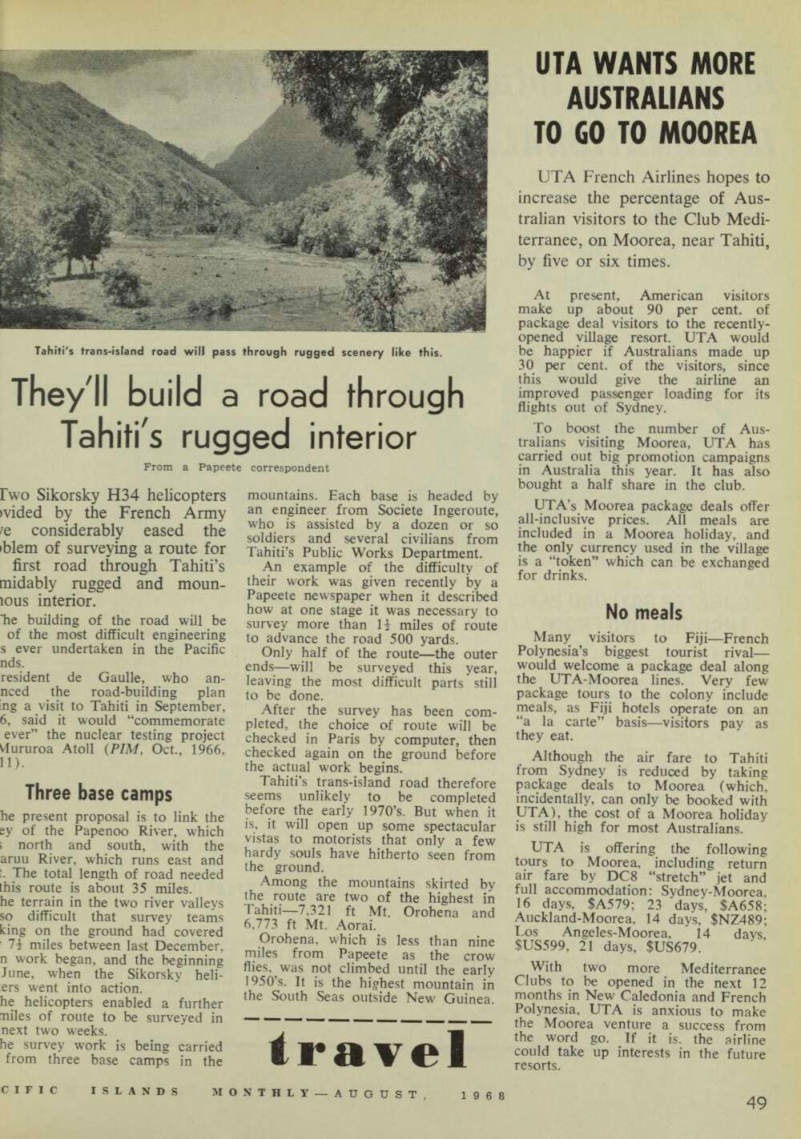
Tahiti's trans-island road will pass through rugged scenery like this.