Tropicalities
pp. 33-35 · Read in the full issue
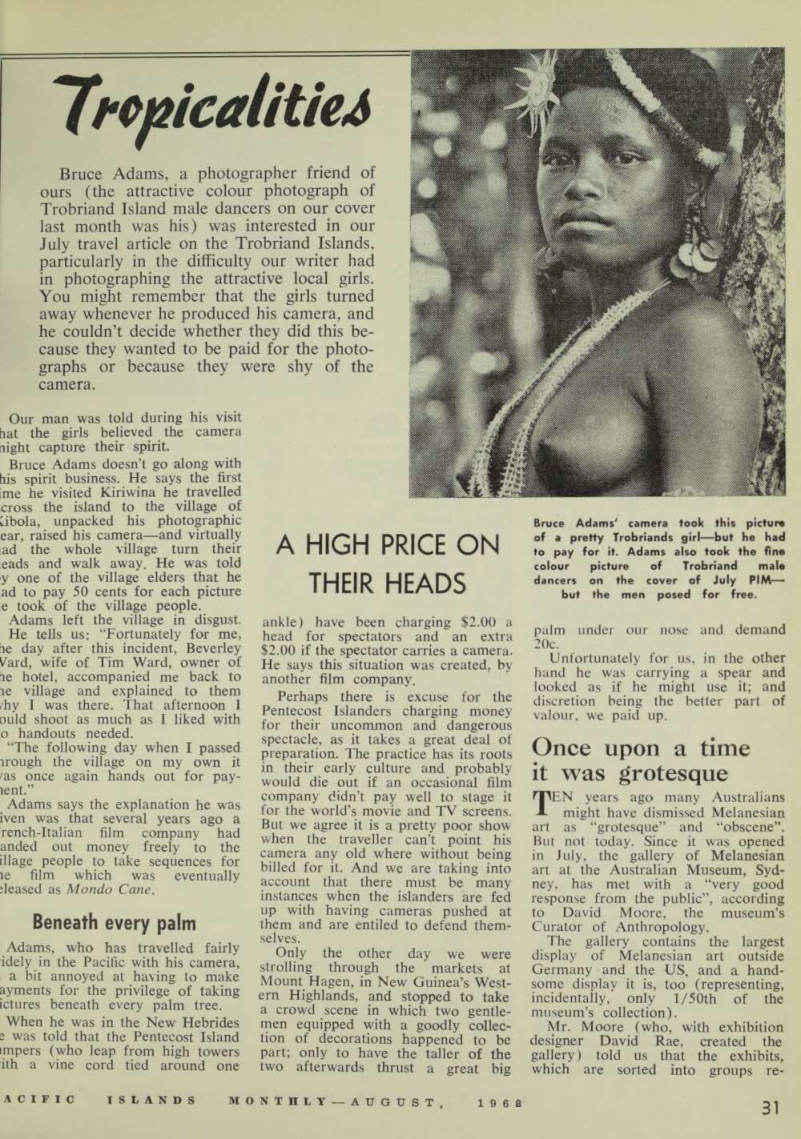
Bruce Adams, a photographer friend of ours (the attractive colour photograph of Trobriand Island male dancers on our cover last month was his) was interested in our July travel article on the Trobriand Islands, particularly in the difficulty our writer had in photographing the attractive local girls.
You might remember that the girls turned away whenever he produced his camera, and he couldn’t decide whether they did this be cause they wanted to be paid for the photo graphs or because they were shy of the camera.
Our man was told during his visit tiat the girls believed the camera night capture their spirit.
Bruce Adams doesn’t go along with his spirit business. He says the first ime he visited Kiriwina he travelled cross the island to the village of Libola, unpacked his photographic ear, raised his camera —and virtually ad the whole village turn their eads and walk away. He was told y one of the village elders that he ad to pay 50 cents for each picture e took of the village people.
Adams left the village in disgust.
He tells us: “Fortunately for me, le day after this incident, Beverley yard, wife of Tim Ward, owner of ie hotel, accompanied me back to le village and explained to them diy I was there. That afternoon 1 ould shoot as much as I liked with o handouts needed.
“The following day when I passed irough the village on my own it 'as once again hands out for pay lent.”
Adams says the explanation he was iven was that several years ago a rench-Italian film company had anded out money freely to the illage people to take sequences for ie film which was eventually deased as Mondo Cane.
Beneath every palm
Adams, who has travelled fairly idely in the Pacific with his camera, a bit annoyed at having to make ayments for the privilege of taking ictures beneath every palm tree.
When he was in the New Hebrides 2 was told that the Pentecost Island impers (who leap from high towers ith a vine cord tied around one
A High Price On
Their Heads
ankle) have been charging $2.00 a head for spectators and an extra $2.00 if the spectator carries a camera.
He says this situation was created, by another film company.
Perhaps there is excuse for the Pentecost Islanders charging money for their uncommon and dangerous spectacle, as it takes a great deal of preparation. The practice has its roots in their early culture and probably would die out if an occasional film company didn’t pay well to stage it for the world’s movie and TV screens.
But we agree it is a pretty poor show when the traveller can’t point his camera any old where without being billed for it. And we are taking into account that there must be many instances when the islanders are fed up with having cameras pushed at them and are entiled to defend them selves.
Only the other day we were strolling through the markets at Mount Hagen, in New Guinea’s West ern Highlands, and stopped to take a crowd scene in which two gentle men equipped with a goodly collec tion of decorations happened to be part; only to have the taller of the two afterwards thrust a great big
palm under our nose and demand 20 c.
Unfortunately for us, in the other hand he was carrying a spear and looked as if he might use it; and discretion being the better part of valour, we paid up.
Once upon a time
it was grotesque
TEN years ago many Australians might have dismissed Melanesian art as “grotesque” and “obscene”.
But not today. Since it was opened in July, the gallery of Melanesian art at the Australian Museum, Syd ney, has met with a “very good response from the public”, according to David Moore, the museum’s Curator of Anthropology.
The gallery contains the largest display of Melanesian art outside Germany and the US, and a hand some display it is, too (representing, incidentally, only l/50th of the museum’s collection).
Mr. Moore (who, with exhibition designer David Rae, created the gallery) told us that the exhibits, which are sorted into groups re
Bruce Adams' camera took this picture of a pretty Trobriands girl—but he had to pay for it. Adams also took the fine colour picture of Trobriand male dancers on the cover of July PIM but the men posed for free.
presenting the different areas of Melanesia, were chosen for their aesthetic qualities, not for their scientific interest.
However, when the exhibits had been chosen, they were checked against the record books and it was found that, almost without exception, the pieces chosen were the oldest owned by the museum. This shows, said Mr, Moore, that there has been a decline in the quality of Melanesian art—a decline caused by the fact that in Melanesia today art is largely a commercial proposition, and not a religious duty, as in the old days.
Dr. F. H. Talbot, director of the museum, told us that the museum’s trustees had asked the NSW Govern ment for an increased grant this year to buy Melanesian art be cause Melanesian art of any quality is becoming dearer as it gets rarer.
Dr. Talbot said that in 10 years’ time, Melanesian art, if there is any out side the museums, will be “ridicu lously expensive”.
A beautifully produced catalogue is available for $1.25 —and worth every cent.
A little bit of
England on Norfolk
ENGLISHMAN Peter Custance and his Australian wife, Joyce, are running Norfolk Island’s first modern dairy farm. When the couple arrived on the island in 1967, they bought 90 acres of undulating farm land at Headstone. They imported a herd of 34 Holstein-Freisian cows (all of whom were in calf) and they bought a modern milking plant— which can milk eight cows at a time —from Australia, A husbandry officer from Victoria planned the layout of the milking shed and the dairy yard to suit con ditions on Norfolk. Another Vic torian, Bob Homfray, is in charge of the dairy.
The farm is run along strict hygienic lines, with milk being trans ferred to cooling rooms as soon as the cows have been milked.
The Custances plan to enlarge the farm. Peter Custance was recently in Australia where he took a course in artificial insemination of cattle at the Werribee State Research Station, Victoria. He intends to increase his herd by using artificial insemination.
They work with the
Kukukuku
THE turnover of Europeans in Papua-New Guinea, and the constant re-posting of government men, often upsets village people. Just
when they feel they know a Euro pean, he’s transferred.
The goldfields around Wau in New Guinea’s Morobe District, and the Kukukuku, Finschhafen (Migrated) and Upper Watut people living on them, have been a little luckier.
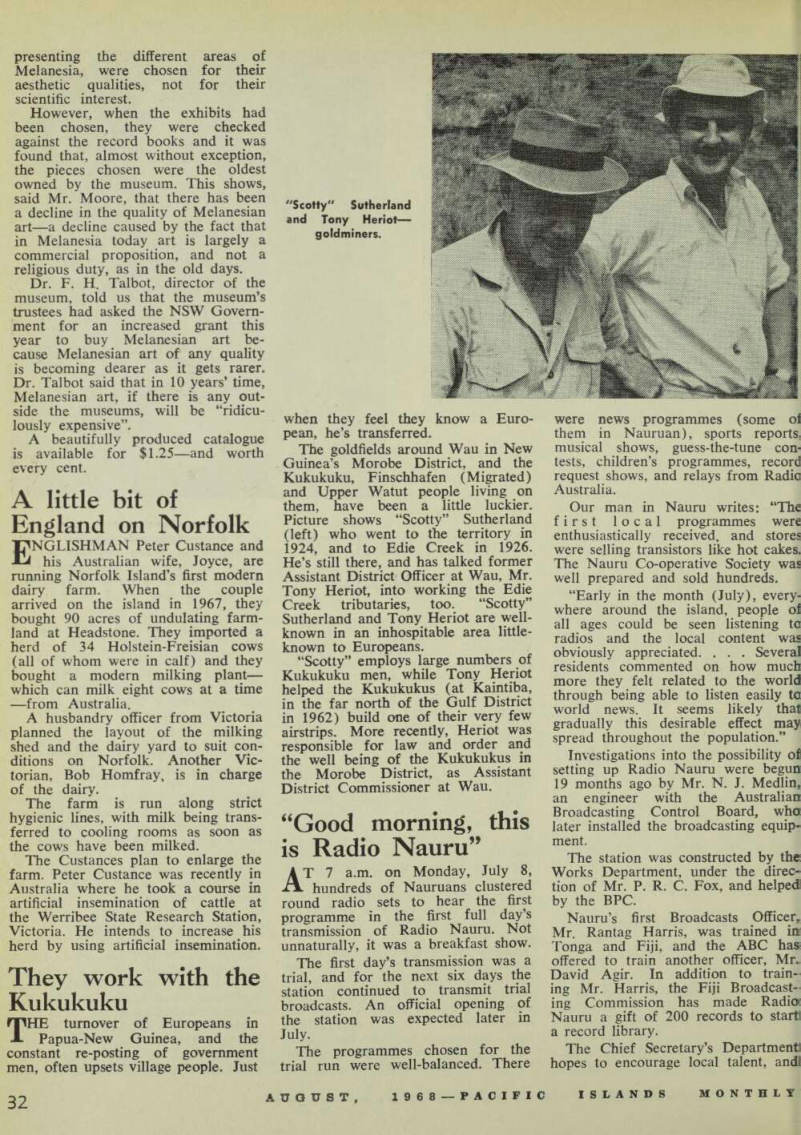
Picture shows “Scotty” Sutherland (left) who went to the territory in 1924, and to Edie Creek in 1926.
He’s still there, and has talked former Assistant District Officer at Wau, Mr.
Tony Heriot, into working the Edie Creek tributaries, too. “Scotty”
Sutherland and Tony Heriot are well known in an inhospitable area little known to Europeans.
“Scotty” employs large numbers of Kukukuku men, while Tony Heriot helped the Kukukukus (at Kaintiba, in the far north of the Gulf District in 1962) build one of their very few airstrips. More recently, Heriot was responsible for law and order and the well being of the Kukukukus in the Morobe District, as Assistant District Commissioner at Wau.
“Good morning, this
is Radio Nauru”
AT 7 a.m. on Monday, July 8, hundreds of Nauruans clustered round radio sets to hear the first programme in the first full day’s transmission of Radio Nauru. Not unnaturally, it was a breakfast show.
The first day’s transmission was a trial, and for the next six days the station continued to transmit trial broadcasts. An official opening of the station was expected later in July.
The programmes chosen for the trial run were well-balanced. There
were news programmes (some ol them in Nauruan), sports reports, musical shows, guess-the-tune con tests, children’s programmes, record request shows, and relays from Radio Australia.
Our man in Nauru writes: “The first local programmes were enthusiastically received, and stores were selling transistors like hot cakes.
The Nauru Co-operative Society was well prepared and sold hundreds.
“Early in the month (July), every where around the island, people of all ages could be seen listening to radios and the local content was obviously appreciated. . . . Several residents commented on how much more they felt related to the world through being able to listen easily tc world news. It seems likely that gradually this desirable effect may spread throughout the population.”
Investigations into the possibility of setting up Radio Nauru were begun 19 months ago by Mr. N. J. Medlin, an engineer with the Australian Broadcasting Control Board, who later installed the broadcasting equip ment.
The station was constructed by the Works Department, under the direc tion of Mr, P. R. C. Fox, and helped! by the BPC.
Nauru’s first Broadcasts Officer, Mr. Rantag Harris, was trained in: Tonga and Fiji, and the ABC ha& offered to train another officer, Mr..
David Agir. In addition to train ing Mr. Harris, the Fiji Broadcast ing Commission has made Radio; Nauru a gift of 200 records to startl a record library.
The Chief Secretary’s Department! hopes to encourage local talent, andi
"Scotty" Sutherland and Tony Heriot— goldminers.
las invited choral groups and instru nentalists to attend auditions.
The record request programmes Listeners’ Choice and Housewives’
Choice) during the seven-day trial ransmission were not entirely >rthodox. According to Naum’s bulletin, “You are invited to take r our record to the studio with a slip ff paper showing your name, address md the particular track you wish to lave played. Your record will be ivailable for collection from the tudio on the day following the election”.
she’s all for
ilack rice
HF you live in Fiji, you may soon L have the opportunity of eating lack rice.
Two years ago, Australian artist lary Edwell-Burke persuaded the iji Department of Agriculture to itroduce a small sample of black ice from Malaysia. From 2-oz of lis black grain rice, pulut hitam, rought into Fiji in December, 1965, :om the Department of Agriculture i Malaya, the Koronivia Research tation grew 2-lb of seed. Half of lis seed is now being cultivated for ommercial trial by an Indian farmer, nd the other half is being cultivated y the research station.
Black rice is widely used in lalaysia and Indonesia as a dessert.
L’s like the rice most of us know xcept that its grains are shiny and lack. When prepared as a dessert, is cooked in water with raw sugar nd served with coconut cream.
It has a nut-like flavour quite un ke white rice.
The chief research officer of the fepartment of Agriculture, Mr. A.
V. Allen says; “This black rice is rst-class with curry and has great otential as dry land rice”.
Who knows—Fiji may have here profitable new crop in the making?
Yho belongs to
Poppie’ Wall?
rHE recent death in Sydney of an old New Guinea personality, diss Iris “Poppie” Wall, has posed . problem for the New South Wales Yust Office.
Shortly after Miss Wall died quietly n the small ward of a Sydney hos >ital, Trust officers found that Poppie” had left a small estate in 4G and Australia.
To her NG friends, who well emembered “Poppie” moving from ob to job in Lae, Salamaua and labaul during her 30-odd years in
the territory, the fact that she had left any money at all was surprising.
The Trust Office’s problem how ever, is not that she left some money, but to whom it should go.
Miss Wall didn’t leave a clear will and had never mentioned her relatives. One NG old hand told PIM he believed she had a brother in Sydney, but neither the Trust Office nor “Poppie’s” friends could confirm this.
She was born in Fiji in the 1880’s or 1890’s, the daughter of a retired mariner called Captain Wall, who later ran a small maritime museum in Suva before World War I.
Her mother was reported to be a beautiful islander from Fiji’s Lau Group.
“Poppie” left Fiji for good before 1914, for Sydney, and she went on to NG in 1930. Her NG friends now would like to see “Poppie’s” next of-kin located so her estate does not sink into the bottomless depths of the NSW Treasury. Can any reader help?
Lure of the
Islands
HARBOUR pilots for Sydney’s Port Jackson Pilot’s Service and the Torres Strait and Queensland Coast Pilots’ Service, based in Bris bane and other major Queensland ports, are among the keenest readers of PlM’s Pacific Shipping Section each month. Most of them know the Islands well.
Men such as “Big Jim” Campbell —the former master of the ill-fated Machdui (bombed in Port Moresby during World War ip—have retired recently but they still keep an in terest in the South Seas. All have master’s tickets and previous experi ence over many years as captains and officers of Islands traders which called at ports like Port Moresby, Suva, Papeete, Nukualofa, Apia and Vila.
Those now in the port Jackson service include Captains Jim West, Brian Bruce and Malcolm Armstrong, all formerly of the Union Steam Ship Company; Frank Sadler, Ken Edwards and Mick Dunn, former BP men; Mike Dodds, formerly of W. R.
Carpenter; Herbert Bolles of the Austasia Line, Mike O’Keeffe, of China Navigation, and Bert Simpson of the Wanganella.
Those in Queensland and Torres Straits service are all former Bums Philp men; they include Captains Ted Clay, “Babe” Davis, Basil Helm, Gordon Howe, “Tommy” Thompson, Alan Aitken, Bill Colquhoun, Eric
McFadyen, Geoff Sadler, Peter Powell and Peter Sturt.
Some pilots take to the sea again after getting their fill of harbour work. Captain Charles MacDonald recently gave away his job as a senior pilot with the Port Jackson group to sail as master of a freighter to New Guinea and the Solomons; and Captain Clive Henderson left a similar job to do a month’s reliev ing work at Honiara.