frets about its future
pp. 30-32 · Read in the full issue
New Guinea University frets about its future
From a Port Moresby correspondent It’s dismaying that, three years after the Australian Govern ment accepted the need for a university for Papua-New Guinea, and gave the go-ahead for it to be established, it should still be necessary for anybody to justify the university’s existence. Still less that the university should have to justify its own existence.
But that is what the University of Papua-New Guinea has been doing in recent months, as a result of a running battle with the Australian Government over financial needs. The fact is that development of the lusty young infant, born with such hope only in 1965, may yet be retarded by malnutrition.
The University of Papua-New Guinea took its first students in February, 1966. Fifty eight of them went through a preliminary year— virtually a matriculation course designed to prepare them for the university’s first full degree courses, which began in March, 1967. Thirty five of that original preliminary year got through the sieve into first-year and were joined by 46 others who had studied elsewhere, mostly in Australia.
This year the university has 40 full time second-year students—the senior year—7o full time first-year students, and 110 doing the preliminary year
(plus 30 prelim, year Medical Col lege students). There is a total en rolment of 400, the extras being part time, or those undergoing post graduate courses for higher degrees, jnon Of IDODOy To the things it wants to do at this stage of its development, the university this year asked for $4.5 million, and was told it could have only $3.5 million. It protested that it had to have at least $3.85 million to be able to keep going, but this has been rejected. The best the university will be able to do is borrow another $200,000 for building, giving it a total of $3.7 million for the year, Although the wrangle over money bas been going on since the univer sity was started, this year the argument is out in the open. Reason for this apparently is that the univer sity is fed-up with the financial system which has been thrust on it,
against the wishes of the Currie Commission—whose detailed repor resulted in the university beinj established.
The new university depends for it allocation of funds on the Australiai Department of External Territories although the Currie Commission pro posed that the Australian Universitie: Commission be asked to act as ex perienced overseer. This was rejectee by the Commonwealth. As a result P-NG gets its funds allocated eacl year, although Australian universitie: are allocated funds three years aheac and some British universities fivi years ahead. The P-NG University finds it impossible to plan.
More serious
As a result of the cut-back in ex penditure this year the university haj abandoned plans for the introductioi of external studies and of three nev. departments.
Another, more serious, cut hao already been made before the yeaj started. Thirty five students, who 01 the basis of examinations would haw had a good chance of getting univen sity degrees, were turned away fron the preliminary year for 1968 s« as to keep the numbers down to round about 100. This was becausn the Department of Territories tolo the university that it must not exceeo a total of 575 students, includini preliminary year students, by 1970 because it could not expect to the money to house and teach any more than that number. The univen sity, which had been planning to have 825 students by 1970, had to apply the brakes at once.
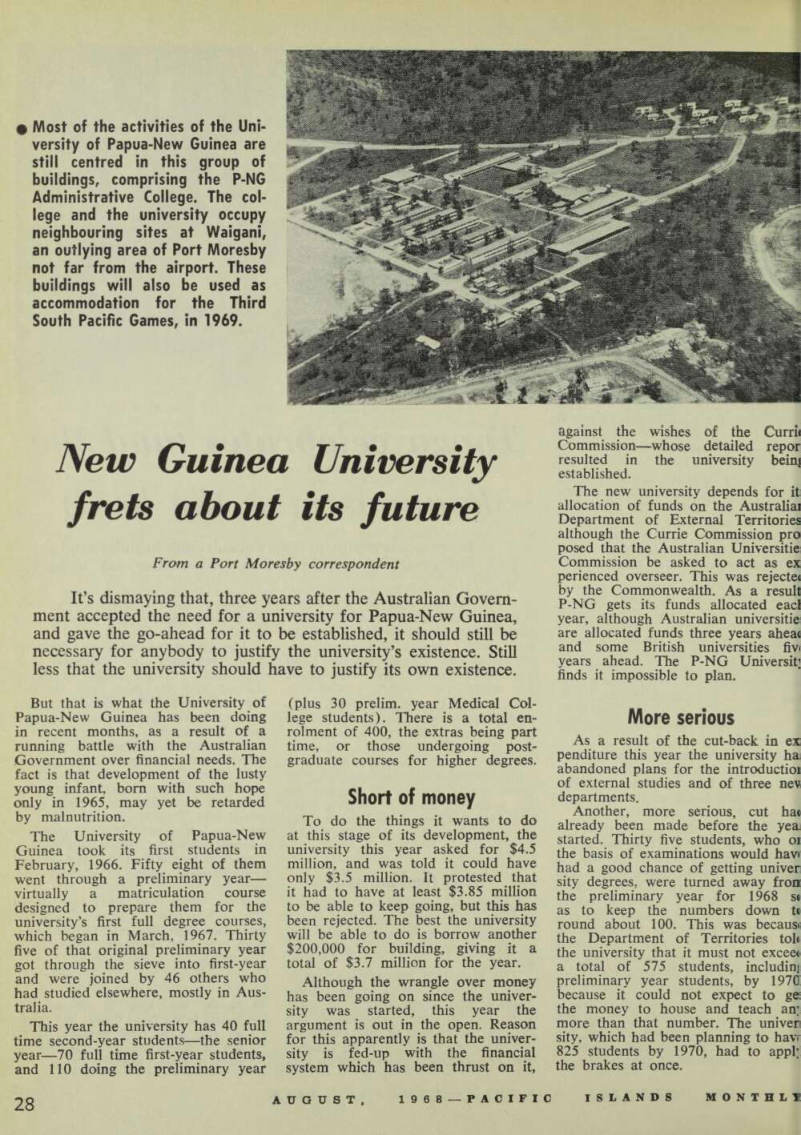
Most of the activities of the Uni versity of Papua-New Guinea are still centred in this group of buildings, comprising the P-NG Administrative College. The col lege and the university occupy neighbouring sites at Waigani, an outlying area of Port Moresby not far from the airport. These buildings will also be used as accommodation for the Third South Pacific Games, in 1969.
It is tragic that students should be urned away in a territory which has , population of two million people nd only four university graduates— -11 from outside universities. No ountry in the world with a com iarable population could have such n academic record.
The P-NG University won’t pro uce its first graduates before 1971, nd then only 40, Even if the univer ity could graduate 200 students each ear from 1976 it would still owhere meet the territory’s needs 3r graduates this century.
The Currie Commission estimated ic territory will need 2,300 univer ity graduates by 1973, of whom ,000 would be needed by the Public ervice.
Crazy arithmetic?
Eh-. John Gunther, vice-chancellor f the university, points out that if ou replace a white man with a sgree by a graduate New Guinean ou save $4,000 a year in salary, save, fares, housing and other costs, f you could replace 2,000 graduate dikes tomorrow you yould save $8 lillion every year in salaries—yet le university would not cost $8 mil on a year to operate.
“It is not crazy arithmetic, but a Kind investment for Australia to rovide monies that will hasten an icrease in the localisation of the few Guinea Public Service,” Dr. iunther says. And he adds: “You can’t have happiness without Jucation. The village person is un appy because he is ignorant, and the
greatest demand in the House of Assembly has been for schools for the children.
“The under-secretary system in the last Assembly failed mainly because we expected too much from the under-secretaries. Not one of those men could, for instance, read the World Bank Report. One man told me it physically pained him in the head to read it; another took three months just to go through the index to see if he could find something he could read.
“The new Ministerial Members are better educated, but the university students we have here already have a better education than most of these people.” HI
So says the vice-chancellor. But why should he have to justify the university’s existence? The Currie Commission’s report has long since been accepted, and the university established. The university has ac cepted staff on the understanding that the Australian Government would develop the university and its courses to international standards.
The staff is already deeply con cerned about the future. The academic section of the university’s staff as sociation said in a resolution recently: “If money is not provided for development we believe that the students and the territory will suffer, and morale of the staff will deteriorate rapidly. Academics will seek appoint ments in institutions whose standards are not in jeopardy, and satisfactory staff will be extremely difficult to obtain”.
What the professors said
Ten professors at the university later elaborated on this in a letter to the Australian Press. The professors said the financial restrictions which had already led the university to turn away 35 students this year would result in the university turning away still greater numbers from the enlarged secondary school output available next year.
“Equally serious,” the professors’ letter said, “is the cumulative post ponement of our capital works pro gramme, which necessarily accounts for a large part of the budget of a new institution. The continued use of inadequate classroom and labora tory facilities will reduce the effec tiveness of teaching over a prolonged
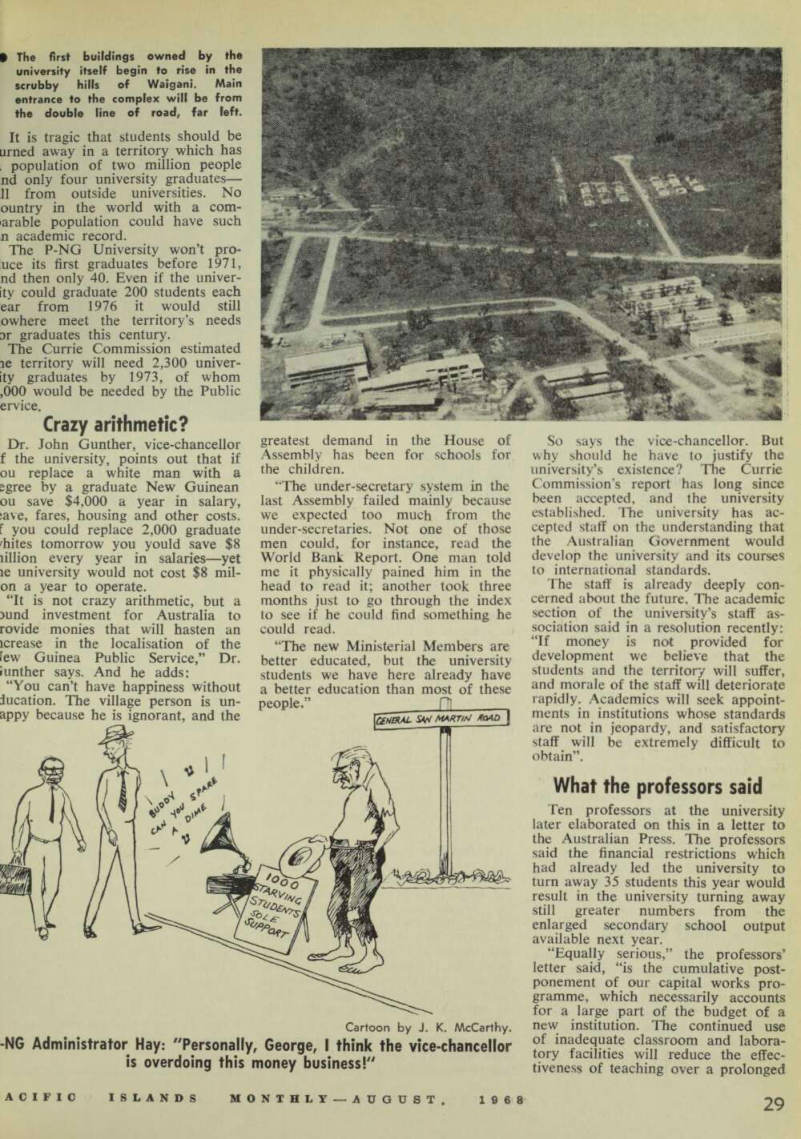
The first buildings owned by the university itself begin to rise in the scrubby hills of Waigani. Main entrance to the complex will be from the double line of road, far left.
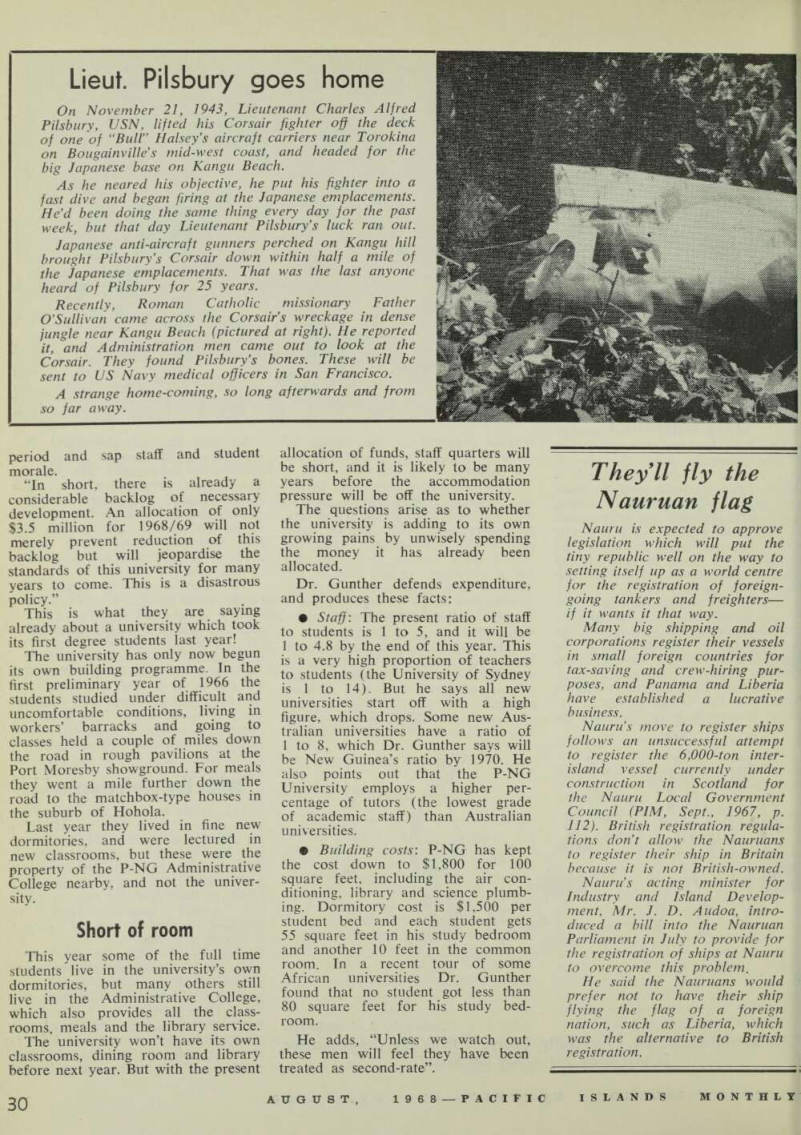
Cartoon by J. K. McCarthy.
P-NG Administrator Hay: "Personally, George, I think the vice-chancellor is overdoing this money business!"
period and sap staff and student morale.
“In short, there is already a considerable backlog of necessary development. An allocation of only $3.5 million for 1968/69 will not merely prevent reduction of this backlog but will jeopardise the standards of this university for many years to come. This is a disastrous policy.”
This is what they are saying already about a university which took its first degree students last year!
The university has only now begun its own building programme. In the first preliminary year of 1966 the students studied under difficult and uncomfortable conditions, living in workers’ barracks and going to classes held a couple of miles down the road in rough pavilions at the Port Moresby showground. For meals they went a mile further down the road to the matchbox-type houses in the suburb of Hohola.
Last year they lived in fine new dormitories, and were lectured in new classrooms, but these were the property of the P-NG Administrative College nearby, and not the univer sity.
Short of room
This year some of the full time students live in the university’s own dormitories, but many others still live in the Administrative College, which also provides all the class rooms, meals and the library service.
The university won’t have its own classrooms, dining room and library before next year. But with the present
allocation of funds, staff quarters will be short, and it is likely to be many years before the accommodation pressure will be off the university.
The questions arise as to whether the university is adding to its own growing pains by unwisely spending the money it has already been allocated.
Dr. Gunther defends expenditure, and produces these facts: • Staff: The present ratio of staff to students is 1 to 5, and it will be 1 to 4.8 by the end of this year. This is a very high proportion of teachers to students (the University of Sydney is 1 to 14). But he says all new universities start off with a high figure, which drops. Some new Aus tralian universities have a ratio of 1 to 8, which Dr. Gunther says will be New Guinea’s ratio by 1970. He also points out that the P-NG University employs a higher per centage of tutors (the lowest grade of academic staff) than Australian universities. ® Building costs: P-NG has kept the cost down to $l,BOO for 100 square feet, including the air con ditioning, library and science plumb ing. Dormitory cost is $1,500 per student bed and each student gets 55 square feet in his study bedroom and another 10 feet in the common room. In a recent tour of some African universities Dr. Gunther found that no student got less than 80 square feet for his study bed room.
He adds, “Unless we watch out, these men will feel they have been treated as second-rate”.