brings hope to dry areas
pp. 139-141 · Read in the full issue
The Practical Planter
SPC's solar still research brings hope to dry areas
Solar stills—devices which use the sun to convert salt water into drinking water —could bring relief to the tens of thousands of Islanders who live in areas where the shortage of drinking water is a serious problem. Governments in the South Pacific are showing an increasing interest in these stills—interest that has been roused by years of research by the South Pacific Commission.
[t all started in 1957 when stills re mentioned at a meeting of the C’s Research Council. At the Comssion’s 24th session in 1962 solar Is were again mentioned. This ic, however, the SPC decided to >sidise research into stills and mted an initial £stg.soo.
Between 1962 and 1967 the SPC, rking with such bodies as the iversity of Wisconsin, the Univerj of California and the CSIRO, up experimental stills m French lynesia, Fiji, the Gilbert and T C p l Kr ndS ’ thC US TrUSt Temtory u Jne of the first experiments was iducted on Rangiroa in February, 53, by Professor Farrington mels, of the University of sconsin, who installed four plastic ar stills in the yard of the
Institut de Recherches pour les Hidles et Oleagineaux (IRHO).
Each still had an area of 24 sq ft and was capable of producing 1 gal. of fresh water on a sunny day. The cost of the stills was SUSIO each.
In the same year another experiment was conducted on Rangiroa by Professor Everett D. Howe of the University of California, who installed three stills: • An inclined-tray still, supplied by the University of California, with a sheet copper tray and a glass cover. It had an area of 18 sq ft and was capable of producing 2 gal. of water per day. The cost of the materials was about SUS2S. • A circular still, also supplied by the University of California, with a black polyethylene basin, and a clear plastic cover. It was 9 ft in diameter
and was capable of producing about 5 gal. of water a day. The cost of the materials was about SUS2S. • A greenhouse-type still, donated by the CSIRO, with asbestos cement basin and glass cover. It had an area of 20 sq ft and was capable of pro ducing 2 gal. of water a day. The cost of the materials was SUS 34, but with packaging and freight the total cost was SUSB3. kppn intprpcf
Imgicst
During 1963 news of the solar still experiments had spread through out the Islands. By October of that year the Solomon Islands, the Gilbert and Ellice Islands and the US Trust Territory were showing a keen interest in the exepriments. In that year also the SPC voted a sub
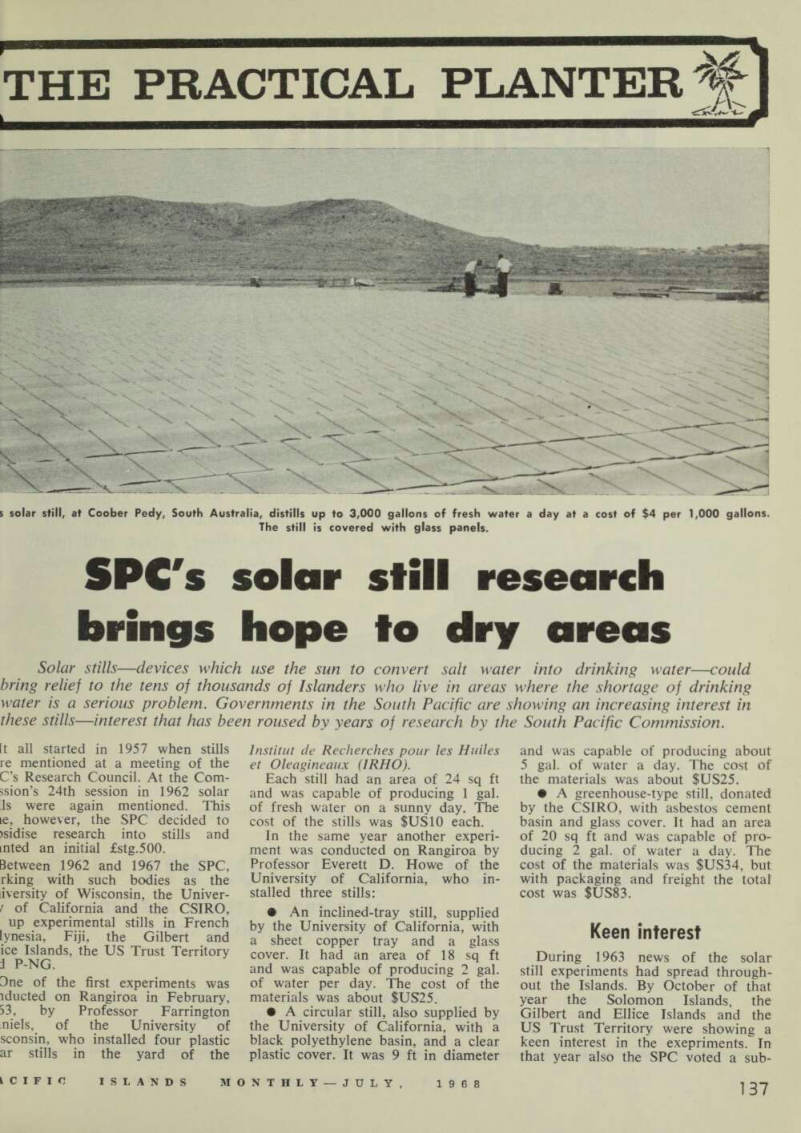
solar still, at Coober Pedy, South Australia, distills up to 3,000 gallons of fresh water a day at a cost of $4 per 1,000 gallons The still is covered with glass panels.
ly of £stg.3oo towards solar still periments.
In August, 1964, the solar still periments were extended by Profes ■ Howe to Fiji. A circular still, ailar to the one in use in Rangiroa, is installed in the grounds of the blic Works Department, Lautoka. iring the same period Professor >we erected two more stills at ingiroa.
At the 26th session of the SPC, October, 1964, £stg.soo was voted continue with the experiments.
The following year, Professor >we, now working with Mr, G. L. tan, Public Health Engineer with ; SPC, installed a still at Lautoka, i. It covered 300 sq ft and was >able of producing 30 gal. of water.
By the time the sixth Conference the SPC was held (in Lae, in ly, 1965) many territories were >wing a keen interest in the stills :n operating in the Islands. At this nference £stg. 1,000 was granted • the continuation of experiments.
Family-size
In 1966, based upon the findings a report by Mr. Chan on the utoka still, Professor Howe, and r. B. W. Tleimat, of the Sea Water inversion Laboratory, University of lifornia, designed a glass-covered, nily-size still, measuring 6 ft by ft and capable of producing :ween 4 and 5 gal. of fresh water.
In October, 1966, Professor Howe
and Mr. Chan went to the Gilbert and Ellice Islands to install family size stills. In the same month the SPC granted a subsidy of $A2,500 towards experiments.
Later in 1966, Professor Howe installed a still on Fisherman’s Island, a coral island off Port Moresby.
In December that year, Professor Howe and Mr, Chan extended the solar experiments to the US Trust Territory.
Work on solar stills continued through 1967. In November of that year, the Fiji Government landed a 50 ft solar still on the tiny island of Viwa ( PIM, Feb., p. 65).
Work continues today, and high hopes are held for solar stills. How ever, they are not without their draw backs.
In a report on solar still ex periments in the Pacific Islands, Professor Howe and Mr. Chan wrote: “The use of solar stills to produce water for drinking purposes is by no means cheap. Where the Ghyben- Herzberg freshwater lens exists, it would be more satisfactory to tap this source of supply.
Only answer
“Also where the rain is regular, it would be more economical to col lect the rain. . . . But where the groundwater is objectionably brackish, or the drought period continues beyond four or five months, the solar still is the only answer to the solution of the water problem in low coral islands.
“The chief disadvantage of the solar still is the initial cost which is particularly high because of the exhorbitant price of sheet glass in these islands. . . . Unfortunately, most of the components have to be im ported from developed countries and, because of the transport difficulties, they cost twice or thrice as much.
“The only way to reduce cost is to mass produce the still, but the demand should be important enough.
The SPC is hoping to achieve this through demonstration.
“Considering that over 100,000 people live on the low islands of the South Pacific, this can become a very worthwhile project.”
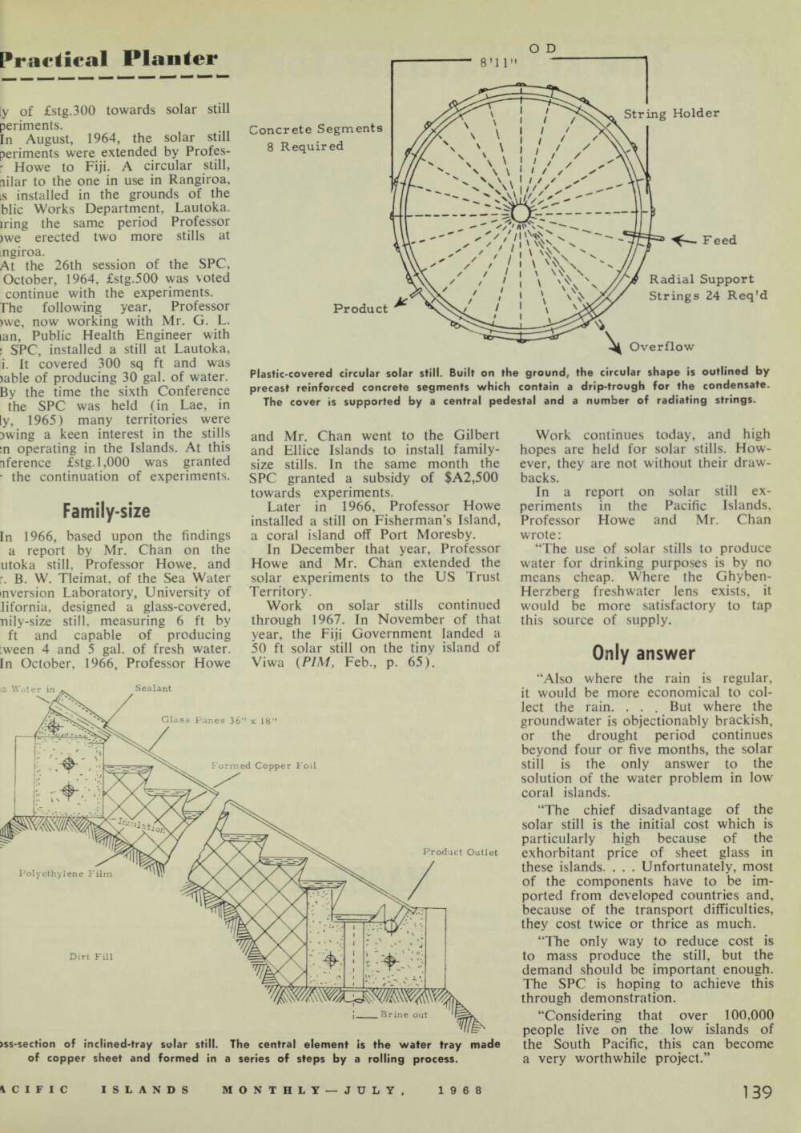
[?]ss-section of inclined-tray solar still. The central element is the water tray made of copper sheet and formed in a series of steps by a rolling process.
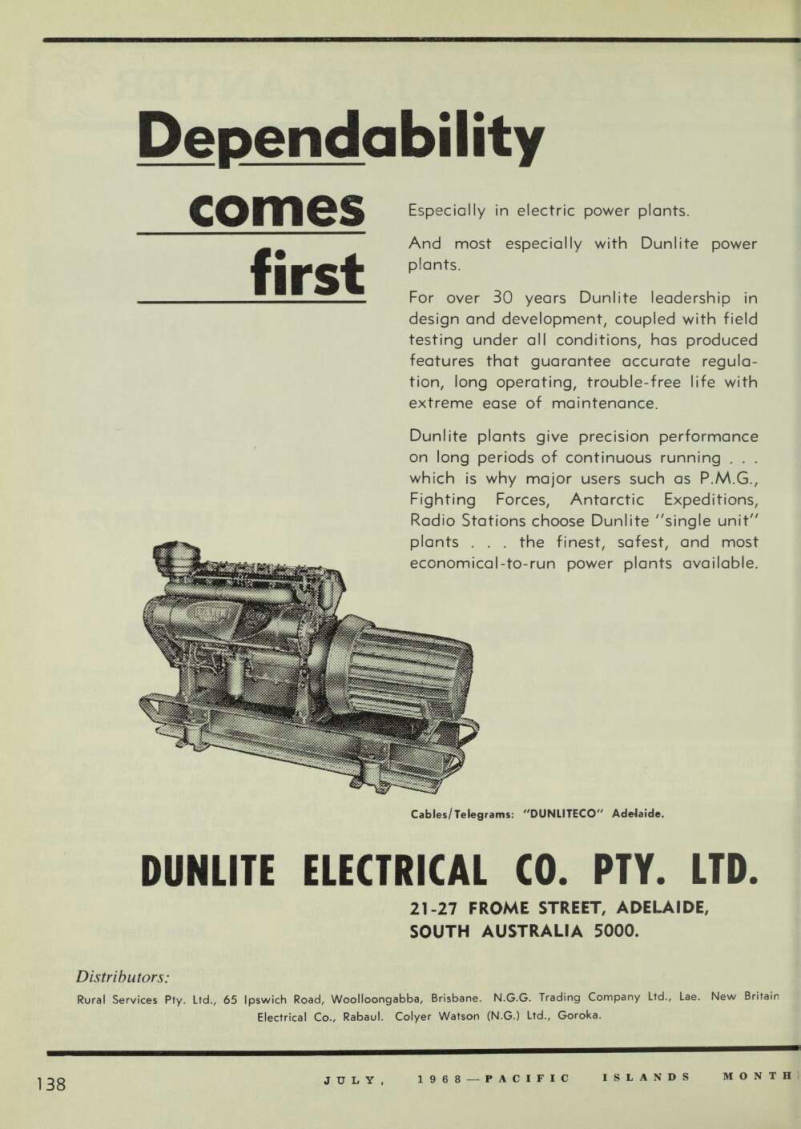
Plastic-covered circular solar still. Built on the ground, the circular shape is outlined by precast reinforced concrete segments which contain a drip-trough for the condensate.
The cover is supported by a central pedestal and a number of radiating strings.