Apprehension as P-NG launches active
pp. 24-26 · Read in the full issue
new strain of party politics
By STUART INDER, who was in Port Moresby for the inaugural meeting of the House of Assembly.
After a half-dozen false starts in the last dozen years, party politics at last appear to have arrived in Papua-New Guinea. That, I believe, is the most significant development to come from the opening session in June of the 94-member House of Assembly. Pangu (for Papua-New Guinea Union) was the name on everybody’s lips, and the fact that the new party received more curses than praises should help guarantee its life.
The advent of the Pangu Pati put stiffening and direction into an inaugural meeting which might other wise have spent a fortnight deliver ing self-conscious maiden speeches to itself on the need for roads and bridges.
The Government had purposely refrained from introducing con troversial legislation, to allow members a shake-down period; among the more exciting of the bills passed were the Laws of the Terri tory (Proof and Printing) Ordinance, the Statistics Ordinance and the Ordinances Interpretation Ordinance.
A number of proposals made from the floor of the House had more elements of controversy, but debate on these invariably came to sudden, unmourned ends.
We don't understand
There were echoes of the previous, 64-member House in the plea of Ebia Olewale (South Fly Open) that he could understand very little of the legislation he was apparently helping to pass, and the complaint by Traimya Kambipi (Kompian Baiyer Open) that he wasn’t impressed by a House where all the good speakers got up and put their ideas, then left the chamber.
But these were merely echoes. This House was not the same as the last, anymore than the last House was the same as the previous Council.
The new members were younger, better educated and certainly more aware. Most of the few old hands left in the chamber (23 out of 84 elected members) commented on this; the awareness in the new House was the strongest impression I gained from watching the members feel their way into their new surroundings.
There are a number of reasons /or this new attitude, but one of the strongest, I suspect, is the fact that local government councils in recent years have followed the same
election procedures as those adopted for electing the Assembly, and the council elections have also been supervised by the P-NG electoral office; thus big new sections of the country have become experienced electors.
No firm judgments
Because of the paucity of con troversial legislation, it is too early for any firm judgments to be made on the political acumen of the new members, but there was some en couraging sniffing at the air follow ing the first behind-the-scenes manoeuvres of the Pangu men.
It was obvious that Pangu were to be the stirrers at this meeting.
After their controversial launching as a party last year, and their victory at the polls, all eyes were on them, and they were conscious of it.
A few days before the House was
opened they used their weight to he; get John Guise the Speakership (s»< “How They Elected the Speaker”, 25), and with that possible thre; to party unity out of the way th«j spent the next day or two in some thing of a frenzy of preparation fi their parliamentary debut.
“If you want to know our plans said Toni Voutas to all outsii questioners, “I suggest you listen the House over the first three dat and you’ll get it all.”
The more mysterious the Pam men became, the more apprehensi became the rest of the House, that by the time the Governo General delivered his opening spec: nobody would have been surpris if Pangu had interrupted it w; a demand for Lord Casey’s recall.
Suspicion of Pangu
Much of the general suspicion Pangu’s motives built up at t: time, and during the party’s carefull prepared pronouncements in t House in the first few days, did i dissipate.
The meeting finished a fortnij later with the House divided ir three unequal, uneasy parts — Government, Pangu and The R> Pangu was very much the minor having started its parliamentary ! with 13 supporters and lost a possibly two, en route. The Gove ment started with 10 and took ui itself another 16 ministerial s assistant ministerial members.
Pangu’s unpopularity with Rest brought predictions that it T finished, that it could last no loir than another two meetings.
Pangu leaders Michael Somare, T Voutas, Paul Lapun and Cecil A appeared confident at the end 1 the party could prove its hoi intentions during the heat of : controversy over Government polii and gradually win for itself' significant following from The Re Thus their decision to shoot f:
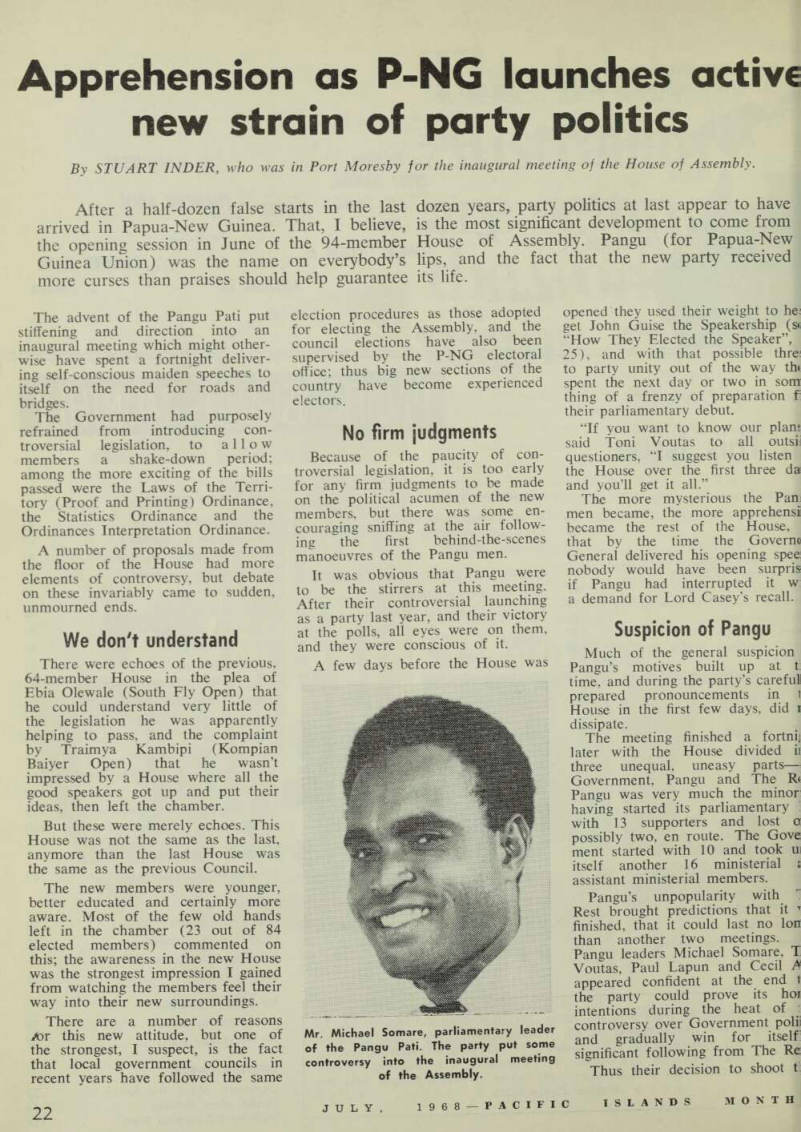
Mr. Michael Somare, parliamentary leader of the Pangu Pati. The party put some controversy into the inaugural meeting of the Assembly.
jolt in the first week, stating firmly vhere they stood, may have been the ight one, for if they stick to the )arty platform they have the next bur years to gain the confidence of heir parliamentary colleagues, and he general electorate such as it is.
The party’s aims were summed up ly Voutas (Morobe Regional) as mmediate home rule, followed by aternal self-government and finally
Home rule
Under home rule, the Assembly r ould decide the territory’s budget nd make general decisions on terri fy affairs, but the Australian Gov "nment would keep the power of ;to. Under home rule, the biggest irty in the Assembly should fill all e ministerial positions.
In the next step, internal self wernment, Australia would no nger have power of veto but would ►ntrol external affairs and defence. ie territory would bargain about e amount of aid to come from ustralia.
P-NG would need plenty of ex rience with home rule before self vernment came, said Mr. Voutas. mgu believe that P-NG should be der the one UN agreement (Papua not under a UN agreement) and ; territory should have one name.
one flag and one national song.
Earlier, Somare (East Sepik Regional) had announced that he was parliamentary leader of Pangu, that Lapun (South Bougainville Open) was deputy leader and Pita Lus (Maprik Open) was party whip.
Somare said that initially no member of Pangu would accept a ministerial appointment because in the early stages of the party’s development the loss of men would weaken it.
Ministerial members, bound by the oath of secrecy, would not be able to obtain a party ruling.
Pangu’s attitude, he told an atten tive House, did not lessen the respect for the ministerial system; nor would Pangu oppose Government measures automatically, but only when the party felt they were contrary to national interests.
Pangu would offer constructive criticism and alternate courses of action, and regarded its role in the House as “a loyal opposition”. It would carry out this “difficult task” despite the fact that the Minister for Territories did not recognise the desirability of fostering a two-party system of government.
Cecil Abel (Milne Bay Regional) put forward the party’s economic platform, which was, in short, to double the territory’s national income in two years with more money from taxes and loans—a commendable policy, most people thought, if only it could be achieved.
Attacks on Pangu
Slings and arrows were hurled at Pangu from all parts of the House in the ensuing fortnight, although it was not always clear why some of the assaults were launched.
Possibly it was because Pangu had the only positive programme, and in the absence of any vexatious Government legislation, Pangu was the only windmill that could be tilted at. And members were suspicious of the party’s intellectual background, particularly of the uni versity people they believed to be behind Abel. The Highlanders con sidered it to be a coastal party, and thus not in their best interests.
Many members attacked Pangu for not having accepted ministerial posts, one of the strongest criticisms coming from Gala Gala Rama (Central Regional), one time president of Pangu, who was eased out following some statements he made in Aus tralia.
Gala made it clear that he was an independent member and that his policy was “straight-out
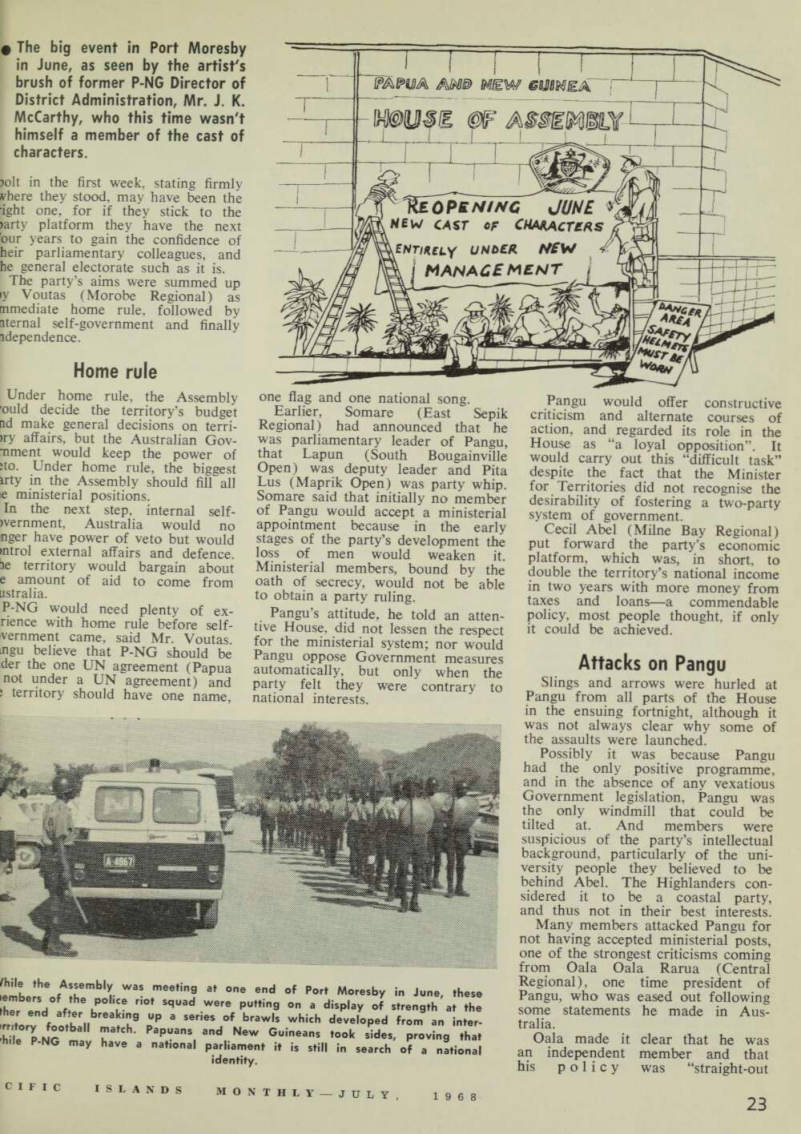
• The big event in Port Moresby in June, as seen by the artist's brush of former P-NG Director of District Administration, Mr. J. K.
McCarthy, who this time wasn't himself a member of the cast of characters.
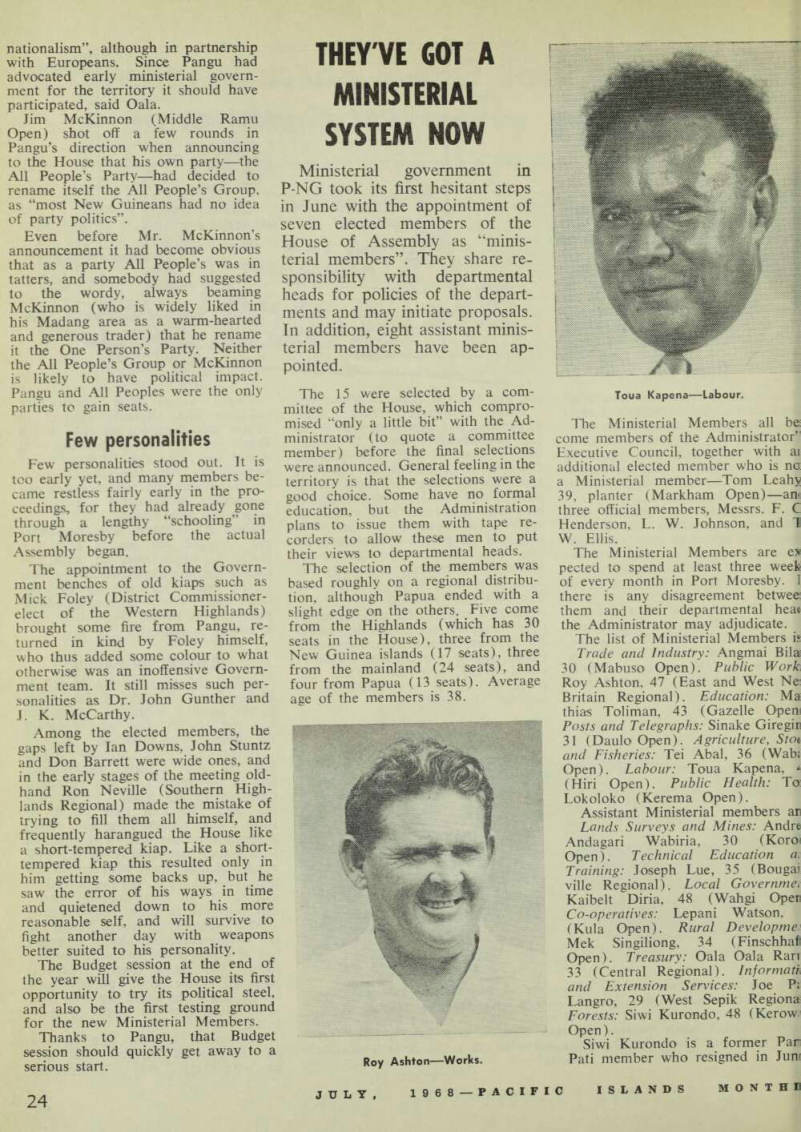
While the Assembly was meeting at one end of Port Moresby in June, these ember of the police riot squad were putting on a display of strength at the [?]her end after breaking up series of brawls which developed from an inter [?]rritory fooball match. Pepuans and New Guineans took sides, proving that while P-NG may have a national parliament it is still in search of a national identity.
nationalism”, although in partnership with Europeans. Since Pangu had advocated early ministerial govern ment for the territory it should have participated, said Oala.
Jim McKinnon (Middle Ramu Open) shot off a few rounds in Pangu’s direction when announcing to the House that his own party—the All People’s Party—had decided to rename itself the All People’s Group, as “most New Guineans had no idea of party politics”.
Even before Mr. McKinnon’s announcement it had become obvious that as a party All People’s was in tatters, and somebody had suggested to the wordy, always beaming McKinnon (who is widely liked in his Madang area as a warm-hearted and generous trader) that he rename it the One Person’s Party. Neither the All People’s Group or McKinnon is likely to have political impact.
Pangu and All Peoples were the only parties to gain seats.
Few personalities
Few personalities stood out. It is too early yet, and many members be came restless fairly early in the pro ceedings, for they had already gone through a lengthy “schooling” in Port Moresby before the actual Assembly began.
The appointment to the Govern ment benches of old kiaps such as Mick Foley (District Commissioner elect of the Western Highlands) brought some fire from Pangu, re turned in kind by Foley himself, who thus added some colour to what otherwise was an inoffensive Govern ment team. It still misses such per sonalities as Dr. John Gunther and J. K. McCarthy.
Among the elected members, the gaps left by lan Downs, John Stuntz and Don Barrett were wide ones, and in the early stages of the meeting old hand Ron Neville (Southern High lands Regional) made the mistake of trying to fill them all himself, and frequently harangued the House like a short-tempered kiap. Like a short tempered kiap this resulted only in him getting some backs up, but he saw the error of his ways in time and quietened down to his more reasonable self, and will survive to fight another day with weapons better suited to his personality.
The Budget session at the end of the year will give the House its first opportunity to try its political steel, and also be the first testing ground for the new Ministerial Members.
Thanks to Pangu, that Budget session should quickly get away to a serious start.