Up Front
pp. 17-18 · Read in the full issue
with the editor
Paulus Arek, a 39-year-old New Guinea schoolteacher, took his seat in the new P-NG House of Assembly in June fresh from a visit to Australia, and what he saw of the treatment of New Guinea news in the Australian newspapers while he was down didn’t impress him much.
AT one of the preliminary get organised meetings of Assembly members held in Port Moresby just before the top-hatted Governor- General vied for sartorial honours with a be-plumed Mr. Speaker at the official opening, Paulus told his colleagues that the Australian Press was inclined to paint an incorrect picture of New Guinea happenings.
I sought him out later to discuss the finer points of this. An articulate, straight-forward fellow, Paulus ex plained that he had attended the Duke of Edinburgh’s Third Commonwealth Study Conference in Australia, and felt that the points of that particular conference which the newspapers had chosen to report didn’t result in a complete picture being presented of what happened there.
Wrong interpretation
The same thing occurred with New Guinea news in the newspapers. He could not easily find anything that was actually inaccurate, but unless readers had a good background on New Guinea —and few did—they ended with the wrong interpretation of the reports. He had found this in many conversations and it dis turbed him.
I think Paulus Arek makes a good point. It is not so easy to over come this lack of interpretative re porting in day-to-day newspaper reports. Space is not available for the backgrounding that is required if the story is to be fully compre hensible to every reader —even assuming that every reader cares to be informed on what is taking plao> in New Guinea.
The interpretative feature writers in the newspapers and magazines have a better opportunity to do the job. But the trouble here is that
sometimes they fall down on it be cause they are specialists, and as specialists they tend to assume wrongly that the reader is as in terested in the subject as they them selves are, and neglect to put the sugar-coating on the pill.
Bad habits
PIM can and does fall into the same bad habits. We sometimes concentrate on what we know to be the most significant development in a territory for the month, to the exclusion of the overall picture. This month, for instance, we carry some weighty pieces on the New Guinea political scene—the opening of the Assembly, the build-up of party politics, the appointment of the first native Speaker, and the details of the McEwen report to the UN.
It’s all necessary, and it’s all happening at this moment as I sit in my room in Port Moresby typing this budget of thoughts. In the House down the street they are politicking in great earnestness, and not even the Kennedy shooting means anything to them. The new comer to Port Moresby could be for given for believing that the New Guineans are interested in their own political future to the exclusion of everything else.
But this is nonsense. For one
thing, there is no real interest ini national politics. Most members ofi the House don’t understand national! issues, as Mr. McEwen has indicated..
What we have in the House is a few' score men from all points of the; territory, sufficiently involved in the; problems of their own immediate: locality to get themselves elected to< a forum which they think might help! bring some of the problems to gov eminent attention. Some of these; men are simply there for the money..
Not interested
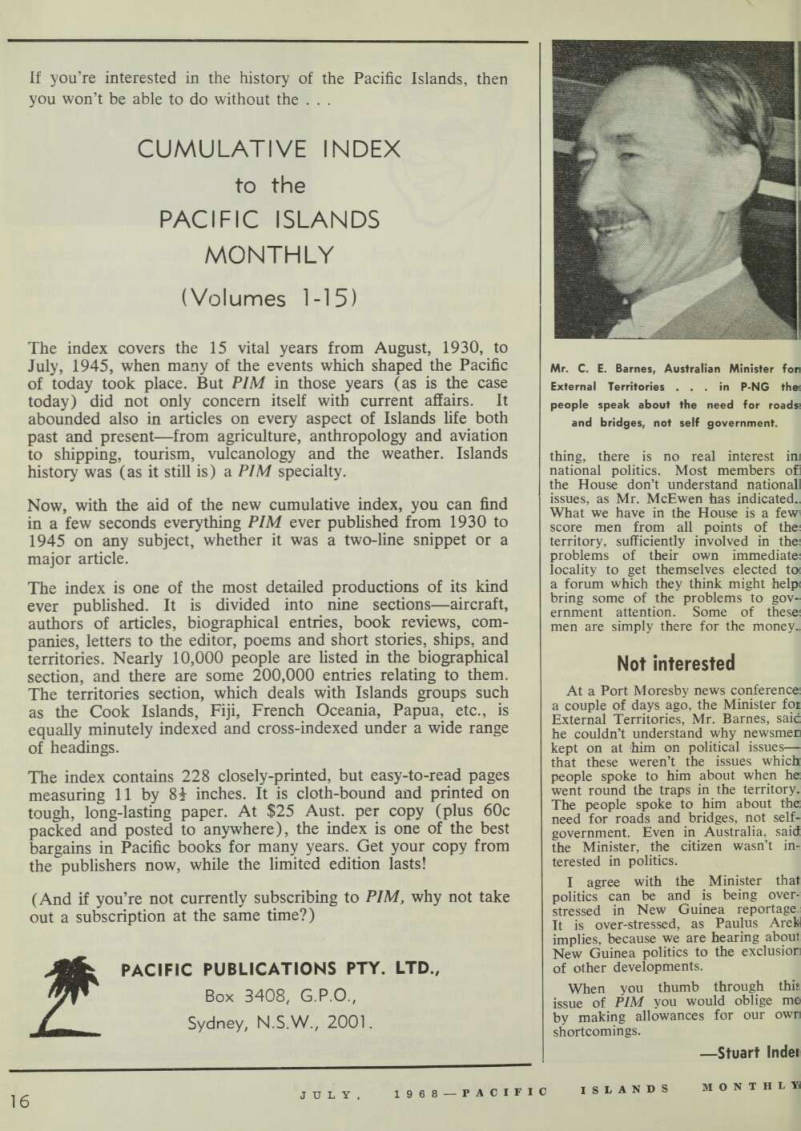
At a Port Moresby news conference; a couple of days ago, the Minister for External Territories, Mr. Barnes, said he couldn’t understand why newsmen kept on at him on political issues— that these weren’t the issues which people spoke to him about when he went round the traps in the territory.
The people spoke to him about the need for roads and bridges, not self government. Even in Australia, said the Minister, the citizen wasn’t in terested in politics.
I agree with the Minister that politics can be and is being over stressed in New Guinea reportage.
It is over-stressed, as Paulus ArekJ implies, because we are hearing about New Guinea politics to the exclusion of other developments.
When you thumb through this issue of PIM you would oblige me by making allowances for our own shortcomings.
Stuart Inde[?]
Mr. C. E. Barnes, Australian Minister for External Territories ... in P-NG the people speak about the need for roads and bridges, not self government.