oil palm industry
pp. 120-122 · Read in the full issue
Business and
Developnaent
They’re off to start NG's oil palm industry
From a Rabaul correspondent Native farmers in May started to fly to New Britain from various parts of the territory for their part in Papua-New Guinea’s most ambitious resettlement scheme —the big New Britain oil palm complex.
The Australian Government has just got to make a success of the oil palm resettlement schem e—there’s too much at stake in hard cash, along with the bitter memories of the partial failure of two other big land settle ment schemes (not oil palm) at Mori-Bamguina near Cape Rodney, in the Central District, and the soldier settlers’ cocoa project at Sangara, near Popondetta in the Northern Dis trict.
Facts and figures
The Administration and the British Harrisons and Crosfield (ANZ) Ltd., are putting up a basic total of at least $3,000,000 for the oil palm plantations at Kapore and Tamba, near Hoskins, on New Britain.
The facts and figures are: 228 native farmers from the East Sepik, Chimbu, Central, Morobe and
New Britain Districts have been granted government land in the two sub-divisions near Hoskins. About 100 farmers are already in New Britain, including Chimbu and Sepik people who were sent in last year to help clear the land, with the guarantee that they’d leceive very favourable con sideration when the first government blocks were allocated. 125 farmers will be flown to New Britain in May, from Wewak, Kun diawa, Lae and Port Moresby. 60 other blocks near Hoskins have just been advertised, and have brought 212 applicants. 213 of the first 228 farmers have each been granted loans of $1,870, by the territory’s new Development Bank.
The money will be paid out over the next four years, and repaid within 11 years. 520 wives and children of the 125
men being flown to New Britain ii May will join them near Hoskins ii July, following another airlift.
At the end of May, when all 221 men arrive, they’ll go into two-mai cubicles built inside seven double classrooms at Kapore and Tamba.
Big quantities of supplies—axes spades, knives, torches, blankets, mos quito nets—are being stockpiled a Kwalakessi by the government, to b handed out to the farmers so the; can erect their own houses of per manent materials supplied by the gov eminent (see below for more details' The government has built acces roads to the first 228 blocks, and ha erected an aid post on each sub division. Six acres of each bloc! averaging about 15 acres, has alread been cleared to give the farmers head start.
Planting in November
Planting of the oil palm seedling from Harrisons and Crosfield’s bi nursery should get under way wit the wet, in November, By the end of next year, 50 farmers should have been grante blocks near Hoskins, as the schem expands. By that time, they’ll hav been joined there by an estimate total of 1,500 wives and childrei making a total resettlement of at lea; 2,000 people. The seven double-clas; rooms being used next month as ten
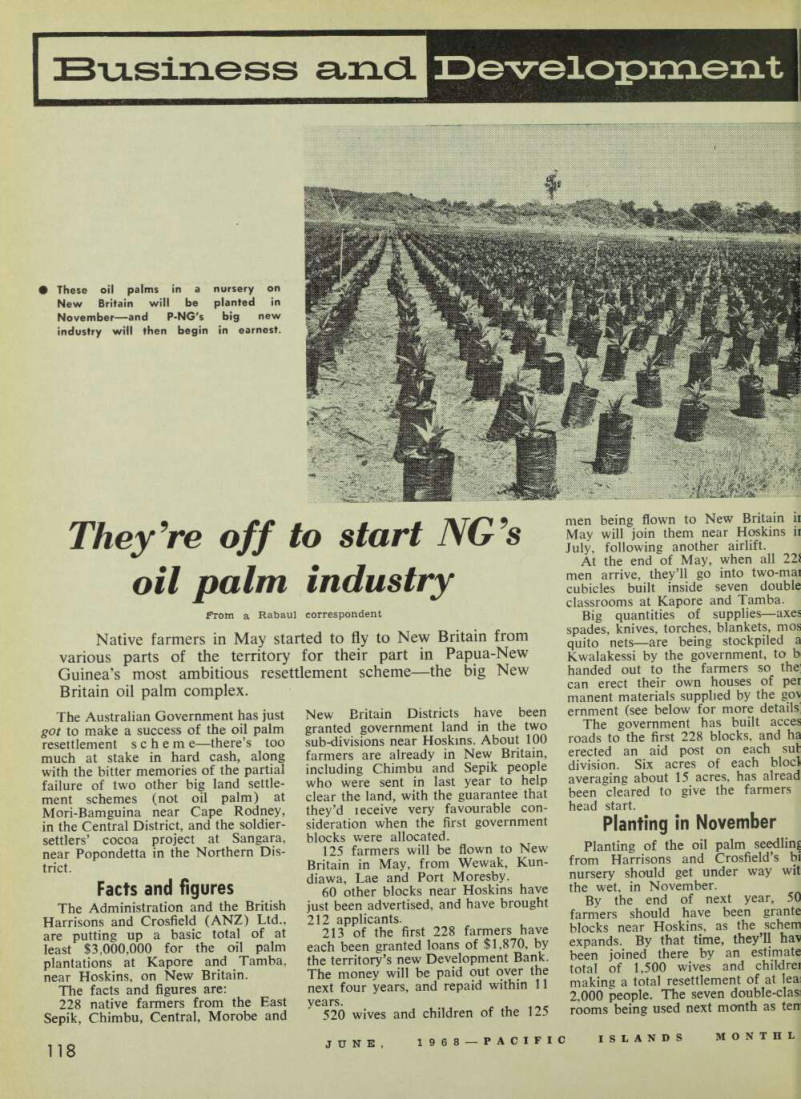
• These oil palms in a nursery on New Britain will be planted in November —and P-NG's big new industry will then begin in earnest.
porary accommodation will then be full of students.
By 1971, the first palm oil pro cessed by the Harrisons and Crosfield factory to be built near Hoskins, should be piped out to tankers in Kimbe Bay, for the world markets.
After three or four years of produc tion, the average native farmer should be netting about $2,000 a year.
The P-NG Administration now owns at least a quarter of a million acres of land between Talasea and Lolobau Island, on the north coast of New Britain, and if the oil palm *oes as planned, it might be ex oanded dramatically over the next 10 or 15 years.
Oil palm trees per acre, produce rom six to eight times as much oil is coconuts. Harrisons and Crosfield, vith a successful history in Malaysia, iim to make the New Britain scheme i winner.
Now, it’s up to the new planters, Ithough some people feel it is also ssential that P-NG should set up a and settlement authority to help mooth out problems as they arise.
Permanent houses
The permanent houses to be used y the New Guinean planters will ast $350 each, and they are the re lit of Administration experiments ito cheap housing.
The Administration for some years as been experimenting with bush laterials and prefabrication mainly i the hope of finding a satisfactory iswer to the problem of housing ousands of New Guinean public rvants and people in private enter ise. But in the past couple of years iministration efforts switched to e housing problems of the New uineans who would be the hack ee of the oil palm project. The dministration realised that good msing would be a vital factor in eping the new planters happy.
Early experiments resulted in a •t-too-impressive mixture of bush d permanent materials, ranging in st from about $l,OOO up. These :re designed at Sabama, near Port oresby. The oil palm houses are a tie more workable and costs are per cent, cheaper.
They have special iron roofs cover l 400 square feet. Weatherboard ills enclose two sleeping areas, ailing 200 square feet. The remain \ 200 square feet take up a breeze y, used for cooking or relaxing.
The sleeping area is raised, on in :t proofed piers supplied by the Iministration. Each house will have own water tank, built on the spot Hoskins by a Rabaul company.
Increase in
copra prices
Chairman of the P-NG Copra Marketing Board, Mr. lan McDonald, gave the following report on the world copra market in Port Moresby on May 23: The Philippine FM price for copra, delivered weights UK/Con tment for April, averaged 5U5271.61 per ton. Since the start of May, prices have increased by SUSIO per ton, and it seems that this level will be maintained at least for the remainder of May.
Recent statistics show that sup plies of coconut, palm kernel and palm oil dropped by some 200,000 tons m 1967; all of this due to sharp declines in production, seasonal in the case of coconut and political (civil war m Nigeria) in the case ot palm oil and palm kernel.
There has also been a decline in certain other edible oils, olive oil being down 94,000 tons and cotton seed oil to 61,000. * s felt any price rises in edible oils will be limited, as world market supply of soyabean, rape- S r e l, and L butter is still m ore than slightly above 1967 levels.
But the Nigerian situation is still a long way from being straightened out and rarnfa!! , n the Philippines is still below normal. So laurics could remain firm.
First interim report
issued by BP
For the first time in its 72 years of life on Australian Stock Exchange limit*?”" 18 ,i Phi!p and Company Limited issued its first interim re port on April 29.
'Hus report follows the company’s first-ever preliminary report last November (PIM Dec., 1967, p. 126) (BP was formed on April 1 1883 with an issued capital of £A250,000 wi h a limited number of stock holders. It joined the Sydney Stock Exchange lists in 1895.) Its April 29 interim report was still not fully in accordance with u Stock Exchange regulations which put a March 30 deadline on these reports.
“Somewhat better net profits” were earned in the six months to De cember, directors said in the report.
T* 167 said the main factor behind the profit was “well maintained” sales in all sections of the group P a T r ent company, island subsidiaries <NG, Fiji, both Samoas, Tonga, Norfolk Island, New Hebrides, Fanning and Washington Islands) and retail stores in NSW and Queensland.
BP’s somewhat vague talk about profits is in marked contrast to exact profit figures by its big island com petitor, W. R. Carpenter, six weeks previously (. PIM , April, p. 124).
However, there seems little doubt now that the two companies, and Steamships Trading Company Ltd hi 1967-68 make Strong profit In an obvious reference in the report to the recent disposal of the P.assenge r-freighter Bulolo, BP directors commented on shipping activities. B ‘‘Shipping losses continue to prove a dram on other earnings, and will sftow no improvement during the they said. “However, remedial action which has been taken, and is still being taken, should bring about a marked reduction in losses next year.” ~c S P-Plantatipn properties operated satisfactorily with production of copra and cocoa being much the same as last year. .“With improved prices being re ceived for produce sales, profit is estimated to be a little higher than for the same period last year, and as prices for copra and cocoa con tinue to rule at higher levels than last year, this upward trend is ex pected to continue; however, costs generally have increased,” directors said.
No mention was made of the com pany’s big investment portfolio, last valued at $41.6 million, or expected devaluation losses. Shareholders did not receive copies of the report.
Prospects bright
for oil, minerals
Extensive copper deposits, bauxite reserves, traces of platinum, gold mining, explorations for more copper and commercial oilfields, spiralling share prices for South Seas mining companies. . . , These encouraging signs all made news in Fiji and New Guinea recently. Significant developments include: • Samples are currently being tested for indications of deposits of alluvial platinum in the Imonda area of the West Sepik, NG. The samples were located in an area covered by a prospecting authority held by the big British-controlled mining con sortium, Conzinc Riotinto. A NG government officer made the find. • Japan will be one of the biggest buyers of Bougainville’s copper de posits at Panguna, and it is probable Japanese funds will be used to fin ance the mining. Once Conzinc Rio
tinto makes a final decision to set up mining operations, over $2OO million will be needed for developmental works. CRA has already made over tures to wealthy American and European sources for financial back ing. Open hands are now turning to Japan following the formation in early May by seven leading smelting companies in Japan of a consortium committee to begin negotiations with
Cra.
• Banno Mining Company Ltd., Fiji-based, Japanese-run miner, has asked the Fiji Government for “fin ancial concessions’’ to mine and ex port copper concentrates from its
Udu copper deposits on north eastern Vanua Levu. Banno, financed by the Japanese Daiwa Bank, hopes to export its first ship ment of 500 tons of ore in June for markets in Japan. • Pacific Island Mines Ltd., cop per prospector near Mt. Sisa, Misima Island, Papua, and gold prospector at Mt. Mosquito, Queensland, has announced a share issue of one 25 cent share for every share held on June 4 at par. The company has also called a special meeting for May 30 in Sydney to approve that the nominal capital of PI Mines be increased from $1 million to s6i
million by the creation of an addi tional 21 million shares of 25 cents each. Recently, the company changed from gold prospecting to copper prospecting on Misima ( PIM, May, P- 25). • Prices for 10 cent shares in Emperor Mines Ltd., Fiji goldminer, have shot to astronomical levels on Australian Stock Exchanges this year. From a low point of 60 cents in January, they reached $4.65 in late May, by far the company’s high est level in its 30 years of listing.
Emperor has announced it will sell gold at premium prices, above the world price of SUS3S an ounce. Pre mium sales have already been made through Hong Kong buyers. How ever, it is uncertain how the com pany’s sales of gold on the “free” market will affect its subsidy from the Fiji Government. • A new company, with three Japanese shareholders Nippon Light Metal Company, Sumitomo Chemical Company and Showa Denko KK will soon be formed in Fiji to exploit bauxite reserves estimated at 6,000,000 tons near Wainunu, on south-west Vanua Levu. Development costs are esti mated at over £FI millon {PIM, Feb., p. 123). • Interstate Oil Ltd., an oil ex ploring subsidiary of Conzinc Rio tinto, will carry out seismic work and possibly drill a test well in the Fly, Wawoi and Turama Rivers area of the Gulf of Papua, under a farm out agreement with Oil Search Ltd.
Interstate will earn a 50 per cent, interest in these areas by completing these obligations and it will spend at least $500,000 on the seismic work which will start later this year. • The Phillips oil rig Glomar Conception spudded in a well on May 11, 55 miles south-east of the Valaila River, Gulf of Papua. Scheduled to 12,500 ft or prior basement, the well is about 100 miles north-west of Port Moresby and 10 miles offshore.
Glomar Conception has been drilling in the gulf since January. In Febru ary it recorded a huge gas flow {PIM, Mar., p. 22). • The boom in South Seas min ing and oil shares, reported earlier this year {PIM, Mar., p. 22), has in creased still further. Prices in late May on Australian Stock Exchanges included: Emperor, $4.65 (highest ever); NG Gold, 96 cents (best for 33 years); Oil Search, $1.05 (best in the 1960’5): PI Mines, 70 cents and CRA, $17.00 (highest-ever).