Book Reviews
p. 95 · Read in the full issue
Getting The Most
From The Sea
Five hundred million people are at present on a starva tion diet. Many millions more will join them unless measures are taken to rid the earth of the scourge of starvation. Sterilisa tion and contraception have been offered as ways of keeping future populations down to proportions small enough to enable the world to be properly fed. But another way is to increase food production.
Farming the Sea , by Alexander McKee, examines the possibilities of underwater development of all kinds, including agriculture. McKee is a general writer and this well-illus trated book is written in terms that :an be understood by anybody.
He appears to have developed the ?ook from a personal scrapbook of lews stories and ideas about the sea, md he uses the word “farming” in he broadest sense—as the exploita tion of all undersea resources, from ish to minerals, and by all possible neans from depth stations to under leas vehicles.
Until recently many ideas of ex ecuting the sea were considered to >e science fiction. But science fiction las an uncanny knack of becoming cience fact, and now more and more >eople are taking seriously the irospect of development beneath the vaves.
There are vast areas to be farmed”. The earth is largely a altwater planet. Very nearly three uarters of it is ocean.
Seaweed as food
McKee describes farming the sea s ... any method of organising iirther the natural organisation Iready present so as to produce a gnificantly greater yield.”
Shellfish and Crustacea are farmed uite extensively; so too is seaweed.
IcKee says that some seaweeds are sed directly as food for human be igs and cattle, but generally it is ie substances which are obtained om them which are important.
One such substance is algin and has more than 100 different uses
in everything from ice cream to aspirin.
However, although much of the book deals with edible foodstuffs from the sea, many other salt-water subjects are discussed by the author.
Ownership of seabed
It is significant that governments have already come together to work out agreements as to the legal owner ship of the seabed down to 1,000 ft, in order to avoid a 20th century “scramble for Empire”.
However, these are early days. As the sub-title points out man is tak
ing the “first steps into inner space.”
McKee says that it would be un wise to forecast exactly to what depth the seas can be exploited. He writes: “Today, in effect, we are simply ex ploring and raiding on the fringe.
Conquest and permanent occupation will surely follow.”—Sß.
(Farming The Sea: First Steps
INTO INNER SPACE. Souvenir Press, re presented by the Hutchinson Publishing Group Ltd., $5.30).
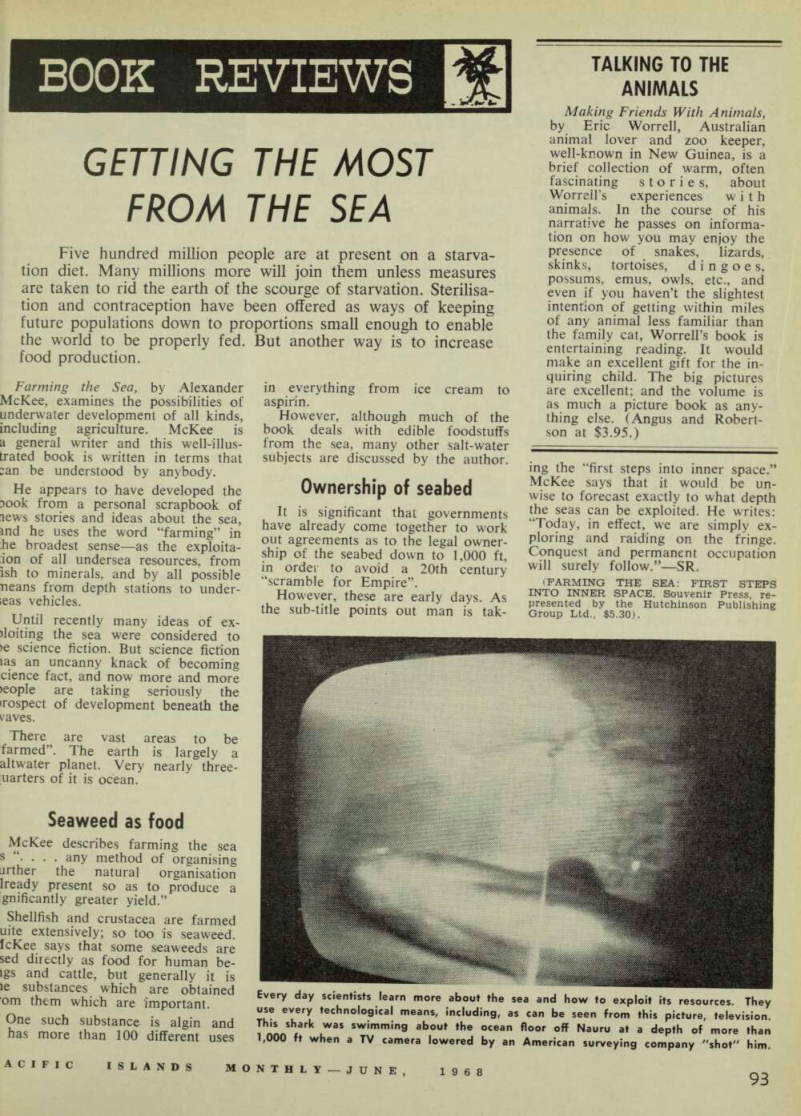
Every day scientists learn more about the sea and how to exploit its resources. They use every technological means, including, as can be seen from this picture, television.
This shark was swimming about the ocean floor off Nauru at a depth of more than 1,000 ft when a TV camera lowered by an American surveying company "shot" him.