From the Islands Press
pp. 71-72 · Read in the full issue
YAP HIGH SCHOOL students recently attended an assembly where the following question was asked: “If you were required to leave Yap today and board a giant rocket which would take you to Mars, and if you knew that you would never return, what ONE strictly Yapese thing, person, quality or custom would you take with you?”
Here are (some of) the answers they wrote: “I’ll take the custom of using my hands when I eat. I mean I’m not going to use a spoon or a fork. I can eat with a spoon or a fork, but sometimes I really want to use my hands. . .
“I want to take stone money.
Whenever I think of stone money, tears come down from my eyes “We are Yapese. Yapese want to chew betelnut while they are working, talking or just resting.
If we go to Mars we will have a lot of work to do. All of us will want to chew betelnut while we are working.”— ltem in “Moge thin”, Yap, Micronesia.
IT has always been a strange prerogative of yachtsmen that they zealously guard the right to hazard their own lives in their love of the sea.
Certainly our heritage would be the poorer without the peculiar British obsession of venturing out in great waters in small craft even as did, so recently, a very old and very brave and a very stubborn gentleman, who, for his incredible endurance, won the plaudits of the world and the accolade of knighthood.
It is now some three-and-a-half years since the recommendations were published of the Commission that was set up following the Kadavulevu disaster (89 lives were lost when the vessel sank in Fiji).
It is almost two-and-a-half years since the Governor, in his address to the Legislative Coun cil, said, “Next year the Depart ment of Marine, recommended by the Safety at Sea Commission, will be established. Once a Director of Marine has been appointed it will be possible to carry out the long overdue revision of our marine legislation and to imple ment many of the recommenda
tions made by the Safety at Sea Commission.”
I wonder how many of the people who travel by sea, or who find their livelihood upon our seas, realise, so far as our local ships are concerned: • That Fiji’s marine legisla tion is now among the most back ward in the Pacific. • That there is no legal re quirement for any ship, large or small, to carry radio, radar, or any other but the barest of naviga tional equipment.
By all means let us tighten up on marine safety. But let us put the emphasis where it is most urgently needed.
Until then, it may be melan choly reflection for those that go down to the sea in ships that there exists not one damned piece of new leglislation that would pre vent another 89 souls drowning to night in a second Kadavulevu. — Letter from C. D, Aidney in “The Fiji Times”, Suva.
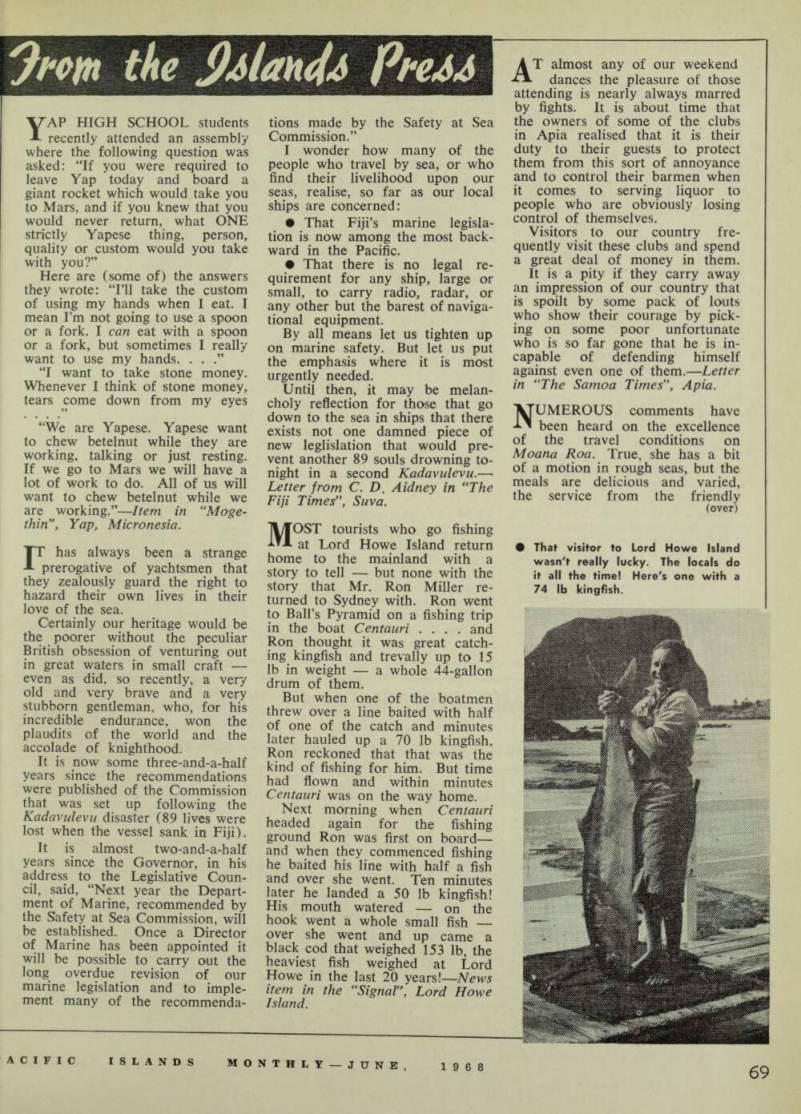
MOST tourists who go fishing at Lord Howe Island return home to the mainland with a story to tell but none with the story that Mr. Ron Miller re turned to Sydney with. Ron went to Ball’s Pyramid on a fishing trip in the boat Centauri ... and Ron thought it was great catch ing kingfish and trevally up to 15 lb in weight a whole 44-gallon drum of them.
But when one of the boatmen threw over a line baited with half of one of the catch and minutes later hauled up a 70 lb kingfish, Ron reckoned that that was the kind of fishing for him. But time had flown and within minutes Centauri was on the way home.
Next morning when Centauri headed again for the fishing ground Ron was first on board— and when they commenced fishing he baited his line with half a fish and over she went. Ten minutes later he landed a 50 lb kingfish!
His mouth watered on the hook went a whole small fish over she went and up came a black cod that weighed 153 lb, the heaviest fish weighed at Lord Howe in the last 20 years!— News item in the “Signal”, Lord Howe Island.
AT almost any of our weekend dances the pleasure of those attending is nearly always marred by fights. It is about time that the owners of some of the clubs in Apia realised that it is their duty to their guests to protect them from this sort of annoyance and to control their barmen when it comes to serving liquor to people who are obviously losing control of themselves.
Visitors to our country fre quently visit these clubs and spend a great deal of money in them.
It is a pity if they carry away an impression of our country that is spoilt by some pack of louts who show their courage by pick ing on some poor unfortunate who is so far gone that he is in capable of defending himself against even one of them.— Letter in “The Samoa Times”, Apia.
NUMEROUS comments have been heard on the excellence of the travel conditions on Moana Roa. True, she has a bit of a motion in rough seas, but the meals are delicious and varied, the service from the friendly (over)
• That visitor to Lord Howe Island wasn't really lucky. The locals do it all the time! Here's one with a 74 Ib kingfish.
officers, stewards, and crew is “just like home”.
The easy, informal approach aboard is decidedly pleasant after the regimen of the huge tourist ships, with the exception, per haps, of the luxury Matson vessels Mariposa and Monterey which rate very high in popularity with those who can afford to sail in them.
We once wrote about the Moana Roa as a “family ship”. Provided there’s a good crowd of passen gers aboard she makes “first choice” with most old island hands. —News item in the “Cook Islands News”, Rarotonga.
HOW comes it that so resplen dent a personage as the Dis trict Commissioner Northern is not illuminated by electricity after dark inside his Labasa resi dence?
It is thought to be sufficient for him, and for his adjacent officials, to enjoy the enchant ment of candles and moonlight while they deliberate upon the destiny of thousands. It is not very often the case that the Com missioner Northern is a caveman.
No offence, therefore, need be feared if plans are fulfilled for the exotic darkness to be pierced by a cautious shaft of civilisation.
It might be muttered that in tricate issues such as these are really rather better reserved for
Labasa residents alone; that it is not very plainly the province of hermits dotted about the bush to be poking their nose into conun drums of this kind. From such an opinion I would beg leave to deviate mildly.
There is not one inhabitant of the Northern District, where the Commissioner’s sway extends, who has not the right, if not to demand, to whisper at any rate, a desire for an exceedingly swift end to this absurdity. Letter from M. E. Basden in “The Fiji Times”.
American Samoa’s kvzk TV has an occasional pro gramme entitled “People” in which interesting people are inter viewed. ... A Samoan Marine sergeant with 22 years’ army ser vice was interviewed on his re turn from Vietnam. Highlight of the interview was his account of how he used a bush knife to de capitate a Viet Cong officer.
Columnist in the “Apia Adver tiser”, WHAT a disappointing and dis graceful sight is our newly created university.
It is an extension of discrim inatory practices which our uni versity professionals claim is only practised by a minority.
What utter nonsense! ...
They claim that they come up here to teach, to learn and to mix
with the indigenes. But as I see it, it is teach, plus enormous salary, then back home ...
There they are at Waigani, liv ing at least a mile from the local students and employees, creating a “little Australia” for them selves Surprisingly there is not even a union to get the whole univer sity together.
However it is not really sur prising. I remember one of the higher officials saying that these people (Papuans and New Guin eans) should not be given much responsibilities or chances because they would not use it responsibly —that is, according to the Euro pean standards I wonder if their graduates will be given greater chances. —Letter from G. Sino in the “South Pacific Post”, Port Moresby.
IT is my opinion that we should have both university graduates and tradesmen. At the present time there are very few natives qualified as tradesmen.
A university graduate is quite capable of performing his own job, be he a lawyer, doctor or what else. But is he capable of performing the job of electrician or a refrigerator mechanic?
At the present time the territory definitely needs skilled tradesmen more than university graduates.— Letter from “Spokesman” in the “South Pacific Post”, Port Moresby.