The Restless River: Where Has
pp. 54-57 · Read in the full issue

All The Business Gone?
By a special correspondent in the Sepik
Whether it is the slums on the outskirts of Hohola, Port Moresby, or the waterlogged villages of the far Sepik River, economic depression breeds political unrest. It is almost as if the national planners want it that way, as they proceed with their plans for the territory to progress as quickly as possible only in those areas where a minimum capital expenditure is needed.
There was a time, not long ago, when the Sepik looked like escaping the main dangers of this policy be cause of its strategic geographical position during the West Irian crisis.
The Australian military planners an nounced all kinds of ideas for air bases which would have meant an injection of capital and badly needed stimulation for the whole area.
But with the changes in Indonesia in the last year or two, and the possibilities of another communist coup becoming more remote, all these development plans have been shelved and the money which would have been spent in this depressed area is being directed towards status symbols and higher salaries in the main towns.
Dormant still
Thus the Sepik still lies dormant, with an expensive new string of un economic patrol posts along the West Irian border, a newly created army ghost town at Wewak, road and agriculture schemes held up for lack of money and equipment, its shipping anchored beyond the surf at Wewak for lack of berth and discharging facilities, the New Guinean and European inhabitants of the terri tory’s largest river area condemned to a life of frustration.
The river, meandering for 700 miles, dominates the Sepik district.
As with most areas of New Guinea land is always a problem, whether there is a shortage or not, and some effective form of land rationalisation must be introduced for effective cash cropping to be carried out. Land shortages and a lack of planning plague the river areas of the Sepik, its land lying for six months of the year under water, its 60,000 or so inhabitants eking out a living trad ing their fish and basketware for sago, meat and vegetables from in land tribes.
The coming of the European affected little the villager’s traditional way of life, except for his head hunting practices, until after World War 11, when the crocodile industry boomed.
From a $500,000 industry a few years ago on the Sepik, a shortage of crocodile skins today has brought the industry to near collapse.
The present unhappy, unprofitable situation is leading many European middlemen in Angoram to move out with the capital they have accumula ted in the “boom” years. Following them are the sawmillers.
Crocodiles finished
This state of affairs, brought about by a general shortage of quality skins and shortage of Administration timber purchase contracts, affects the European businessman little, as he can move at any time to more comfortable climes in Australia. But with this exodus goes the skills which operate the only effective means of transportation on the river—the out board motor.
There are over a thousand motors on the river and its tributaries—most of these native-owned, individually and communally. The simplest out
board motor to operate and repair is the 12 hp Archimedes motor of Swedish manufacture. Though most native operators can strip this motor down completely they are not usually able to comprehend enough of the delicate workings of the electrical system and relatively simple gearbox to enable repairs and re-assembly to be effective. Thus it falls on the European who has the workshop, skills and spare parts to repair these motors.
At the moment there are only two companies on the river able to repair Archimedes and these firms are usually only able to repair their own motor and motors of natives with whom they have favoured business dealings because the shortage of crocodile skins has meant that few natives can afford repairs.
Two years ago it was different.
Credit then was quite acceptable, but now there is no credit, few skins and thus fewer powered canoes plying the rivers.
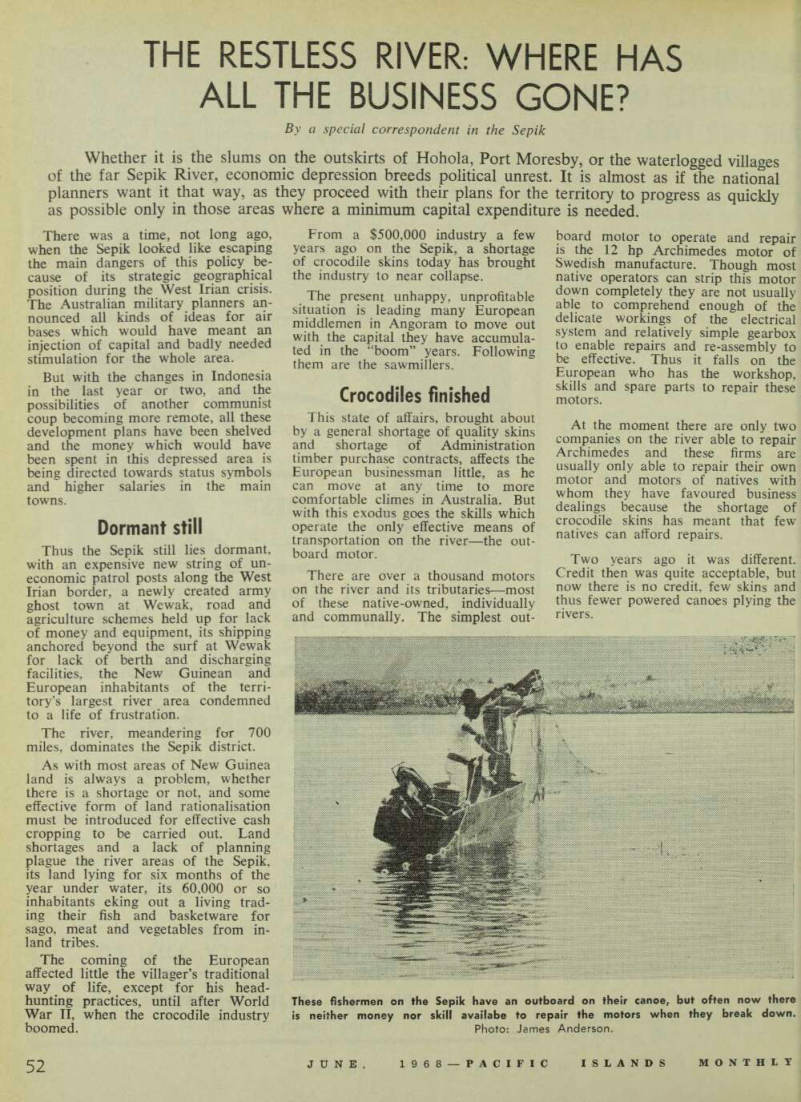
These fishermen on the Sepik have an outboard on their canoe, but often now there is neither money nor skill available to repair the motors when they break down.
Photo: James Anderson.
Almost a cargo cult
A glance at the Administration’s vorkshop at Angoram will serve to ndicate what poor maintenance does 0 transportation and the patrol >fficer’s budget, A breakdown of :ommunication between village and illage, village and trader through ack of spare parts, money and skills yill bring serious trouble. Already latives in some areas realise the fall »ff in skins is causing a series short ge of money and “business mastas” re being offered all sorts of in entives to set up businesses within he village—schemes so impracticable hat they are almost cargo cult.
With this growing state of ecession, there will be a proportion te increase in dissatisfaction with le Administration, European busi ess and the missions, all of which ave the “cargo” and facilities, and rill exchange them only for cash, dns or because there is a political mergency on the border.
This situation could be improved the Administration realised that le European is not in the country ) exploit. When, as so often happens 1 these times, the machinations of )me Administration officers cause le Administation to pit the tax ayers’ money against the efforts of niggling private enterprise, only arm results.
Feuding
There are, for instance, the activities F government-sponsored buyers’ übs which, originally created to give ation personnel access to consumer aods, have in some areas threatened ith total collapse private companies tempting to provide better services, nee Administration vessels carry eight free of charge and use risoners to handle non-Administra on cargo, then private enterprise iay as well give up. The recent uding over these clubs has already msed deep rifts.
It is too readily forgotten in bush eas where patrol officers believe icy are still master that the Public jrvice is a community service, and, ; in most countries, is expected to ■ovide services which cannot be ■ovided effectively by other means.
The one star on the horizon is ic potential of the tourist industry, ut for the Sepik River tourism re iires direction by those with an tpert knowledge of local culture id people. There is management Dtential on the river, but dwindling
profits have led to a lethargy which airlines and other outside tourist organisations are finding it difficult ' t ...
Politics are busy!
Politically, it can hardly be said that there is a lack of development on the Sepik. Every area of the middle and lower Sepik has, or is about to have, a local government council. Three councils have been planning amalgamation at Angoram, which will enable better planning with greater finances. The most likely project of the new council would be construction of a road into the fertile Marienberg Hills, and on to Wewak if need be. This would enable new farming and resettlement areas to be opened up.
If we are to look at the practical solution of the economic problems of the Sepik River, first and foremost there must be efficient transportation —for the villagers and business.
Lately there has been much
sans ■a
c^nTfor 11 suppts n,i " 1 Present transport problem of the Mapnk area could largely be
(Continued on p. 55)
solved by putting in an all-weather road to Pagwi on the river, thus avoiding the long road haul for locally produced rice and coffee to the inadequate port facilities at Wewak. With such reading facilities, and an easily constructed wharf at Pagwi, the movement of cargo to and from Madang could be greatly accelerated and so costly “backtrack ing” to Wewak would be avoided.
Certainly it would be cheaper in the meantime to open up Pagwi than :ontinue with the Wewak-Maprik Road.
In the House of Assembly last criticism was levelled at the Administration for the lack of overall planning in land resettlement schemes. Nowhere could a better jxample of Administration confusion n land resettlement be seen than hat at Gavien, four miles from \ngoram.
Unless there is a more positive ipproach by the Administration in ts efforts to assist and promote jrivate investment and local services, md unless the Sepik is sitting on a mineral fortune or can attract ourists, there are no ready-made ;olutions to the Sepik problem while msiness continues to deteriorate.
If the snake is allowed to continue o coil and recoil over 700 muddy niles, there is bound to be a whip ash effect somewhere.