Tropicalities
pp. 28-29 · Read in the full issue
If Fiji doesn’t end up with an international-sized tourist industry it won’t be for want of trying. In 1968 over 360 additional first-class hotel rooms will be available, which is more than is currently necessary. But plans are also in hand for getting people to Fiji to fill these—and more.
It is proposed to add another 4,000 feet to the main runway at Nadi International Airport bringing it up to 14,000 feet. This length is considered adequate for the largest jumbo-jet now due in less than three years, even taking into consideration the fact that Nadi is in the tropics and has some mountains in the back ground. The added length can be achieved with little trouble, having been provided for by good planning when Nadi was reconstructed for jets in 1958-59.
Large-scale modifications to the existing passenger terminal are also proposed. These will provide for aircraft parking stands into which planes come nose-first and passengers board from first-floor level directly through the front entrance of the aircraft.
This is already standard practice in many new overseas terminals and does away with passengers having to trudge across the tarmac in all sorts of weather, or having to be herded into buses to be taken out to waiting aircraft.
Standard practice
The new design for Nadi is, how ever, reasonably compact although planned to service several giant jets at once, so it shouldn’t be necessary, in the forseeable future, for pas sengers to have to walk literally half a mile or more along tiled corridors to get to the loading zone for their particular plane.
The worst examples of this sort of thing overesas are at Los Angeles and Orly in Paris where the loading bays are strung out across such vast distances that the use of motorised bath-chairs, roller-skates or moving footpaths seem logical if customers are not to drop dead from exhaustion while trying to get to their aircraft.
The new set-up at Nadi will pro vide for quicker and increased pas senger handling and as the planes will be loaded direct from first floor level, will get over the ridiculous
Fiji Prepares
For The
Jumbo Jets
architectural mistake made with the present terminal, where all arriving passengers have to climb to first level for health and migration and then climb down again for Customs inspection.
The cost of the new modifications at Nadi will cost approximately £F4 million, which is the sum that was spent in 1958-59 in building the existing terminal and facilities and bringing the main runway to jet standard. The cost will be borne by the South Pacific Air Transport Council (United Kingdom, Aus tralia. New Zealand and Fiji), which has the job of promoting civil avia tion in the South Pacific.
It is expected that the modified Nadi will be ready when the jumbo jets start flying the Pacific around September-October, 1971.
More operators
By then, of course, not only will the aircraft have about three times the capacity of present international jets, but it is likely that there will be many more operators. Most Ame rican visitors to Fiji today come from Pacific Coast airports. The allocation of Pacific routes to ad ditional United States operators earlier this year provides new re servoirs of possible customers be cause these services will originate in inland cities of the United States.
Eastern Airlines, for example, has been given several services from in land States which include either Papeete or Nadi (see p. 47).
Most aviation predictions sound like science-fiction, at the time they are made. But at the rate develop-
merits are taking place in this field, the three years that SPATC has allowed for making-over Nadi is going to be none too long.
The air battle
for Tonga
THERE is another important de velopment in Pacific aviation in the offing. Much to the chagrin of the British Government, Tonga looks like starting its first internal air ser vice on July 4, using the small, Fiji based air service. Air Pacific Ltd.
In late May, it was an odds-on bet that Air Pacific would get the final go-ahead from the Tongan Govern ment to make the first scheduled flight from Tongatapu to Vavau, probably with a Beechcraft, Running Tonga’s internal air ser vices could in the long term be a fat prize for the young Fiji firm, because King Taufa’ahau may insist on overseas air rights for the king dom’s airline after Tonga becomes fully independent soon. Thus over night a new international airline could be created.
Britain, of course, can see the danger to the already-established Government airlines in the area.
Despite a decision in April by Tonga’s
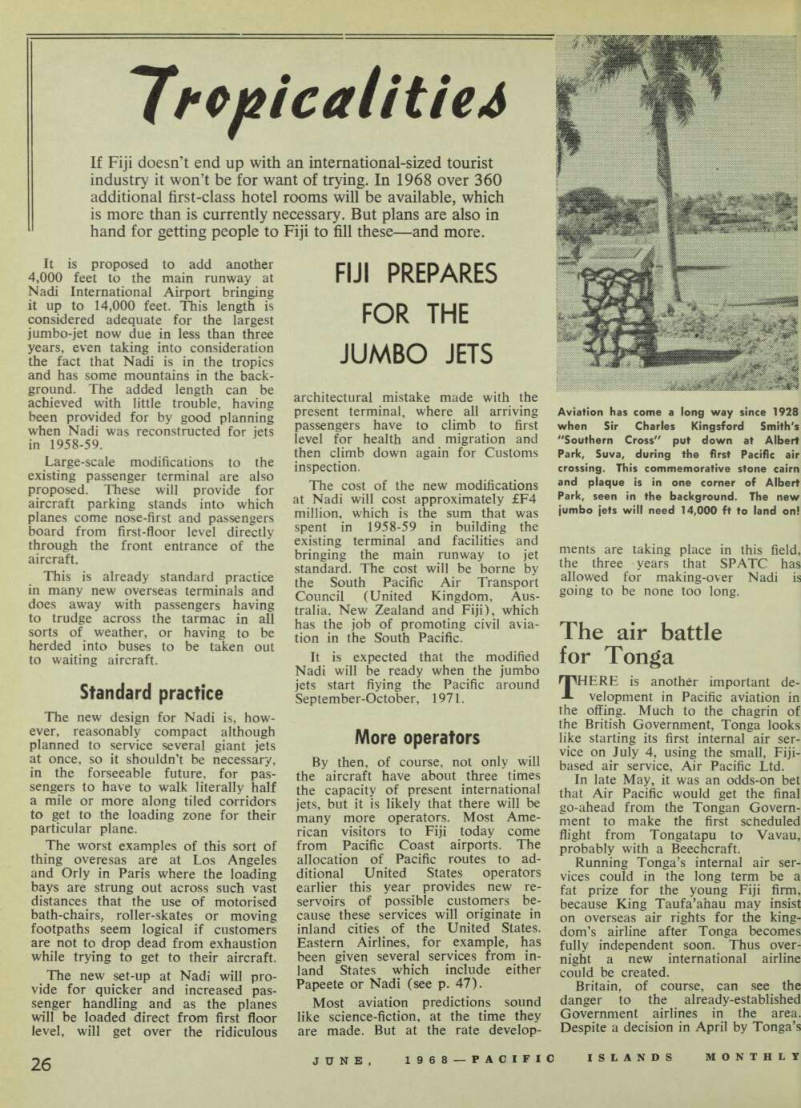
Aviation has come a long way since 1928 when Sir Charles Kingsford Smith's "Southern Cross" put down at Albert Park, Suva, during the first Pacific air crossing. This commemorative stone cairn and plaque is in one corner of Albert Park, seen in the background. The new jumbo jets will need 14,000 ft to land on!
Cabinet to accept in principle Air Pacific’s proposal to run its internal nr services, Britain, acting through "iji Airways, and Qantas made tough, >ehind-lhe-scenes moves in May to lave the decision revoked. Britain vants Fiji Airways to run the ser vice and so keep a hand on Tongan iviation and prevent anyone else noving in. But the British moves ippear to have annoyed the Tongans, vho covet their independence.
It’s an interesting battle.
Leading light behind Air Pacific s Fiji planter J. L. P. (for Pat) rlacassey, who has the support of number of leading Fiji business len, including Sir Maurice Scott, 'here was a change in the sharehold ng in May, and in came Hawker de lavilland (Aust.) Pty Ltd., with a linority shareholding. They are istributors of Beechcraft light air raft. De Havilland can see the ommercial opportunities for them f Pacific airline development, and Iready have a minority shareholding i Macair Charters Pty. Ltd., of New juinea. This company has just ought Megapode Airways, in the lolomons, and renamed it British olomon Airways Ltd.
Barefoot on the
VG trail
3Apua-New Guinea Has A
L barefoot patrol officer. At least, hat was the position at last report.
He is Cadet Patrol Officer |arry Arnold, 20, one of the ix young Australian Government fficers running the Kiunga Sub istrict 8,000 square miles con fining 20,000 native people—in re Western District of Papua.
CPO Arnold, the son of a Qantas ilot, says he discovered in his first -w weeks in the territory that boots nd socks are a refuge for leeches, d he got rid of his footwear.
He says he finds it easier now to :ay upright on greasy jungle paths, nd on the treacherous single-log ridges in the Kiunga area.
However, Arnold went home to Brisbane on leave recently and West rn District Commissioner Allen ensted has since said he has rdered him to wear boots or shoes t all times in future.
Government attitude is that Arnold lould protect his feet with boots, nd for the sake of the prestige of le service, must NOT appear on uty at the Kiunga Subdistrict ffice, without shoes or boots.
It seems that DC Bensted sent ut his order to CPO Arnold on the 'Cond day of the annual District commissioner’s conference in Port Moresby. The report is that the
other District Commissioners gave Mr. Bensted a hard time, with unmerciful “ragging”, so the order went out, a s keen no comment from Arnold, who is no doubt enjoying ms leave.
T'v i . i i
UUKe notes me bad
nnrl thf* hpcnififnl
tilt. ucdULUUI NORFOLK Island’s Cascade Bay clifftop road and the island’s shopping centre both were the subject of the Duke of Edinburgh’s notorious wit during his two brief stopovers on Norfolk in May, en route between Australia and New Zealand.
Despite the sudden torrential rain the night before—which many Islanders feared might cancel the call altogether—Prince Philip landed an Andover of the Queen’s flight on Norfolk’s airstrip in sparkling, sunny weather on May 20 (he likes to take the controls as often as he can).
After being personally greeted by a dozen or so Islanders, the Duke, accompanied by the Administrator, Mr. Reg Marsh, was whisked by car to .~^ ed P° ad > ° n a site right at the cliff edge overlooking Cascade Bay.
There, the Duke was asked to unveil a solid stone structure. Pointmg to it, he said: I don’t know what’s under here, but I know it will serve a useful purpose. If someone comes around
the corner too fast it will save him going into the sea. Perhaps we will have to increase the wall around here a little bit to stop them going over.”
The Duke then pulled away a flag to expose a large plaque inscribed “Prince Philip Drive”, which is now part of an area of the island con trolled by Norfolk’s Flora and Fauna Society.
Later, at a reception elsewhere on the island Prince Philip said; “And what, have you done since I was here las iT , . , 4 , Then ’ gesturing at Burnt Pines ever-growing numbers of gaudily coloured shops and stores just up the road ’ he added: “This sort of thing!”
Diplomatically, the Duke didn’t elucidate. His point, which has been continually made over the past 18 months by Islanders and visitors, who complain of the growing ugliness of the island’s commercial centre, had surely gone home,
A first for
1 1 Aui A
is in the process of estab lishing its first botanical garden.
It is of six acres not far from the Dateline Hotel on the Nukualofa waterfront. Mr. J. Clarke, a retired parks supervisor and horticulturist from New Zealand, has been engaged by the government to carry out the project, and already he has trans formed this once vacant area.
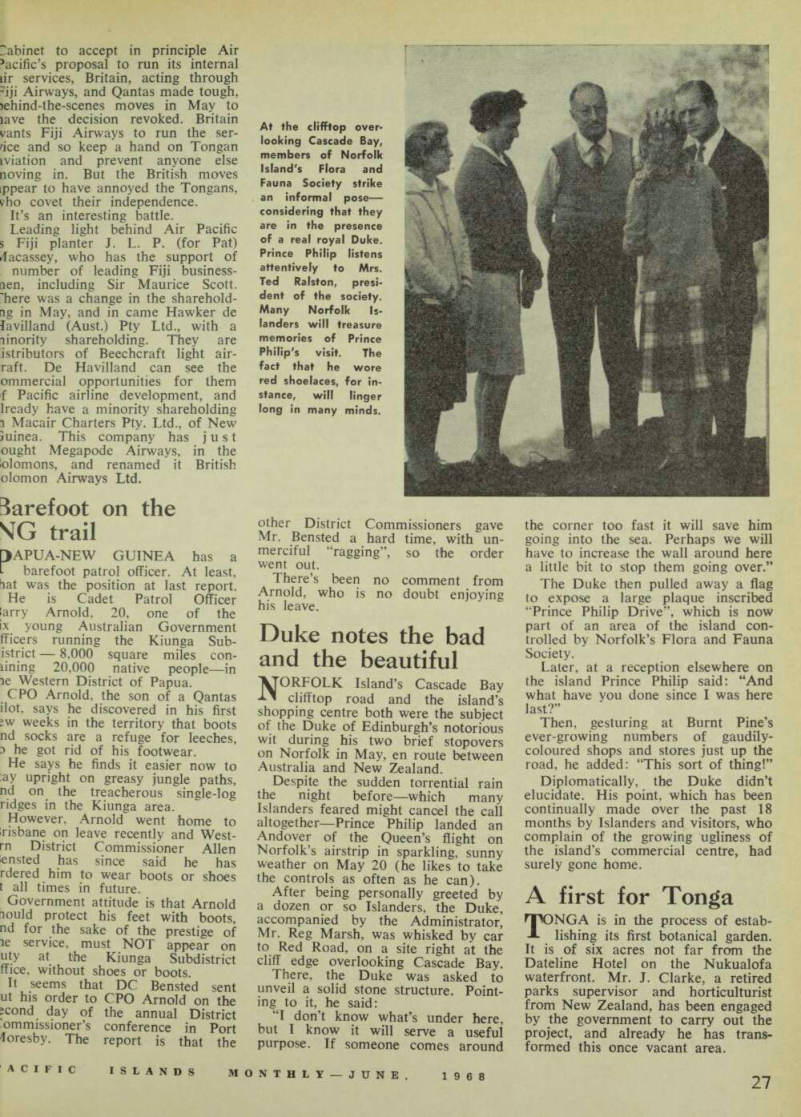
At the clifftop over looking Cascade Bay, members of Norfolk Island's Flora and Fauna Society strike an informal pose — considering that they are in the presence of a real royal Duke.
Prince Philip listens attentively to Mrs.
Ted Ralston, presi dent of the society.
Many Norfolk Is landers will treasure memories of Prince Philip's visit. The fact that he wore red shoelaces, for in stance, will linger long in many minds.