Cooks with a bang
pp. 26-27 · Read in the full issue
Albert Henry hack in the Cooks with a bang
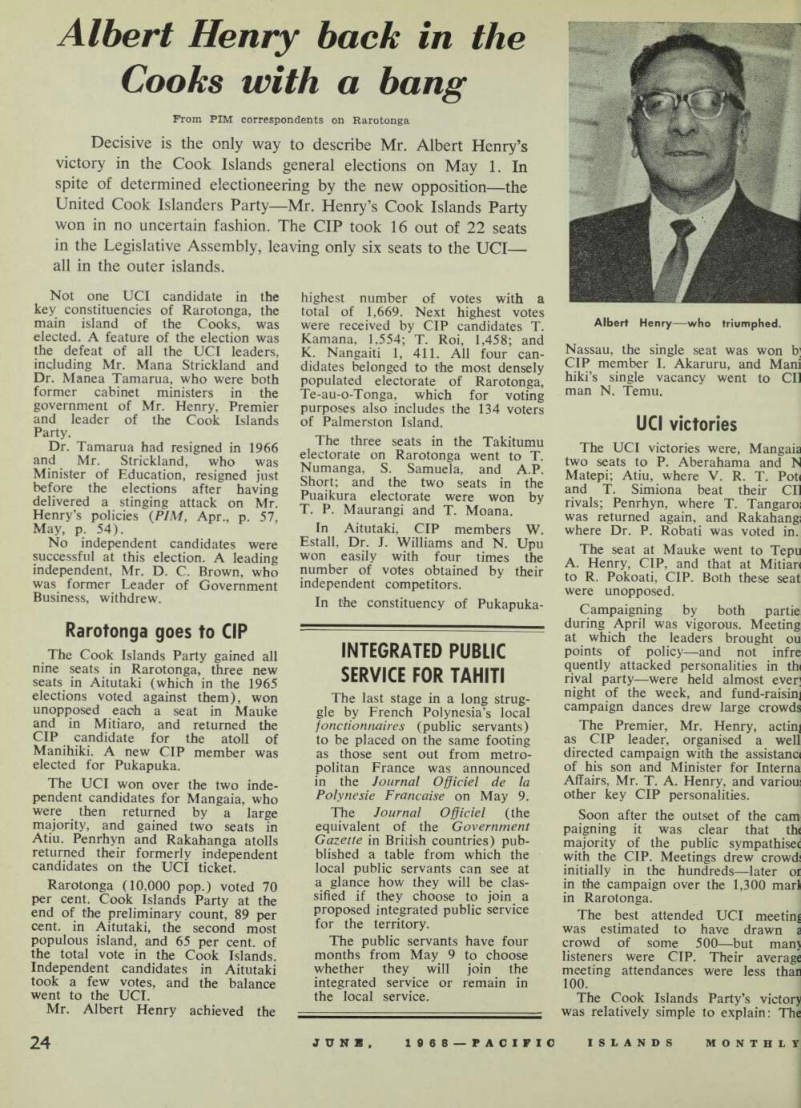
From PIM correspondents on Rarotonga Decisive is the only way to describe Mr. Albert Henry’s victory in the Cook Islands general elections on May 1. In spite of determined electioneering by the new opposition—the United Cook Islanders Party—Mr. Henry’s Cook Islands Party won in no uncertain fashion. The CIP took 16 out of 22 seats in the Legislative Assembly, leaving only six seats to the UCl— all in the outer islands.
Not one UCI candidate in the key constituencies of Rarotonga, the main island of the Cooks, was elected. A feature of the election was the defeat of all the UCI leaders, including Mr. Mana Strickland and Dr. Manea Tamarua, who were both former cabinet ministers in the government of Mr. Henry, Premier and leader of the Cook Islands Party.
Dr. Tamarua had resigned in 1966 and Mr. Strickland, who was Minister of Education, resigned just before the elections after having delivered a stinging attack on Mr.
Henry’s policies {PIM, Apr., p. 57, May, p. 54).
No independent candidates were successful at this election. A leading independent, Mr. D. C. Brown, who was former Leader of Government Business, withdrew.
Rarotonga goes to CIP
The Cook Islands Party gained all nine seats in Rarotonga, three new seats in Aitutaki (which in the 1965 elections voted against them), won unopposed each a seat in Mauke and in Mitiaro, and returned the CIP candidate for the atoll of Manihiki. A new CIP member was elected for Pukapuka.
The UCI won over the two inde pendent candidates for Mangaia, who were then returned by a large majority, and gained two seats in Atiu. Penrhyn and Rakahanga atolls returned their formerly independent candidates on the UCI ticket.
Rarotonga (10,000 pop.) voted 70 per cent. Cook Islands Party at the end of the preliminary count, 89 per cent, in Aitutaki, the second most populous island, and 65 per cent, of the total vote in the Cook Islands.
Independent candidates in Aitutaki took a few votes, and the balance went to the UCI.
Mr. Albert Henry achieved the
highest number of votes with a total of 1,669. Next highest votes were received by CIP candidates T.
Kamana, 1,554; T. Roi, 1,458; and K. Nangaiti 1, 411. All four can didates belonged to the most densely populated electorate of Rarotonga, Te-au-o-Tonga, which for voting purposes also includes the 134 voters of Palmerston Island.
The three seats in the Takitumu electorate on Rarotonga went to T, Numanga, S. Samuela, and A.P.
Short; and the two seats in the Puaikura electorate were won by T. P. Maurangi and T. Moana.
In Aitutaki, CIP members W.
Estall, Dr. J. Williams and N. Upu won easily with four times the number of votes obtained by their independent competitors.
In the constituency of Pukapuka-
Nassau, the single seat was won b] CIP member I. Akaruru, and Mani hiki’s single vacancy went to CII man N. Temu.
UCI victories
The UCI victories were, Mangaia two seats to P. Aberahama and N Matepi; Atiu, where V. R. T, Pot« and T. Simiona beat their CII rivals; Penrhyn, where T. Tangaro; was returned again, and Rakahangi where Dr. P. Robati was voted in.
The seat at Mauke went to Tepu A. Henry, CIP, and that at Mitian to R. Pokoati, CIP. Both these seat were unopposed.
Campaigning by both partie; during April was vigorous. Meeting at which the leaders brought ou points of policy—and not infre quently attacked personalities in th< rival party—were held almost ever] night of the week, and fund-raisinj campaign dances drew large crowds The Premier, Mr. Henry, acting as CIP leader, organised a well directed campaign with the assistant of his son and Minister for Interna Affairs, Mr. T. A. Henry, and variou! other key CIP personalities.
Soon after the outset of the cam paigning it was clear that the majority of the public sympathiser with the CIP. Meetings drew crowds initially in the hundreds—later or in the campaign over the 1,300 marl in Rarotonga.
The best attended UCI meeting was estimated to have drawn a crowd of some 500—but manj listeners were CIP. Their average meeting attendances were less than 100.
The Cook Islands Party’s victory was relatively simple to explain: The
Albert Henry—who triumphed.
Interest in opposition
CIP had, in its three years as govern ment, done enough for the average Cook Islander to win his loyalty and support. Housing, electric power, water systems, roads, agricultural machinery, improved shipping serv ices—these are the things in which the CIP Government was able to assist the majority over the past three years. The average voter was ap parently enough satisfied with things accomplished in the islands to re ject the government which had led the islands into self-government.
Albert Henry, minutes after the HP victory was announced over he radio, made a short speech of hanks to the crowd outside the allyroom and a huge crowd spilled >ver to his home, where he and his candidates were deluged with lower ’eis, handshakes, and messages >f goodwill.
Orderly poll
As during the previous general lections in April, 1965, the evening >f polling day on Rarotonga was a ret one, and a crowd gathered in be rain to watch the results chalked p on the big result boards placed efore the old Administration build igs in Avarua. At every CIP victory 'omen shrieked and danced with lee. The polling had been orderly nd there were no fights or other icidents.
Mr. Henry in his address to the 'owd, thanked them “for giving le party another chance”.
He said the CIP honestly believed could do what it promised it would 0 during the campaign—if not Liickly then eventually. To the jople standing in pouring rain he ided, “I think if I keep on speaking may cry. The feelings are too rong in me”.
The crowd gave him three cheers.
Immediately after the elections e main interest was in which of e six members of the Opposition ould be elected leader now that 1 the leading UCI candidates have :en defeated.
The Opposition consists of jpuke Robati, Vaine Rere, Tangata miona, Tangaroa Tangaroa, Nga puna Matepi and Pokino Abera ima.