Everybody's In Town As
p. 24 · Read in the full issue
P-Ng Launches It's Larger
Than-Life-Size Assembly
From a Port Moresby correspondent Papua-New Guinea’s brand new, larger-than-life-size, 94 man (and no women) House of Assembly gets going on June 4, and the big event —to be launched by Australia’s Governor- General, Lord Casey—is being preceded by a general flurry of political and academic activity in the territory’s capital.
There is surely not a spare bed to be found in Port Moresby as the 22 old hands and 62 “new boys” in the House assemble the week previous to the opening session for something which has been ominously described as a “briefing”.
Overlapping the “briefing”, as well as the first meeting of the House, there is a big seminar—the Second Waigani Seminar—on the history of Melanesia. This seminar, organised by the P-NG University, the Aus tralian National University, the P-NG Administrative College and the Council on New Guinea Affairs, has assembled a galaxy of talent.
Distinguished
Two former Administrators, as well as academics, missionaries, public servants and politicians, will be among the 36 speakers and presenters of papers.
One might have hoped that such a distinguished consortium of learned bodies would have been able to avoid choosing a time when so many of those who would have liked to learn more about the history of their country will be engaged in making it. But so be it.
As far as the pre-Assembly “briefing” is concerned, some of the old hands are wondering if “briefing” is a polite term for brain-washing, and would have preferred something more on the lines of the pre-session seminar of 1964, which was con ducted by the head of the New Guinea Research Unit of the Aus tralian National University.
In 1968, with our own university in being, it should have been even easier than it was in 1964 to arrange a seminar run by a well-clued out sider with no axes to grind. How ever, members will now have to make the most they can of the fare pro vided.
The “briefings” will take place in
the House itself, but the members will be housed at the Administrative College, and perhaps the informal discussions which take place there in the evenings will be more fruitful than the formal sessions during the day. It will be there, almost certainly, that the vexed question of the Speakership will be thrashed out.
Rehearsed
Four years ago it was at the pre- Assembly briefings that the Speaker ship was decided. But now the obvious choices are not available.
Until the new members begin to swap opinions there is no tipping how the cat will jump. Mr. Noel Casey is reported to be very in terested. Roy Ashton and Percy Chatterton might be reluctant starters if they were pressed hard enough.
The “brief’ will reach its climax on June 3, when the members will be rehearsed in the required rituals for the formal opening by the Governor-General, Lord Casey, which will take place on the following day.
On the morning of that day the House will meet for the election of the Speaker (whose actual selection should have been accomplished dur ing the previous week), and at 2.30 in the afternoon Lord Casey will formally open the First Session of the Second House of Assembly.
As in 1964, authority has not
considered this a sufficiently impor tant day in the life of the territory to be declared a public holiday. Anc perhaps authority is right, since t( some observers here the recentb enacted amendments to the Papuj and New Guinea Act take a hesitat ing step forward towards self government followed by two smar paces backward.
The step forward is the provisioi for the appointment of “ministeria members”, who will also be member of the Administrator’s Executive Council, and “assistant ministeria members”, who will not be notice ably different from the last House’ under-secretaries. And it may fairb be described as hesitating, since th< functions and powers of these gentle men are not, as one would hav< hoped, spelled out in the Act. The] are to be as determined from tinn to time by the Minister, who wil thus be able to bring the occupant of these offices to heel if they shov too much initiative.
The two paces backward are th< vesting in the Governor-General o the power of partial as well as tota veto of ordinances enacted by th< House, and the vesting in the Admini strator of the power to tell th( Speaker of the House what the orde of priorities is to be in the trans action of its business.
These two retrograde steps sugges that even the establishment of i phony ministry has caused Canbern to panic.
The Minister explained to th< House of Representatives that th< first of these two provision “simplifies the situation”. Experience< members of the House of Assembh are already asking, “Simplifies it fo: whom?”
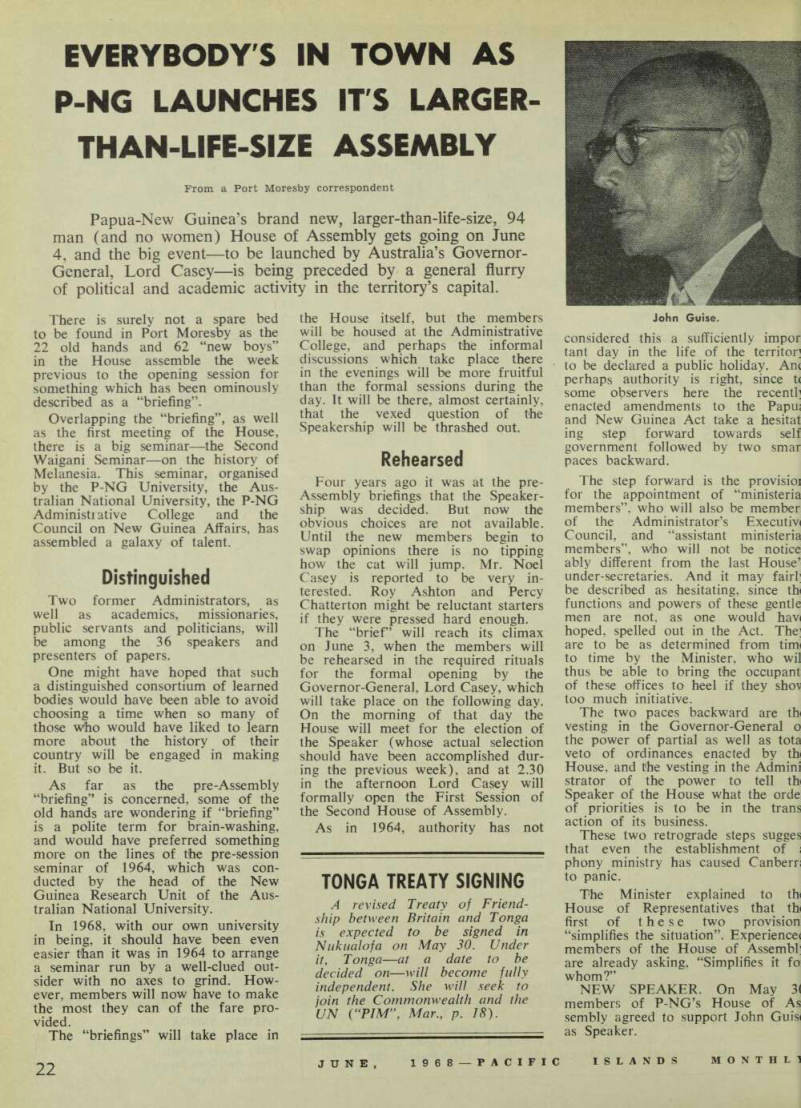
New Speaker. On May 3(
members of P-NG’s House of As sembly agreed to support John Guis< as Speaker.
John Guise.