Leisurely flying-boat helped
pp. 89-91 · Read in the full issue
Book Reviews
Leisurely flying-boat helped build airline's reputation
During the early days of the Pacific war, two Qantas pilots flew out-of-date DHB6 biplanes behind the Japanese lines in New Guinea to rescue 78 people stranded on the Mount Hagen Plateau.
The details of this exploit are given in one of many similar stor ies in Qantas at War, a book which traces the history of the airline from 1934-1945. Written by Sir Hudson Fysh, who directed Qantas during the period, it is the second volume in a three-volume history of Qantas. The first was Qantas Rising.
Qantas at War is divided into three main sections: Australia’s First International Air Service The DHB6 Era; Enter the Flying boat Era; and The War Era.
The title of the book is apt, for Qantas was always involved in some fight or other during those hectic years, and Sir Hudson, who knew exactly what was going on in the air, on the ground and behind the scenes at the time, records them all.
Flying-boat era
The combining of Qantas and Imperial Airways in 1934 was Aus tralia’s first step into the field of international air transport where to day Qantas is one of the world’s leaders. It also ushered in the fly ing-boat era.
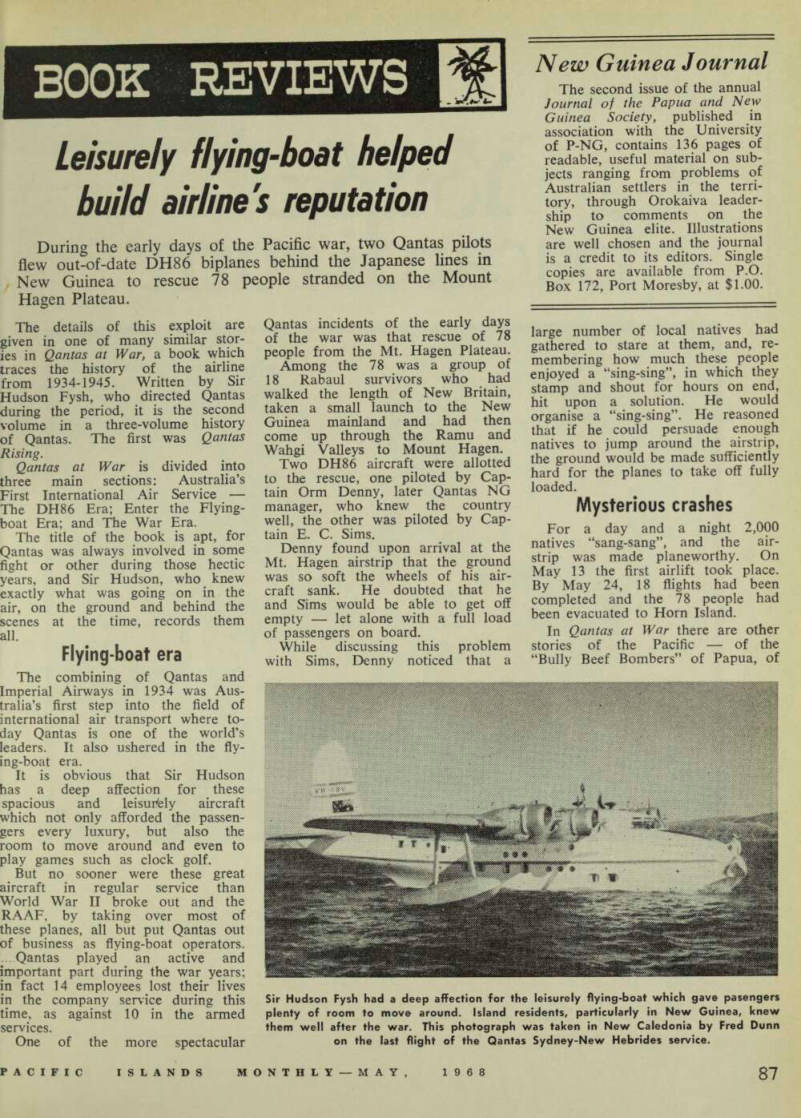
It is obvious that Sir Hudson has a deep affection for these spacious and leisurely aircraft which not only afforded the passen gers every luxury, but also the room to move around and even to play games such as clock golf.
But no sooner were these great aircraft in regular service than World War II broke out and the RAAF, by taking over most of these planes, all but put Qantas out of business as flying-boat operators. ; . Qantas played _an active and important part during the war years; in fact 14 employees lost their lives in the company service during this time, as against 10 in the armed services.
One of the more spectacular
TZ “
78 M waf f
18 Rabaul survivors who had walked the length of New Britain, taken a small launch to the New Guinea mainland and had then come up through the Ramu and Wahgi Valleys to Mount Hagen.
Two DHB6 aircraft were allotted to the rescue, one piloted by Captain Orm Denny, later Qantas NG manager, who knew the country well, the other was piloted by Captain E. C. Sims.
Denny found upon arrival at the Mt. Hagen airstrip that the ground was so soft the wheels of his aircraft sank. He doubted that he and Sims would be able to get off empty let alone with a full load of passengers on board.
While discussing this problem with Sims, Denny noticed that a
large number of 1-aI had P-ple enjoyed a sing-sing , iin w ic t ey stamp and shout for hours on end hit upon a solution. He 'would a s“f-smg • He reasoned tf >a‘ if he could persuade enough natives tO . ) um P around the a.rstnp. the ground would be made sufficient y hard for the planes to take off fully loaded.
A/lysteriOUS Crashes
. u . For a day and a night 2,000 natives sang-sang , and the air strip was made planeworthy. O May 13 P !2l« May ac completed and the 78 people had been evacuated to Horn Island, In Qantas at War there are other stories of the Pacific of the “Bully Beef Bombers” of Papua, of
Sir Hudson Fysh had a deep affection for the leisurely flying-boat which gave pasengers plenty of room to move around. Island residents, particularly in New Guinea, knew them well after the war. This photograph was taken in New Caledonia by Fred Dunn on the last flight of the Qantas Sydney-New Hebrides service.
evacuating the wounded and flying in supplies to the island battle fronts.
However, the major part of the book does not deal with Pacific affairs.
The mysterious crashes involving several of the DHB6 aircraft are covered early in the book.
Another interesting story is the selection of the aircraft for the England-Australia air-link, and the survey flights that were necessary before it could become a regular passenger and mail route. (Do you remember those days when an Air Letter could be sent anywhere in the British Commonwealth for a lid?) The book ends with Qantas fac ing, and overcoming, the vast pro blems of re-organisation after the war, and it is a tribute to Sir Hud son Fysh and the men who worked with him that they succeeded so admirably.
It was at this time that the Cata lina, Lancastrian and the C 47, forerunner to the immortal DC3, were introduced into the Qantas
service.-
WT
(QANTAS AT WAR. Angus and Robert son, Sydney. $6.75.)