yesterday
p. 87 · Read in the full issue
The South Pacific Commission, set up in 1947 by Britain, France, Holland, New Zealand, Australia and the United States to co-ordinate administrative policy in their South Pacific territories, held its first meeting in Sydney just 20 years ago this month. Delegates from the six mem ber nations heard a powerful address by the Rt. Hon. H. V.
Evatt, PC, MP, the originator of the plan for the Commis sion, in which he said: <( Here, in this new Commission, is one practical expression of international co-operation and goodwill, to function in a world that is literally crying out for co-operation and goodwill.
THIS was one news item in PIM for May, 1948. Other items in that issue were:— THE New Zealand Prime Min ister, Mr. Frazer, formally opened the first session of the Legislative Assembly of Western Samoa. The Assembly, which took the place of the Legislative Council, was described in New Zealand as “a new step forward in the gradual process of confer ring self-government on the Samoans.”
“ A USTRALIAN Insult To Poly nesians,” declared PIM in a headline—and the Australian Min ister for Immigration, Mr.
Calwell, was under fire. Mr.
Calwell had said in Parliament that a Maori soldier married to an Australian girl would not be allowed to settle in Australia. He was immediately attacked both in Australia and New Zealand. Some people suggested that he was abusing the White Australia Policy.
The furore caused by Mr. Calwell’s statement was so great that Aus tralia’s ban on the Maori in question was lifted.
A “gold discovery” in Central New Guinea, near Wabag, was reported to be a wash-out. The Leahy Brothers were said to have gone into the area from Mount Hagen in March or April, and to have returned with the news that the gold-bearing area was small and not rich. However, some people in Port Moresby were sceptical about this report. They pointed out that prospectors who have made a rich discovery will sometimes circulate stories of a failure in order to discourage a rush—which, as it turned out, was an undeserved slur on the prospectors in question.
(Governor-General Parisot
J retired as Governor of New Caledonia after less than 18 months on the island. He was re placed by Govemor-G eneral Cournarie. PIM observed: “In re cent years a new Governor for New Caledonia has been almost a yearly event.”
NEW GUINEA suffered its worst air disaster on April 18 when a Lockheed Hudson, under charter to New Guinea Air Traders, crashed shortly after leaving Lae, killing 37. Four of the dead were crew members; the remainder were native labourers being carried to the goldfields as freight—at 3d a pound. The fact that the natives were carried as freight (the plane was not licensed for passengers) angered many Australians, and an immediate investigation was pro mised.
A SMILING and fit Queen Salote returned to Tonga after a five-month health visit to New Zealand. Among the many people who welcomed the Queen were Crov/n Prince Tupooto’a-Tungi, and Prince Tu’i Pelehake.
ONE of Fiji’s most memorable cricket seasons ended with a one-day match between Fiji (just back from a New Zealand tour) and the Rest of Fiji. Fiji thrashed the Rest, despite the fact that the star of the New Zealand tour, Ilekena Bula, as well as other top line Fiji players, had returned home to outlying parts of the group.
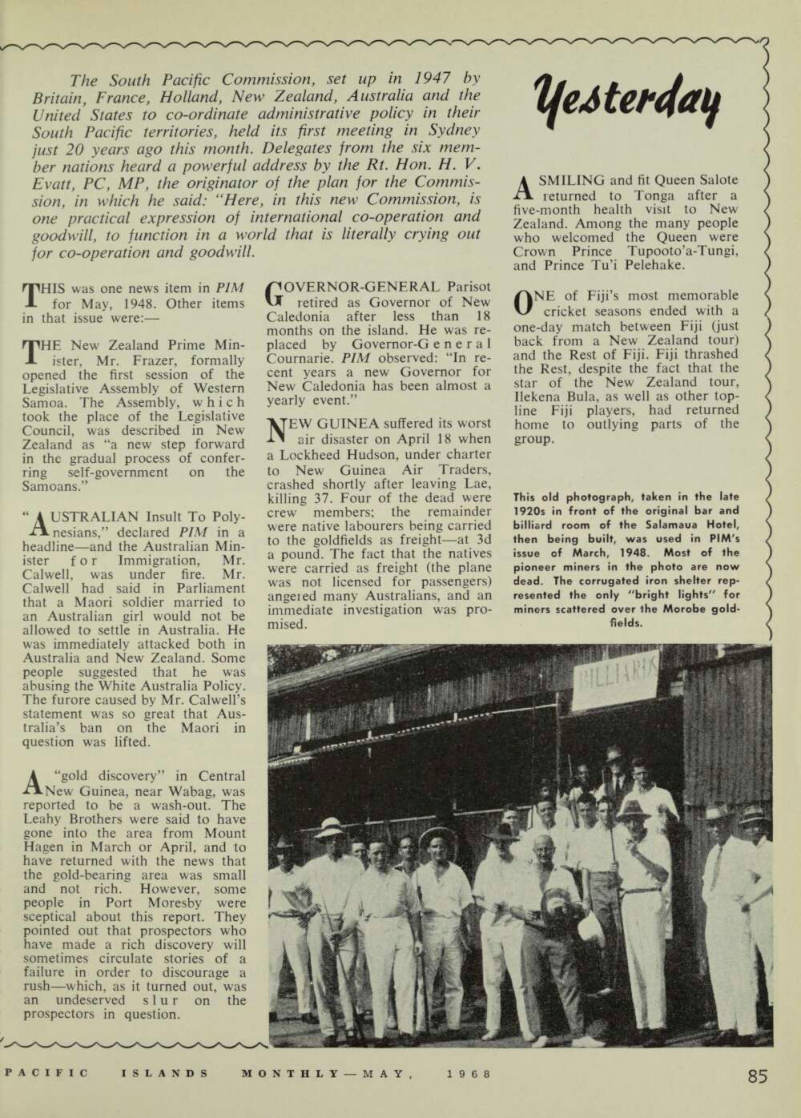
This old photograph, taken in the late 1920s in front of the original bar and billiard room of the Salamaua Hotel, then being built, was used in PIM's issue of March, 1948. Most of the pioneer miners in the photo are now dead. The corrugated iron shelter rep resented the only "bright lights" for miners scattered over the Morobe gold fields.