What You Should Know
pp. 143-147 · Read in the full issue


The Practical Planter
About Soils
Compiled by the Editor of “Power Farming” Magazine, Sydney.
Some fundamental knowledge of soil structure, together with an understanding of the importance of organic material and crop residue treatment, and the role of micro organism activity in the soil, provides a basis for a wise choice and use of tillage machinery.
.S A R E composed of aggregates articles which contain both solid inal and spaces called voids. ;e aggregates may be subdivided their constituent particles by iical and mechanical means. n the constituents retain their ical and chemical identity and ot be subdivided further they are d ultimate particles. Usually ' aT 9 . non -P° r ous and have actenstic crystal structures. timate particles differ in shape size as well as in composition, for each soil they collectively ;itute an unchangeable characterwhich allows soil to be compared, Strurtlirp ic Imnnrtant aiFUCTUre IS important 1 soils may be defined in terms e range of sizes of their ultimate :les, and soil structures describe ispects of the size, shape and igement of the soil particles and . Structure is important in its on the growth of plant because tie direct relationships between percentages of solid, liquid, and
gas aeration, water movement, and root penetration. Soil structure is a dynamic aspect of the soil, which varies with moisture content and vegetation, and which may be modified by cultivation.
The strength properties of soils are a result of structure, particle size distribution, and the physio-chemical properties of the soil colloids. They affect the ease with which soil can be cultivated, and the mechanical strength of agriculturally important structures, such as dams and embank ments. They also have a direct effect on the ability of soil inhabiting organ isms to move through the soil. Con sistence describes the mechanical behaviour of the soil when worked.
Crumbly consistence, which coincides a limited moisture content range is agriculturally desirable.
Structure develops in field soils by different processes and some produce smaller aggregates and pores than
others. Each microclimate, type of vegetation, and form of management produces its characteristic structure.
For example, alternate freezing and thawing produces a satisfactory structure for seedbeds in a field rough ploughed at the start of cold winters.
This is associated with ice crystals shattering the large, moulded aggregates produced by cultivation in wet conditions.
Shrinking and swelling also de velops structural units, as in the so called “self-mulching” soils. These often have a highly developed structure of loose granules and large pores in the surface horizons.
Vegetation also develops structure both by the mechanical action of roots, and by adding organic matter from which micro-organisms produce organic substances that stabilise aggregates produced mechanically.
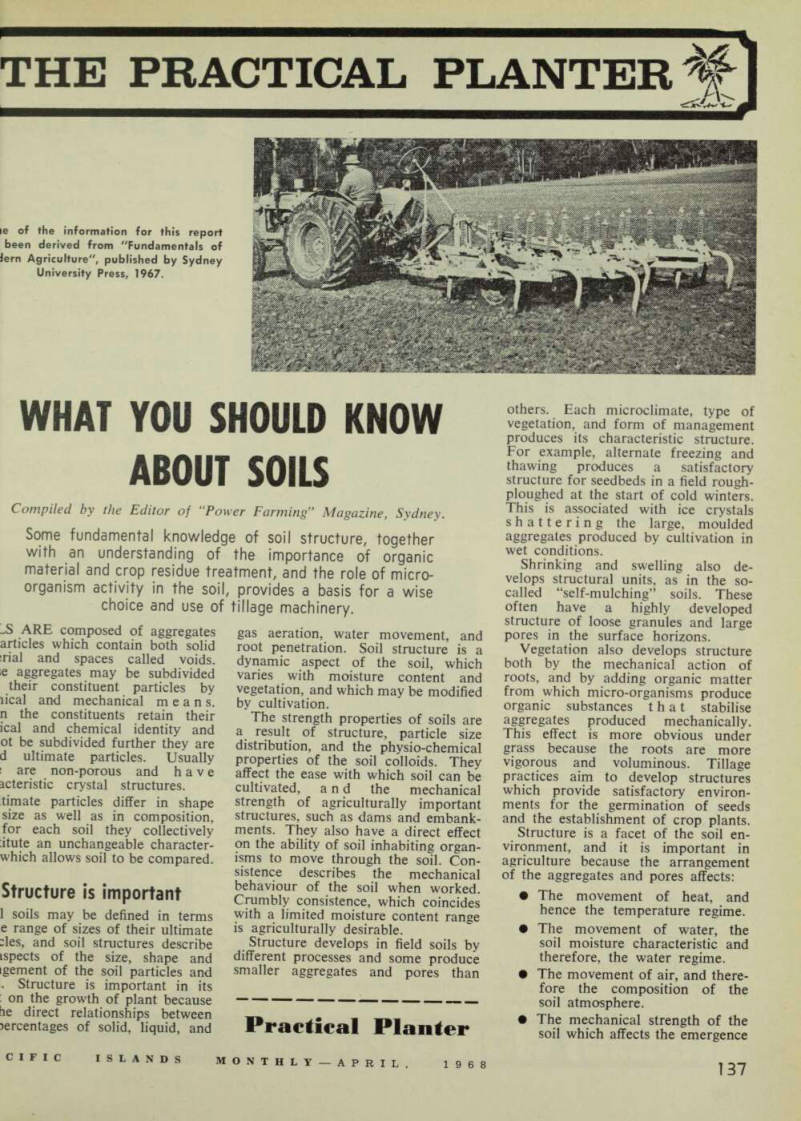
This effect is more obvious under grass because the roots are more vigorous and voluminous. Tillage practices aim to develop structures which provide satisfactory environ ments for the germination of seeds and the establishment of crop plants.
Structure is a facet of the soil en vironment, and it is important in agriculture because the arrangement of the aggregates and pores affects: • The movement of heat, and hence the temperature regime. • The movement of water, the soil moisture characteristic and therefore, the water regime. • The movement of air, and there fore the composition of the soil atmosphere, • The mechanical strength of the soil which affects the emergence
[?]ie of the information for this report been derived from "Fundamentals of dern Agriculture", published by Sydney University Press, 1967.
of seedlings, the root-hold, and the amount of work a root or organism must do to move through the soil. )rganic matter decomposition is ntially an oxidation process
light about by micro-organisms,
in any process of this nature, greater the supply of air, the e rapidly will the process of lation take place and the more ipletely will the organic matter ppear. Cultivation causes much mic matter which was previously ected to some degree from lation, to be exposed and broken n by micro-organisms, hese points indicate the part that ivation plays in causing the rapid ppearance of organic matter and hasise that unwanted cultivation ild not be carried out especially sandy soils. Once the organic ;er content of a soil has been seri y depleted, its restoration to any g like its original level is a slow costly process. rop residues must be managed to ide suitable conditions for sowing s. The retention of residues on surface of the soil for as long riod as possible is important for umber of reasons, particularly the summer months. Some of 5 reasons are to protect the sur soil from the beating action of Irops; to reduce evaporation s; and to slow down the move ; of water over the soil surface, providing time for more corn absorption. op residues left on the surface reduce erosion and provide ture retaining mulches.
Too much tradition?
il tillage is a manipulation of soil to achieve physical condi that are satisfactory for the ination, establishment, and th of plants is one object of cultivation. Other objects, like g and burying of weeds or mulch to reduce evaporation, involve ;ame reactions. In soil physical », the objects of cultivation may 3 alter soil thermal properties, aeration, hydraulic conductivity nfiltration, and evaporation from oil. e methods vary in detail but the :sses involve the mechanical ing of the soil in such a way failure patterns develop. The re it aggregates and fragments are anged to increase the specific tie of the soil. The optimum ure condition for each soil to
produce the desired structure is a characteristic of each soil, and the experienced farmer knows that there are only a few days in each year when cultivation improves the soil structure. At all other periods the soil is too wet or too dry.
Soil tillage is probably the world’s largest materials handling operation.
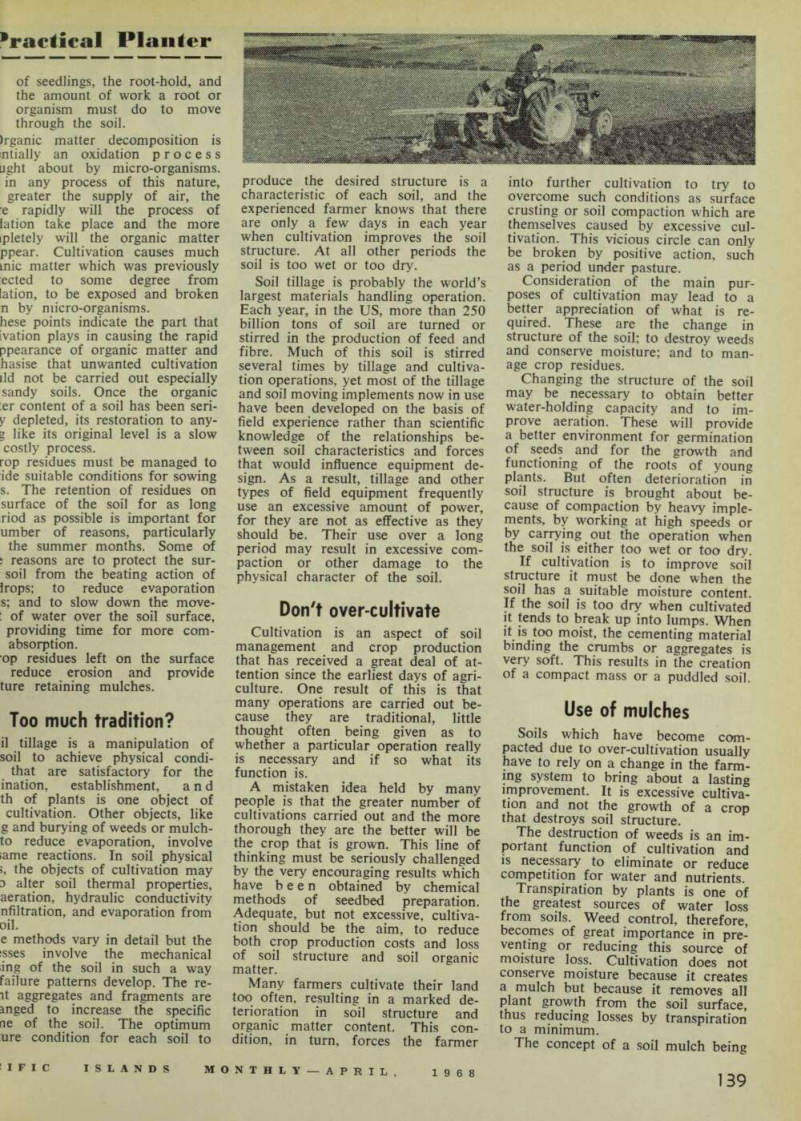
Each year, in the US, more than 250 billion tons of soil are turned or stirred in the production of feed and fibre. Much of this soil is stirred several times by tillage and cultiva tion operations, yet most of the tillage and soil moving implements now in use have been developed on the basis of field experience rather than scientific knowledge of the relationships be tween soil characteristics and forces that would influence equipment de sign. As a result, tillage and other types of field equipment frequently use an excessive amount of power, for they are not as effective as they should be. Their use over a long period may result in excessive com paction or other damage to the physical character of the soil.
Don t over-cultivate
Cultivation is an aspect of soil management and crop production that has received a great deal of at tention since the earliest days of agri culture. One result of this is that many operations are carried out be cause they are traditional, little thought often being given as to whether a particular operation really is necessary and if so what its function is.
A mistaken idea held by many people is that the greater number of cultivations carried out and the more thorough they are the better will be the crop that is grown. This line of thinking must be seriously challenged by the very encouraging results which have been obtained by chemical methods of seedbed preparation.
Adequate, but not excessive, cultiva tion should be the aim, to reduce both crop production costs and loss of soil structure and soil organic matter.
Many farmers cultivate their land too often, resulting in a marked de terioration in soil structure and organic matter content. This con dition, in turn, forces the farmer
into further cultivation to try to overcome such conditions as surface crusting or soil compaction which are themselves caused by excessive cul tivation. This vicious circle can only be broken by positive action, such as a period under pasture.
Consideration of the main pur poses of cultivation may lead to a better appreciation of what is re quired, These are the change in structure of the soil; to destroy weeds and conserve moisture; and to man age crop residues.
Changing the structure of the soil may be necessary to obtain better water-holding capacity and to im prove aeration. These will provide a better environment for germination of seeds and for the growth and functioning of the roots of young plants. But often deterioration in soil structure is brought about be cause of compaction by heavy imple ments, by working at high speeds or by carrying out the operation when the soil is either too wet or too dry.
If cultivation is to improve soil structure it must be done when the soil has a suitable moisture content.
If the soil is too dry when cultivated it tends to break up into lumps. When it is too moist, the cementing material binding the crumbs or aggregates is very soft. This results in the creation of a compact mass or a puddled soil.
Use of mulches
Soils which have become com pacted due to over-cultivation usually have to rely on a change in the farm ing system to bring about a lasting improvement. It is excessive cultiva tion and not the growth of a crop that destroys soil structure.
The destruction of weeds is an im portant function of cultivation and is necessary to eliminate or reduce competition for water and nutrients.
Transpiration by plants is one of the greatest sources of water loss from soils. Weed control, therefore, becomes of great importance in pre venting or reducing this source of moisture loss. Cultivation does not conserve moisture because it creates a mulch but because it removes all plant growth from the soil surface, thus reducing losses by transpiration to a minimum.
The concept of a soil mulch being
essary to conserve moisture can be supported by experimental fence except under very special aimstances such as when the water le is within three or four feet of surface. Under most conditions water table is much deeper than and a mulch has little direct ct in conserving soil moisture, n most soils the rate of evapora i from the soil surface is much re rapid than capillary movement water, and a layer of dry soil ormed without any cultivation be required. The amount of moisture during the development of this layer is no greater than that lost formation of a mulch by cultiva i. There is no evidence to sug that a mulch formed by cultiva is any more effective in prevent further moisture loss than a irally formed mulch, is stated previously, weeds are of it importance as a medium for water loss. Consequently, mulch is only important in so far as ivation forms a mulch during d control operations. As far as d control is concerned, this :tion could probably be just as performed by chemicals, with sfits in many cases to soil structure ervation, A point in favour of irbing the surface soil in the pro of weed control by cultivation lat there will generally be better irption of rainfall, because sur run-off is impeded to some ex by the rough surface, he main conclusions that can be vn from work carried out in tralia and overseas are that >ture conservation by cultivation ue almost entirely to weed con and that pulverising surface for the sole purpose of creating ulch is not effective in reducing iture losses. As far as conserva of soil moisture is concerned, cultivation practice that does not rol weeds and at the same time It in increased moisture intake Mention during the storage period 3th unnecessary and undesirable.
Tiile the important role that cul ion plays in agriculture must be gnised it must also be recognised there are a great many myths :iated with it. There can be no tion that excessive cultivation is mental as far as soil structure oncerned and that it increases of production. The use of crop systems which require the least ant of cultivation has consider merit.