palm development
pp. 128-130 · Read in the full issue

Business and
Development
Fiji is hopeful of oil palm development
By a staff writer
“Import substitution” is Fiji’s current policy for the de velopment of its natural resources. Fiji’s Minister for Natural Resources, Mr. D. W. Brown, says the colony will go all out to concentrate on the production of rice, beef, dairy products and fish so as to cut down on the import bills for these requirements.
But he also has some hopes for some new export industries, particu larly oil palm.
In March Mr. Brown concluded a 3,000 mile tour of Malaysia, and a visit to Australia, to gather develop ment information, and he passed through Sydney “very pleased” with what he had found.
Mr. Brown, 46, is a former farmer and agricultural school principal in Fiji.
Rice, beef
He said Fiji imported £BOO,OOO of rice a year, and consumption con tinued to grow. The colony had applied for a UN grant for a pre investment survey of irrigated rice possibilities on the Rewa, and he was hopeful the experts would arrive by July The plan was to irrigate and drain 8,000 acres of the left bank of the Rewa, to be followed by 5,000 acres on the right bank.
Information from this survey might help in plans to bring 12,000 acres of rice under irrigation at Navua.
He said he saw much irrigated rice in Malaysia, including varieties under double cropping, and he had been assured that double cropping was viable in Fiji.
Speaking of beef, Mr. Brown said that the colony was just reaching self sufficiency and would soon export beef to other territories. Wallis Island and the Gilberts had had small trial shipments. There was promise of a good industry. In Queensland and NSW he had got the promise of help in establishing a structure for the meat industry.
He hoped that the Japanese fish freezing factory at Levuka would move into canning of fish after it had completed a pilot project on tuna. Fiji imported £350,000 worth of canned fish last year.
Imports of Oregon had already dropped considerably, and local timbers were taking more of the market following last year’s re organisation of the Fiji timber in dustry. Merchants were pushing local timbers.
West Australian Plywoods Ltd. whom he had visited on his trip, were seriously considering setting up a veneer project on Vanua Levu, and were also looking at the possibility of a plywood factory in conjunction with their sawmill operations.
“We have got to chase these im port substitutions if we are to pro gress,” Mr. Brown said.
Oil palm
Mr. Brown had an extensive tour of oil palm projects in Malaysia. He saw one area of 23 acres of oil palm, some of it planted on steep slopes (“this surprised me”, he said). The general manager was a Malay aged about 30. This was run in con junction with a land settlement scheme.
In Malaysia the system was to build complete towns, with the settlers buying their own houses and being shareholders in the agricultural de velopment. The land was government owned. The settlers went off from the town each morning to work at any kind of job on the oil palm project that needed to be done.
He was impressed with the vitality of this method over the usual scheme of individual settlement on separate blocks. This way, an inexperienced man was not faced with failure.
Mr, Brown was very hopeful of Fiji’s oil palm prospects. He said Morris Hedstrom’s Rewa lease had lapsed (the firm was now working at Taveuni and Vanua Levu) but a trial plot of oil palm planted by the
Commonwealth Development Com pany about four of five years ago on 40 acres at Navono, Vanua Levu, had produced results well up to expecta tions.
He expected a decision soon or whether the CDC would extend the scheme to about 3,000 or 4,000 acres, thus launching Fiji into an oil pain industry such as New Guinea wai developing.
While in Malaysia Mr. Brown alsc took a look at rubber, which once grew in Fiji. Although world rubbei prices were depressed, he felt tha new wind-resistant, high yielding type: might be economic in Fiji today anc the colony would carry out trials.
Ford plan for
New Guinea
The Ford Motor Company o Australia is planning to build j vehicle assembly plant in Papua-Nev Guinea. It is a long-term project The director of Ford’s operation in Australia, Mr. W. D. Bourke recently inspected likely sites for ; plant at Port Moresby and at Lae.
He said that design planning wa being carried out to produce vehicle specially suited for Papua-Ne\ Guinea. New suspension systems special tyres, and air conditionin were being considered.
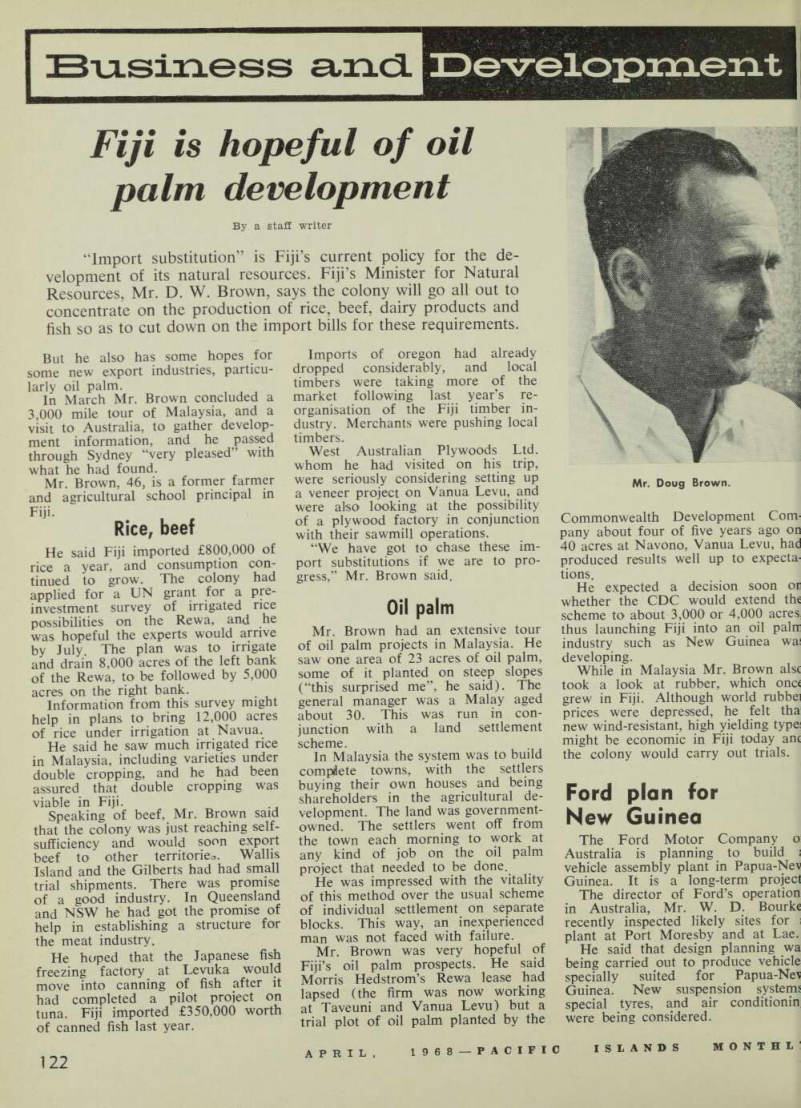
Mr. Doug Brown.
Flour war win
hr Australia
f and loss for Fiji?)
Fiji suffered her worst ihortage of flour and sharps for nany years in February. The
hortage was caused by the Fiji
jovernment’s banning in Janu
iry of all imports of French flour
ind sharps, coinciding with the
hree-week breakdown of the rSR freighter Rom —the only
egular shipper of Australian
lour and sharps to the colony.
Rona suffered rudder damage on er way to Suva from Sydney in late anuary and had to return to Sydney or repairs. She sailed for Fiji with ig quantities of flour and sharps on February 17 and returned to Sydney n March 12.
Normally stocks of flour and sharps re held in Fiji for short term needs nly because of the risk of weevil ifestation. Big Suva sellers quickly ecame very short of both foods in arly February.
Their position was partly relieved dien the P and O liner Arcadia rrived with a special consignment of our.
"Foot and mouth"
The Fiji Government announced tat it had banned the French flour nd imports because of the risk of X)t and mouth disease, and the eed to protect the developing beef idustry.
But it was a ban which delighted Lustralian flour millers, who have )ng complained of France’s “unfair” olicy of exporting cheap, subsidised our and sharps to the Pacific Islands, articularly Fiji.
In 1967 France exported more than ,000 tons of sharps to Fiji and nearly ,000 tons of flour.
The French prices for flour and harps lowered ex-wharf prices in iji, cutting down imports from the olony’s biggest supplier, Australia.
French flour and sharps benefited te colony’s two biggest traders— turns PhiJp (SS) Co. Ltd. and lorris Hedstrom Ltd., who pre iously made only a small margin of rofit— about 5 cents Aust. a bag.
Australian flour millers were selling our to Fiji at “cut-throat” prices in n attempt to compete with French our.
Both traders imported the French
produce and made much higher profits than on Australian flour and sharps.
Now, with the ban applied, and Australian flour set to dominate the Fiji market again, prices seem certain to go up to the public in Fiji. Aus tralian millers, not worried by French competition, may sell at higher prices.
No official French protest against the ban had been heard up till late March, but French flour millers ob jected strongly to losing a fast-growing market they had developed only over the last couple of years, Australian millers believe the ban on French flour could spread to Papua-New Guinea, the BSIP and
Western Samoa —a development they would relish because with French produce heavily subsidised by the French Government they cannot com pete with France’s prices.
Is worst over
tor rubber?
Sharply reflecting the current very low prices on world markets for natural rubber, three Papuan rubber planters—Rubberlands Ltd., Kerema Rubber Ltd. and Koitaki Para Rubber Estates Ltd.—all announced falls in profits and omission of dividends in March.
Rubberlands Ltd.’s net profit for
the year to December 31 last fell nearly $7,000 to $13,170.
Worst hit was Kerema, whose profit fell from $21,000 in 1966 to $3,807 in 1967. Koitaki, whose financial year ends on June 30, did not an nounce any figures, but directors said earnings were lower and interim dividend was being omitted.
Despite the current doghouse posi tion of rubber producers, Papuan growers are “cautiously optimistic”— they believe prices have already hit their lowest and must now recover.
Higher profits
for W.R.C.
Despite significant losses arising from devaluation of Fijian and UK currencies, Island trader, planter and investor W. R. Carpenter Holdings Ltd. has reported higher half-yearly profits and declared an increased in terim dividend.
The devaluation losses are a re minder that fellow Islands traders, Burns Philp and Co. Ltd. and Burns Philp (South Sea) Ltd., will sustain similar—and likely bigger—losses in the current year.
In mid-March the directors of W. R. Carpenter declared an interim ordinary dividend of eight per cent., or four cents per 50 cent share, pay able on April 30—for shares registered at March 27.
Last year the company paid an in terim dividend of 7i per cent., fol lowed by a final dividend of 82 per cent., making a total of 16 per cent for the vear.
The directors report that interim accounts presented by subsidiaries in dicate an increase in turnover and earnings of the group when compared with the corresponding period of the previous year.
Aggregate profits of the group for the half-year showed an increase of 13 per cent., after taking into account certain losses on currency devaluation in respect of companies whose six months’ period ended in December, 1967.
Further devaluation losses of approximately $200,000 will be absorbed in the current half-year and profits for the full year to June 30 will be “at least maintained,” directors say.
Sir Donald Cleland, who recently retired as Administrator of Papua and New Guinea, has joined the board of W. R. Carpenter (TPNG) Ltd.
Mr. Walter Randolph Carpenter has been appointed chairman of W. R.
Carpenter (TPNG) Ltd. in succession to Mr. C. H. V. Carpenter, who re tires from the board. The other directors are:
Messrs. S. S. Proud, of Sydney.
C. B. Bailey, of Port Moresby.
L. E. Clayphan, of Rabaul, and C. W. Batten, of Mount Hagen.
Mr. Clayphan has been appointed managing director of Coconut Pro ducts Ltd. and chairman of its sub sidiaries —Island Estates Limited, Tovarur Plantations Ltd., and Gama Plantations Limited.
In a newly-reorganised manage ment structure, divisional general managers of the group are: Tea estates, Mr. C. W. Batten; desiccated coconut, Mr. H. J. Rothkirch; auto motive, Mr. J. L. Graham, assisted by Mr. James Whiley; general merchandise, Mr. G. Motthershead.
Plastics plant
opens in Fiji
Cups, saucers, salt and pepper shakers and a variety of other plastic household articles started popping out of a machine at Lautoka, Fiji, in February as another secondary in dustry got under way in the colony.
With machinery imported from Hong Kong, Mini Moulders (Fiji) Ltd., a newly registered company with a majority of shares held by New Zealand interests, has established a factory in the western district capital and hopes to capture a substantial share of the household plastics markets both in the colony and in other Pacific territories.
An earlier attempt to set up pro duction at Nadi, 20 miles from Lautoka, failed as the local power supply was not sufficient to keep the factory in production for 24 hours a day.
The process used by Mini Moulders is injection moulding. Dies for the machinery are supplied by New Zea land subsidiaries, and raw materia) comes from NZ and Australia.
The company plans to extend its activities into the extmsion system of manufacture for rigid and flexible piping up to six inches in diameter.
Machinery installed at Lautoka already is fully automatic and operated by local staff trained on-the spot.
When in full swing the factory expects to employ up to 200 local staff and become a substantial factor in export earnings.
Rise in the
copra market
Chairman of the P-NG Copra Marketing Board, Mr. lan McDonald, made the following comment on the world copra market in Port Moresby on March 23; Although there has been little
activity in the copra market for some weeks, prices have remained firm.
There has, in fact, been some in creases because of the restricted supply situation which has been in sufficient to fulfil demand except at increasing prices.
Prices for Philippines copra fixed by the London Copra Association rose from SUS 267 per ton on March 1 to SUS 277 by mid-month, with every indication of remaining around that level.
Copra exports have continued to decline, particularly from the Philip pines, and there does not appear to be much hope of any increase in supplies to Europe for some time.
This situation has been caused by typhoon damage. However, with reasonable rains and new trees com ing into bearing, the supply position could improve by June/July this year.
Other than in Lauries, the market in edible oils has remained dull, with little inclination on the part of sellers to put supplies on the market at present prices.
It seems fairly certain that the present-day shortage of supply can only lead to an increasing demand for edible oils, and consequently in creased prices. This situation could eventually react against copra when, as can be expected later this year, production in the Philippines re covers to normal levels.
Cheaper fuel, no
wharf, for Norfolk
Plans by Mobil Oil Australia to build a bulk fuel depot at Ball Bay, Norfolk Island, raised local hopes in March that the island was at last to get an overseas wharf which would allow small ships to discharge cargo directly, instead of into lighters. But it won’t happen.
Mobil is certainly building a depot at Ball Bay, at a cost of $150,000. which will mean cheaper fuels for Norfolk.
Mr. N. D. Hack, manager of Mobil’s Islands division, said in Mel bourne in March that the company had called for tenders and one should be accepted towards the end of March to start work immediately. The com pany hoped to have the bulk plant completed by July-August.
Mobil Oil is not building a deep water wharf. Instead the plant will be serviced by two small ships of the company’s fleet, which will anchor off-shore and pump through a floating pipe-line.
Mobil has contributed towards the cost of a sealed road to the plant site which is being built by the Adminis tration.