Cruising Yachts
pp. 105-115 · Read in the full issue

Pacific Shipping And
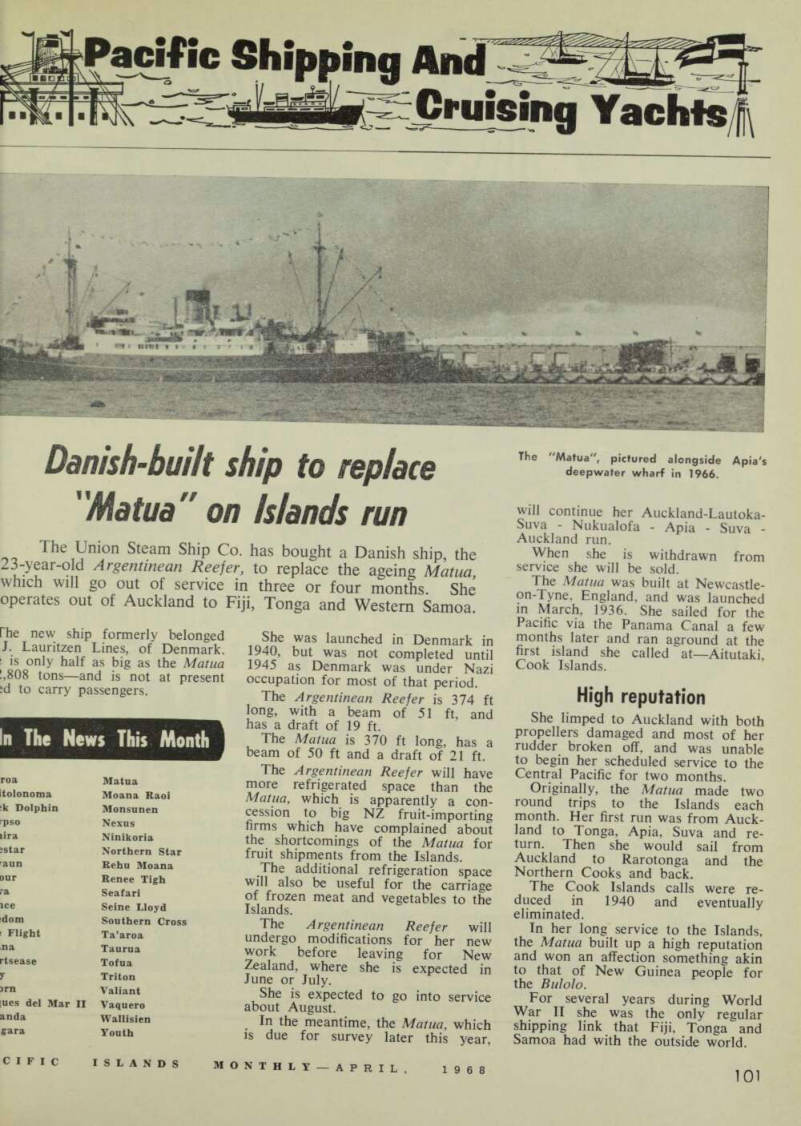
Danish-built ship to replace "Matua" on Islands run
The Union Steam Ship Co. has bought a Danish ship, the 23-year-old Argentinean Reefer, to replace the ageing Matua, which will go out of service in three or four months She operates out of Auckland to Fiji, Tonga and Western Samoa
fhe new ship formerly belonged J. Lauritzen Lines, of Denmark. : is only half as big as the Matua 1,808 tons—and is not at present id to carry passengers.
She was launched in Denmark in 1940, but was not completed until 1945 as Denmark was under Nazi occupation for most of that period.
The Argentinean Reefer is 374 ft long, with a beam of 51 ft, and has a draft of 19 ft.
The Matua is 370 ft long, has a beam of 50 ft and a draft of 21 ft.
The Argentinean Reefer will have more refrigerated space than the Matua, which is apparently a con cession to big NZ fruit-importing firms which have complained about the shortcomings of the Matua for fruit shipments from the Islands.
The additional refrigeration space will also be useful for the carriage of frozen meat and vegetables to the Islands.
The Argentinean Reefer will undergo modifications for her new work before leaving for New Zealand, where she is expected in June or July.
She is expected to go into service about August.
In the meantime, the Matua, which is due for survey later this year,
will continue her Auckland-Lautoka- Suva - Nukualofa - Apia - Suva - Auckland run.
When she is withdrawn from service she will be sold.
The Matua was built at Newcastle on-Tyne, England, and was launched in March, 1936. She sailed for the Pacific via the Panama Canal a few months later and ran aground at the first island she called at—Aitutaki, Cook Islands.
High reputation
She limped to Auckland with both propellers damaged and most of her rudder broken off, and was unable to begin her scheduled service to the Central Pacific for two months.
Originally, the Matua made two round trips to the Islands each month. Her first run was from Auck land to Tonga, Apia, Suva and re turn. Then she would sail from Auckland to Rarotonga and the Northern Cooks and back.
The Cook Islands calls were re duced in 1940 and eventually eliminated.
In her long service to the Islands, the Matua built up a high reputation and won an affection something akin to that of New Guinea people for the Bulolo.
For several years during World War II she was the only regular shipping link that Fiji, Tonga and Samoa had with the outside world.
The "Matua", pictured alongside Apia's deepwater wharf in 1966.
Wspecting Job For
Jl Ship
The Fiji-registered vessel Taranui 11 prospect for phosphorites on the lathams Rise, near the Chatham ands, off New Zealand’s South and, in April.
Taranui arrived in Suva last year d had a special instrument for sp-echo sounding installed for her ;anographic work, which she does charter for three months of the it for the NZ Government.
Previously, the Taranui, which is ned by three NZ mariners, took t in a scientific expedition in the lomons. She has a Fiji crew.
00,000 Ship
R G.E.I.C.
\t a cost of more than $A500,000 GEIC Government has bought 1,200-ton passenger vessel to ruit workers for the phosphate losits on Ocean Island and Nauru. 1 for general passenger work, fhe ship will be called Ninikoria, aning “brave” after a previous IC vessel.
Captain E. V. Ward, well-known :aptain of the colony’s two Moana ?is was in Newcastle, England, March, supervising the conversion the vessel, which was formerly a »oslavian coastal trader. She is it years old and 220 ft long.
Vhen work is completed. Captain rd will command the Ninikoria her delivery voyage to Tarawa, bably about June, he Ninikoria will cruise at 12 ts, with a maximum speed of 15 ts.
Unikoria will have the following
roximate accommodation: First
class air-conditioned berths, with toilet and baths for 12; second class air-conditioned berths for 25, and a fourth class passenger room for 120.
Captain Ward, the GEIC’s senior master with 20 years’ service, sailed the first Moana Raoi from Hong Kong to Tarawa in 1958. Last year he delivered the second Moana Raoi from Hamburg for the Wholesale Society.
To help him with arrangements
for the Ninikoria in England is Mr.
R. W. “Torchy” Sellars, the vessel’s second engineer.
Ill-Fated "Wallisien"
Up For Sale
The 530-ton motor vessel Wallisien, which was wrecked on Nukutolo Reef, about 30 miles south-east of Taveuni, Fiji, last May (PIM, June, 1967, p. 101) was sold in mid-March to McNicholl Industries (Fiji) Ltd.
Fiji’s Receiver of Wreck said some fixtures and fittings remained on the Wallisien, and that Customs duty would be considered as included in the price tendered, but the highest tender would not necessarily be accepted.
Wallisien’s former skipper, Captain Ernse Wilhelm Lamberty, is now in charge of the Burns Philp trader, Konanda, which is working out of Santo, New Hebrides.
From Islands Skipper
To Old. Land Agent
Selling land and letting flats on Queensland’s famous Gold Coast is quite a change from commanding Island traders and other ships in the backwaters of the Solomons or the New Guinea Islands, but Captain A.
J. D. McArthur is willing to give it a go.
He retired in January after two
id a half years as skipper of the ell-known Conzinc Riotinto ex oration ship, Craestar, to take up i interest in a Broadbeach real tate and letting agency, Surfers ccommodation Centre.
During his work for CRA, Captain cArthur, a New Zealander, took e Craestar to almost every island oup in Melanesia in a broad arc Dm Wewak in the north to Santa Da in the Solomon Islands.
Vhen a landing pad was constructed card the Craestar for a helicopter, G territorial quickly dubbed the 0 ft vessel the “world’s smallest ■craft carrier”.
Captain McArthur’s Islands sea periences go back 36 years to when skippered the small Auckland cht Heartsease on a six-month jise of the Pacific Islands.
Captain McArthur took a liking the Islands and in 1932 got a ) as skipper of the vessel France, tdmg for W. R. Carpenter and Co., 10 were then operating in the lomons.
The France was one of the best own schooners in the South Seas ;n —she had previously spent feral years collecting flora and ma in all the Pacific Islands for ; Whitney Syndicate of New York.
Captain McArthur skippered the mce for about two years, plying ween Rabaul, New Britain, and rpenter trading posts in the lomons.
In 1934 Carpenters gave him com
aptain A. J. D. McArthur and his wife.
nand of another well-known vessel —the 820-ton steamer Durour— >ought by the group in 1926, The Durour carried timber on :ontract for the Kauri Timber Co. *ty. Ltd., which had valuable timber eases on Vanikoro, in the Santa Cruz jroup of the Solomons.
For two years Durour plied be kveen Vanikoro and Melbourne. She lad a mixed crew —a New Zealand kipper, a British chief engineer, a )anish mate, three Chinese engineers, Malayan cook, and several Solomon slanders as crew.
Everything was said in Pidgin mglish.
In late 1934, Captain McArthur Dok the small island trader Dawaun rom Tulagi, then the administrative entre of the Solomons, to Vanikoro 3 pick up several stranded Danes, 'hose vessel, Monsunen, had been wrecked on the island a month before.
One of the Danes, Hakon Mielche, iter wrote a successful book, Let’s ee if the World is Round, which the Monsunen’s voyages nrough the Atlantic and Pacific Iceans.
Captain McArthur was depicted as devil-may-care, cursing Scottish ja-captain in the book, which is ill one of the most readable and musing traveller’s descriptions of the outh Seas in the 1930’5.
Captain McArthur left the Durour nd the Solomons in 1936 for Queensland, where he spent the next 5 years as harbourmaster and pilot i Port Alma, Townsville, and Bris ane.
He “retired” about four years ago, nly to take command of the raestar in mid-1965. He “retired” gain in January to set up in business i Queensland.
“More and more territorians from few Guinea and public servants in »e Solomons are looking for an ivestment in Queensland,” he told IM in March, “I hope to give a >ecial service to these people be mse I have an idea of how they link and what they are looking for.
“There is a lot of New Guinea loney from Australians and Chinese Ding into land in south Queensland ; the moment.”
Iji Plan For Better
Avigational Facilities
The Fiji Marine Department has unched a scheme to improve arine facilities in the Colony with grant of £25,000 from the Govern ent.
Half of the grant will be used »r fairly extensive reef blasting, to ve better access to harbours and ichorages.
The remainder will be spent on
new lighthouses and improving existing lighthouses.
According to the Marine Department there are not enough lighthouses in Fiji.
The department hopes to rectify the deficiency. As part of its plan, it has imported five new lighthouses from the UK The lighthouses are revolutionary in design and operate o« batteries/ They use only small light bulbs, and the outer glass is ground to magnify the light.
The lighthouses cost about $1,300 each, installed.
The department expects three of them to be in service late in April or early in May at Makogai, Vatu-i- Ra passage and Yadua.
The department some time ago carried out a pilot scheme in reef blasting at Fulaga and Kabara in t* l6 Lau Group, They improved access to those j s > a l .° an extent that copra
luTrsTuXS injure
than previously, Soon after the department launched its scheme, the director of a UK lighthouse firm, Mr. K. Sutton-Jones, arrived in Fiji to discuss the
ossibility of Fiji buying more light ouses and navigational aids.
He said that flashing beacons owered by solar energy would be racticable for the Western Pacific.
The beacons are a British inven on.
Fiji at present uses gas cylinders >r its navigation beacons. These ave to be refilled when the gas is sed.
Captain A. Newport, the Fiji lirector of Marine, said recently that ne of the major problems with larine lighting in Fiji is the supply f power to isolated stations, of hich there are many in Fiji waters.
That was why his department was iterested in solar energy and also ind-driven generators, he said.
The beacons under consideration ave a solar energy panel which ansforms the sun’s rays into ectrical energy for keeping a battery larged.
Ew Master For
Moana Raoi"
Captain Peter King, 28, has taken as master of the GEIC Whole ile Society ship, Moana Raoi. He icceeds Captain Robin Bibby, who is gone to the UK for leave.
Captain King served his apprentice lip in tankers and for the last ght years has been with the NZ lipping Co.
Md Of The Line
Or The "Mangara"
After nearly 25 years of trading id transporting among the New uinea Islands, the well-known 85 motor vessel Mangara was being ripped for scrap in Rabaul in arch.
The vessel first appeared in the ew Guinea Islands during World ar 11, carrying up stores and pplies for the Australian Army.
In 1946 the vessel was acquired r the Production Control Board, >w the Copra Marketing Board, and ed for plantation inspections. Two issenger cabins were installed.
The Mangara was sold to the NG in the early 1950’s id since then she has been used r transporting government officials outposts which cannot be reached r plane.
Edlloyd Suspends
Lands Service
Nedlloyd Line’s six-weekly cargo rvice from Europe to New Guinea, e Solomons and the GEIC has been mporarily suspended because of the ntinued closure of the Suez Canal.
Last year, all shipping lines which irmally serviced the South Pacific.
via Suez diverted their ships through the Panama Canal, or around South Africa.
Nedlloyd diverted its ships around South Africa and continued calls at major NG ports, Honiara, West Irian ports and Tarawa.
Early this year this service stopped, but a three-weekly Nedlloyd cargo service from Europe, via Panama, to all major ports in Polynesia and Fiji has continued.
In early March, the line’s Sydney agents, Royal Interocean Lines, issued a circular to all shippers and export-import agents concerned with Nedlloyd’s Melanesian calls.
The circular said Nedlloyd Line had made “great financial sacrifices”
because of the comparatively low level of cargo offerings to West Irian and New Guinea.
The line was not yet able to nominate its next sailing, although it hoped the MV Seine Lloyd, sailing from Rotterdam on June 21, might be available to call at a number of NG and West Irian ports,
Tongan Seafarers
m rue mcia/c mc " CY¥;> In separate incidents in March, travelling Tongans made the news— in Fiji, New Zealand and Tonga.
Three Tongan stowaways tried un successfully to land unnoticed in Auckland in mid-March. The trio
ived off the Union Steam Ship reighter Tofua in Auckland Harbour nd swam three miles to the nearest each —and into the waiting arms of le police.
The three were expected to be harged under the Immigration Lestriction Act of landing unlawfully i NZ.
Meanwhile, the New Zealand abour Department refused work ermits for 13 Tongans at Gisborne, i NZ’s North Island.
These Tongans arrived in Auck ind recently on the 33 ft Tongan acht Aositolonoma, under Captain lavid Fifita, of Minerva Reef fame FIM, March, p. 103).
NZ Gisborne fruitgrowers opposed le labour department’s decision not > allow the Tongans to work. There as, said the fruitgrowers, a labour lortage.
Four other Tongans were in the 2ws in March, when they reached akeba, in Fiji’s Lau Group, in double-ended 30 ft whaler.
Tonga’s Criminal Investigation •epartment asked Fiji police to seize le whaler and arrest the youths, he department alleged the whaler ad been stolen on February 22.
The youths are Vanila Fotofili, of latuku, Lopeti Palu and Fono aingaa, both of Tungua, and Tevita iosio, of Eua.
Akatere" In Nz
Or Repairs
The well-known, 200-ton Cook lands trader Akatere, which was imaged in the December hurricane i the Cooks, was in Auckland in larch for repairs.
When the hurricane struck, katere was in Avatiu Harbour, arotonga. Her master. Captain A. ickering, immediately put to sea— ith no cargo and only her oil drums ; ballast—into winds estimated at )0 knots.
Huge waves threatened to capsize the Akatere, but the little trader managed to run before the southerly winds, blowing her out of the hurricane area ( PIM, Feb., p. 109).
Papuans Cash In
On Crayfish
Papuans at Kairuku, 75 miles north of Port Moresby, have taken full advantage of a recent “flush” of crayfish in Kairuku waters.
In early March 13,000 lb of green crayfish tails from Kairuku left Port Moresby by ship for the United States,
The big shipment was the result of co-operation between the Kairuku Fishing Co-operative Society and a local European businessman.
Papuans near Kairuku used out riggers to trap and hold the crays in large netting catchments set off shore. Pick-up boats then systemically collected the catches and they were processed at a modern factory at Kairuku.
Uncooked tails were quick frozen and packed in cartons for shipment.
The 600-member society then shared its facilities with the European to ship the crays to the United States.
Captain Fifita.