South Seas Paperbacks
pp. 97-98 · Read in the full issue
Among the new Pan paperbacks to come our way are two that deal largely with the South Seas.
One is J. B. Priestley’s novel Faraway (first published in 1932).
This is basically about an un charted island somewhere be tween Tahiti and Easter Island, which is full of pitchblende, or uranium ore.
The novel sounds rather far fetched these days, but Priestley’s descriptions of Tahiti, which he expressly visited to obtain local colour for the novel, will make interesting reading for those who know Tahiti today. Faraway sells in Australia for $1.15.
The other new Pan book con cerning the South Seas is Geoffrey Bennett’s Coronel and the Falk lands (90c) an account of the battles between British warships and Germany’s Pacific squadron in World War I.
The German squadron included three ships whose names are particularly familiar to students of Pacific history.
One, the Nurnberg, raided Fanning Island on September 7, 1914, and dislocated communica tions over the trans-Pacific cable by destroying equipment at the cable station.
Two others, the Scharnhorst and Gneisenau, are celebrated for their
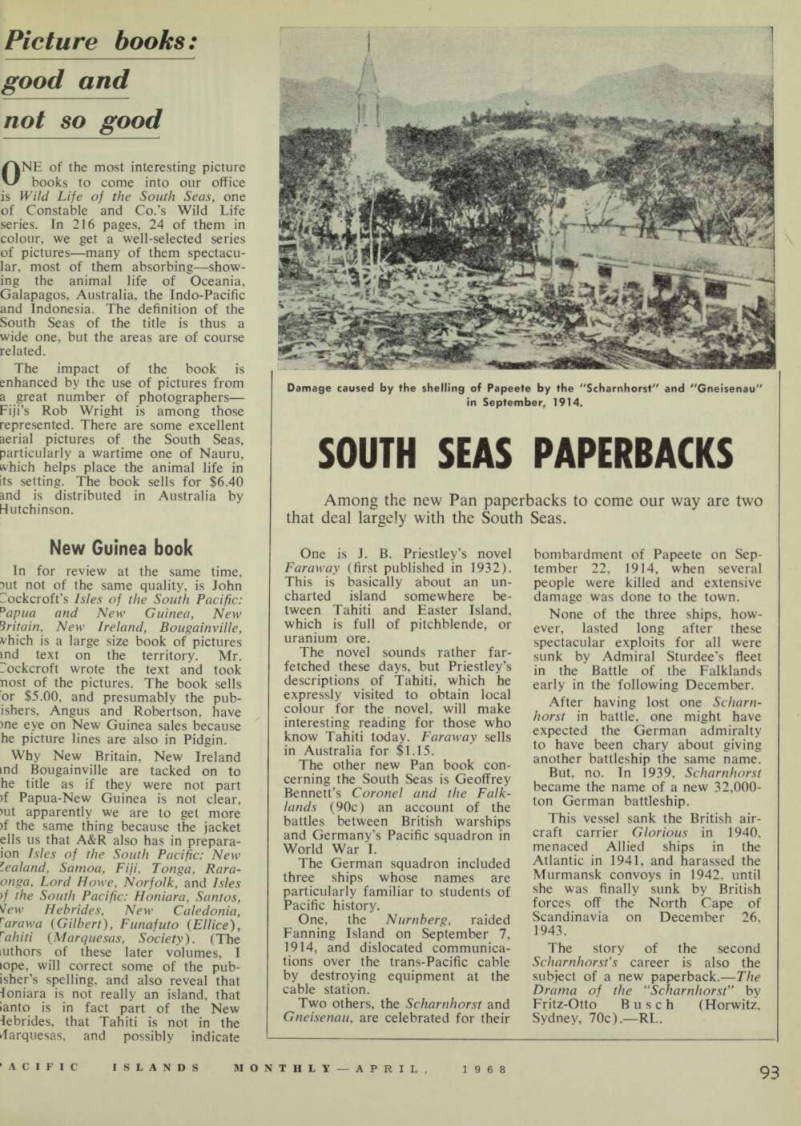
bombardment of Papeete on Sep tember 22, 1914, when several people were killed and extensive damage was done to the town.
None of the three ships, how ever, lasted long after these spectacular exploits for all were sunk by Admiral Sturdee’s fleet in the Battle of the Falklands early in the following December.
After having lost one Scharn horst in battle, one might have expected the German admiralty to have been chary about giving another battleship the same name.
But, no. In 1939, Scharnhorst became the name of a new 32,000ton German battleship.
This vessel sank the British air craft carrier Glorious in 1940, menaced Allied ships in the Atlantic in 1941, and harassed the Murmansk convoys in 1942. until she was finally sunk by British forces off the North Cape of Scandinavia on December 26, 1943.
The story of the second Scharnhorst’s career is also the subject of a new paperback.— The Drama of the “Scharnhorst >> by Fritz-Otto Busch (Horwitz,
Sydney, 70c).
RL.
Damage caused by the shelling of Papeete by the "Scharnhorst" and "Gneisenau" in September, 1914.
which of the two Samoas the book will be talking about.
None of this, of course, has any thing to do with the present volume on New Guinea by John Cockcroft.
Mr. Cockcroft is described as hav ing led an adventurous life as horsebreaker, drover, rough rider in the Northern Territory and Western Queensland, as a soldier for six years, as a cattle station manager in New Caledonia, an officer of the P-NG Administration in Port Moresby, Lae, Rabaul and Samarai, a national broadcaster, TV producer, docu mentary award winner, script writer, film director and editor of an inter national radio and TV magazine.
Nevertheless, he hasn’t produced a satisfying book on P-NG. Many of his black and white pictures give the appearance of having lost definition by having been taken off transparencies, and some others simply lack impact, so that one wonders why they were included— as for instance the murky cloud shot on page 57 mostly filled with a wing of an aeroplane. One large aerial photograph of the Port Moresby wharf area (not taken by Mr. Cock croft) has been reversed, with con fusing geographical results. The picture layout is generally poor.
Perhaps these deficiencies may have been balanced with good text, but the text is dull and uninspiring.—SI.