Yesterday
p. 91 · Read in the full issue
When the worst cyclone in 15 years hit Noumea on March 14, 1948, a woman carrying her baby to safety was thrown against a truck and killed and damage on land and sea ran into millions of francs. More than 30 inter-island ships were sunk or destroyed, three French Naval patrol boats were sunk, two Catalina-type planes were seriously damaged, installations at nearby Tontouta international air port were wrecked and hundreds of buildings in Noumea were damaged or destroyed.
THE Noumea cyclone was one of the main news items in PIM for 20 years ago this month.
Other items in that April, 1948, issue were:— REPORTS of a rich new gold field near Wabag, in New Guinea’s Western Highlands, had sent miners rushing to the scene from most of the main towns in the territory. The Leahy brothers —Jim, Mick and Dan—were at the forefront of the rush.
Mr. Islay Mcowan, A
former top public servant in Fiji for many years and also former British Agent and Consul in Tonga from 1917 to 1926, died in Sydney in April, aged 77. He started as a clerk in the office of the Colonial Secretary, Fiji, in 1892.
Trans-pacific shipping
services were to cease for the first time for many years when the chartered vessel Marine Phoenix completed her voyage at San Francisco in May, 1948.
Matson Line had decided to sell its two liners, Mariposa and Monterey, and the Union Steam Ship liner Aorangi was not expec ted to resume her New Zealand- United States run until late 1948.
ADMIRAL Tamura Ryukichi, who ordered 23 captured Aus tralians to be executed by strangu lation in March, 1944, at New Ireland, was hanged in March, 1948, after an Australian War Crimes Court in Hong Kong found him responsible for the murders, THE British Phosphate Com missioners, who lost five of their big freighters in World War 11. had bought the new freighter MV Levuka from W. R. Car penter and Co. Ltd. for service to and from the phosphate deposits on Nauru and Ocean Islands.
MR. A. J. VOGAN, well-known throughout the South Seas for his work on archaeology and his interest in native races, had died in Sydney after an accidental fall. He was 89. He visited the Fly River, Papua, as a member of an exploring expedition in the 1880’s and from then on travelled widely, claiming credit for dis covering ancient Chinese inscrip tions on the wall of a cave in the Yasawa Islands, Fiji.
A GROUP of 36 young men and women from Vancouver had decided to set up a “model community” in 1949 on an island in Tonga or Fiji. PIM claimed it was the 104th enterprise of its kind that it had reported.
“No consideration appears yet to have been given to such mundane things as how they are going to eat, or what Sir Brian Freeston (Fiji’s Governor) or Queen Salote (Tonga) will say when they learn that one of their islands is being pinched,” a PIM writer said. “The idea is that one just sits in the sun, and makes love, and eats bananas. The other 103 groups had the same idea.”
REPORTS that 300 Chinese had dug themselves in a defensive perimeter, with machine-gun posts, and were defying the Australian Administration on Manus Island, New Guinea, were investigated by a 50-man police detachment flown in from Port Moresby. The detachment found no signs of a general disturbance, only ill-feel ing between Chinese and natives concerning assaults on native women.
CUTHBERT’S Goldmine Ltd., whose activities had been interrupted by the war, had re sumed goldmining on Misima Island, Papua, while another firm.
Gold Mines of Papua, had started exploration. (Today, after a 10year search. Pacific Islands Mines Ltd. is still continuing the work).
Mr. A. W. Moverley, A
New Zealander, had been appointed the first official school teacher on Pitcairn Island. A pre-fabricated schoolhouse was being shipped to Pitcairn from England for him.
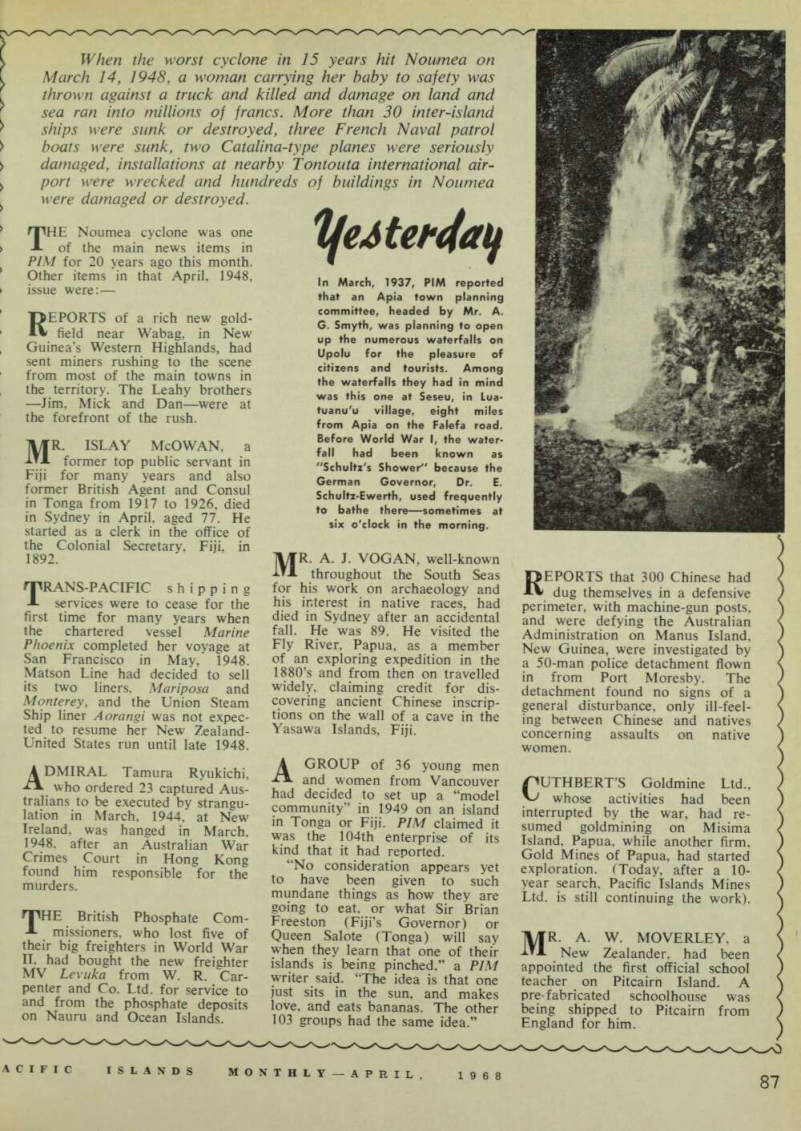
In March, 1937, PIM reported that an Apia town planning committee, headed by Mr. A.
G. Smyth, was planning to open up the numerous waterfalls on Upolu for the pleasure of citizens and tourists. Among the waterfalls they had in mind was this one at Seseu, in Lua tuanu'u village, eight miles from Apia on the Falefa road.
Before World War I, the water fall had been known as "Schultz's Shower" because the German Governor, Dr. E.
Schultz-Ewerth, used frequently to bathe there—sometimes at six o'clock in the morning.