need guarantees,
pp. 75-76 · Read in the full issue
P-NG investors need guarantees, says BP's head
By staff reporter KEN McGREGOR
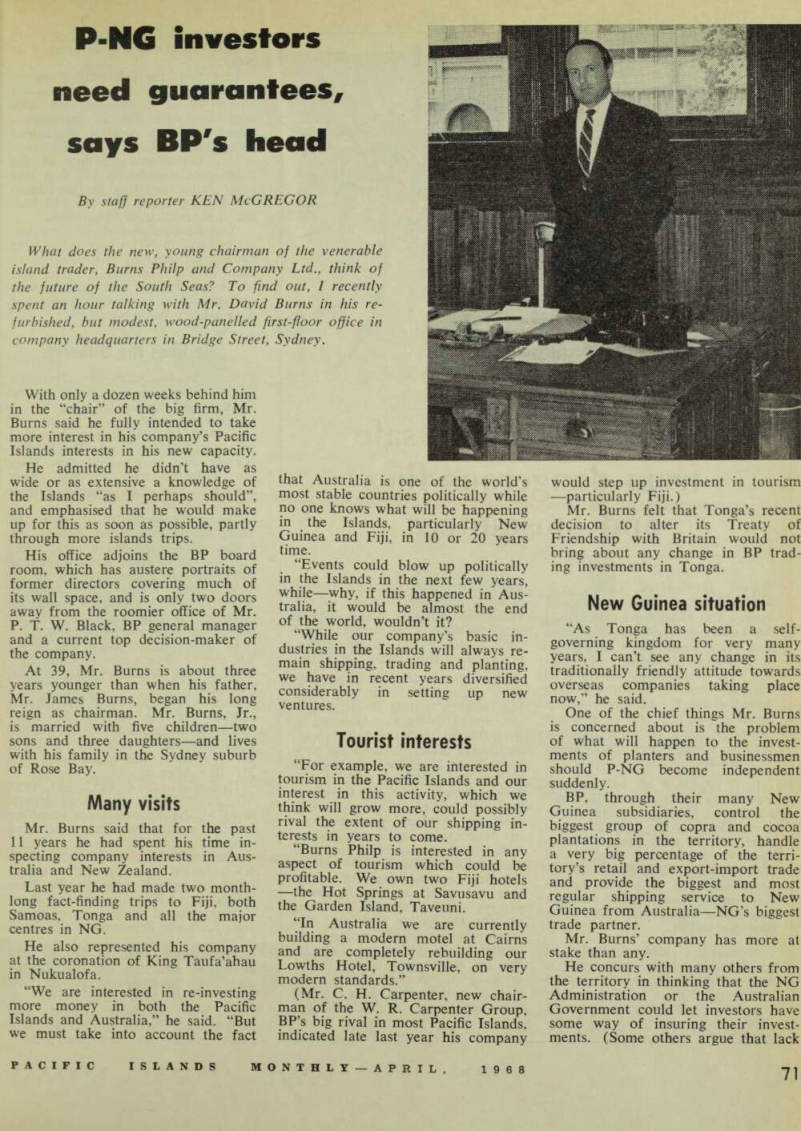
What does the new, young chairman of the venerable island trader, Burns Philp and Company Ltd., think of the future of the South Seas? To find out, I recently spent an hour talking with Mr. David Burns in his re furbished, but modest, wood-panelled first-floor office in company headquarters in Bridge Street, Sydney.
With only a dozen weeks behind him in the “chair” of the big firm, Mr.
Burns said he fully intended to take more interest in his company’s Pacific Islands interests in his new capacity.
He admitted he didn’t have as wide or as extensive a knowledge of the Islands “as I perhaps should”, and emphasised that he would make up for this as soon as possible, partly through more islands trips.
His office adjoins the BP board room, which has austere portraits of former directors covering much of its wall space, and is only two doors away from the roomier office of Mr.
P. T. W. Black, BP general manager and a current top decision-maker of the company.
At 39, Mr. Burns is about three years younger than when his father, Mr. James Burns, began his long reign as chairman. Mr. Burns, Jr., is married with five children—two sons and three daughters—and lives with his family in the Sydney suburb of Rose Bay.
Many visits
Mr. Burns said that for the past 11 years he had spent his time in specting company interests in Aus tralia and New Zealand.
Last year he had made two month long fact-finding trips to Fiji, both Samoas, Tonga and all the major centres in NG.
He also represented his company at the coronation of King Taufa’ahau in Nukualofa.
“We are interested in re-investing more money in both the Pacific Islands and Australia,” he said. “But we must take into account the fact
that Australia is one of the world’s most stable countries politically while no one knows what will be happening in the Islands, particularly New Guinea and Fiji, in 10 or 20 years time.
“Events could blow up politically in the Islands in the next few years, while—why, if this happened in Aus tralia, it would be almost the end of the world, wouldn’t it?
“While our company’s basic in dustries in the Islands will always re main shipping, trading and planting, we have in recent years diversified considerably in setting up new ventures.
Tourist interests
“For example, we are interested in tourism in the Pacific Islands and our interest in this activity, which we think will grow more, could possibly rival the extent of our shipping in terests in years to come.
“Burns Philp is interested in any aspect of tourism which could be profitable. We own two Fiji hotels —the Hot Springs at Savusavu and the Garden Island, Taveuni.
“In Australia we are currently building a modern motel at Cairns and are completely rebuilding our Lowths Hotel, Townsville, on very modern standards.” (Mr. C. H, Carpenter, new chair man of the W. R. Carpenter Group, BP’s big rival in most Pacific Islands, indicated late last year his company
would step up investment in tourism —particularly Fiji.) Mr. Burns felt that Tonga’s recent decision to alter its Treaty of Friendship with Britain would not bring about any change in BP trad ing investments in Tonga.
New Guinea situation
“As Tonga has been a self governing kingdom for very many years, I can’t see any change in its traditionally friendly attitude towards overseas companies taking place now,” he said.
One of the chief things Mr. Burns is concerned about is the problem of what will happen to the invest ments of planters and businessmen should P-NG become independent suddenly.
BP, through their many New Guinea subsidiaries, control the biggest group of copra and cocoa plantations in the territory, handle a very big percentage of the terri tory’s retail and export-import trade and provide the biggest and most regular shipping service to New Guinea from Australia—NG’s biggest trade partner.
Mr. Burns’ company has more at stake than any.
He concurs with many others from the territory in thinking that the NG Administration or the Australian Government could let investors have some way of insuring their invest ments. (Some others argue that lack
of government assurance is severely holding back overseas investment in NG).
Last year, the influential Planters’
Association of New Guinea—of which BP is a member, but with only one vote like all members— called for some sort of guaranteed protection for European investments.
Mr. Burns said another of the main problems facing his firm and other firms operating in the Islands was finding houses for staff and find ing staff, particularly tradesmen.
“Our housing problem is a particu lar bugbear in NG where it has been necessary to employ more Europeans than in Fiji. In Fiji it is possible to secure Fijians and Indians who are suitable to our requirements and who already have homes.”
He likes the Gilberts
Mr. Burns said his favourite islands were the low atolls of the Gilberts and the Line Islands.
“Fifteen years ago I joined our ship, MV Muliama, on a recruiting trip to Fanning and Washington Islands, We took labour over from the Gilberts and brought back labourers who had completed their contracts,” he said.
“I don’t know if it was the islanders or the actual islands but I have ever since had a great affec tion for the Gilberts and always take an interest in happenings up there.”
Mr. Burns joined Bums Philp in March, 1947, when 18, and he qualified as an Associate of the Society of Accountants in 1953.
In those early years, the whole BP empire was guided by the firm hand of the legendary, late Mr. I.
Mitchell.
From 1947 to 1952 Mr. Burns worked for the then Burns Philp Trust Co, Ltd., except for six-months aboard the MV Bulolo as an assistant to the purser, the well-known, late Mr. Ben Allen.
During most of 1952 and 1953 Mr. Burns was in the island depart ment at the Sydney office handling freight and forwarding, including checking copra from New Guinea.
The next three years included a brief period in the BP London office, inspection trips to the New Hebrides and New Zealand and about a year divided between the claims and accounts departments of head office.
And which branches hasn’t the new BP chairman visited in his company’s South Seas domain? Daru in the Gulf of Papua, Levuka in Fiji, Niue. Norfolk Island and Haapai and Vavau in Tonga. Not many, but he intends to see them.