development: The Volunteer
pp. 71-73 · Read in the full issue

Historic new phase in Pacific development: The Volunteer
By Ron Crocombe
The Peace Corps operates a training camp on the beach at the end of Molokai, one of the smaller Hawaiian Islands.
They recently trained a group of about 70 volunteers there for two years service in Western Samoa and they kindly invited me to join them for a couple of days, living with the volunteers and participating in the training programme.
They were near the end of a solid three months course of training, with classes beginning at 7 a.m. and end ing at 7 p.m. Mondays to Fridays, plus Saturday mornings. In addition, films, slides and talks on Samoa were given on many evenings.
Great emphasis was placed on language, and Samoan teachers (some brought to Hawaii for the purpose, others already resident in Hawaii) spent several hours every day with the trainees, who were encouraged to talk Samoan at every opportunity, in class and out.
The training programme was com prehensive and included staff from the Government of Western Samoa, the University of Hawaii and from the Peace Corps. Teachers and students impressed me as being of generally good quality.
Students were given a broad introduction to Samoan history, geography, economy and society as well as specific training in the fields in which they were going to work (most were teachers of English or agricultural extension workers).
To give them some familiarity with living conditions in Samoan villages, they lived in households, each of which was controlled by one of the Samoan teachers acting as household head in the Samoan manner. Some Samoan foods were served, dress was Samoan style, and many practices common in Samoan villages (includ ing obligatory church attendance on Sundays) were observed.
Just like Samoa
There are certainly limits to how much can be taught in such a pro gramme, but it nevertheless had a number of advantages. It weeded out many who decided (or for whom the training staff decided) that this was not the life for them—and it is much better to weed them out before arrival than have them fail in the field.
Secondly, it gave a very compre hensive introduction to the kinds of life and the kinds of problems they would meet in the field, and gave them some idea of how such problems might best be handled.
With all its shortcomings, it struck
me as perhaps the best training given by any government, mission, com pany or other organisation for work in the Pacific Islands.
The Samoan and Tongan govern ments do not now normally hire many expatriates at overseas rates of pay. As their contracts expire, the present ones are being replaced by volunteers from the US, Aus tralia, New Zealand, and the United Kingdom. Cost is one factor, but increasingly the independent govern ments in the Pacific are looking for expatriate staff who will live among the village people and at standards similar to those of islanders doing similar work (such as senior school teachers, agricultural officers and public health officers).
A new phase
These volunteers are part of an historically important new phase in the development of the Pacific area (and indeed of the developing countries of the world as a whole).
Generally the first agents of change were commercial—ship-owners and traders who imported manufactured goods, exported raw materials from the islands, and introduced a cash economy. Then came the missions, working at a more personal level, and spreading secular as well as religious teachings. They soon out numbered the expatriate businessmen.
Somewhat later came the colonial governments, working at first on a fairly narrow front concerned mainly with law and order, but after World War II expanding to a wide front of economic, social and political development. At that stage they out numbered both mission and business people.
After 1947 the international organisations entered the field—South
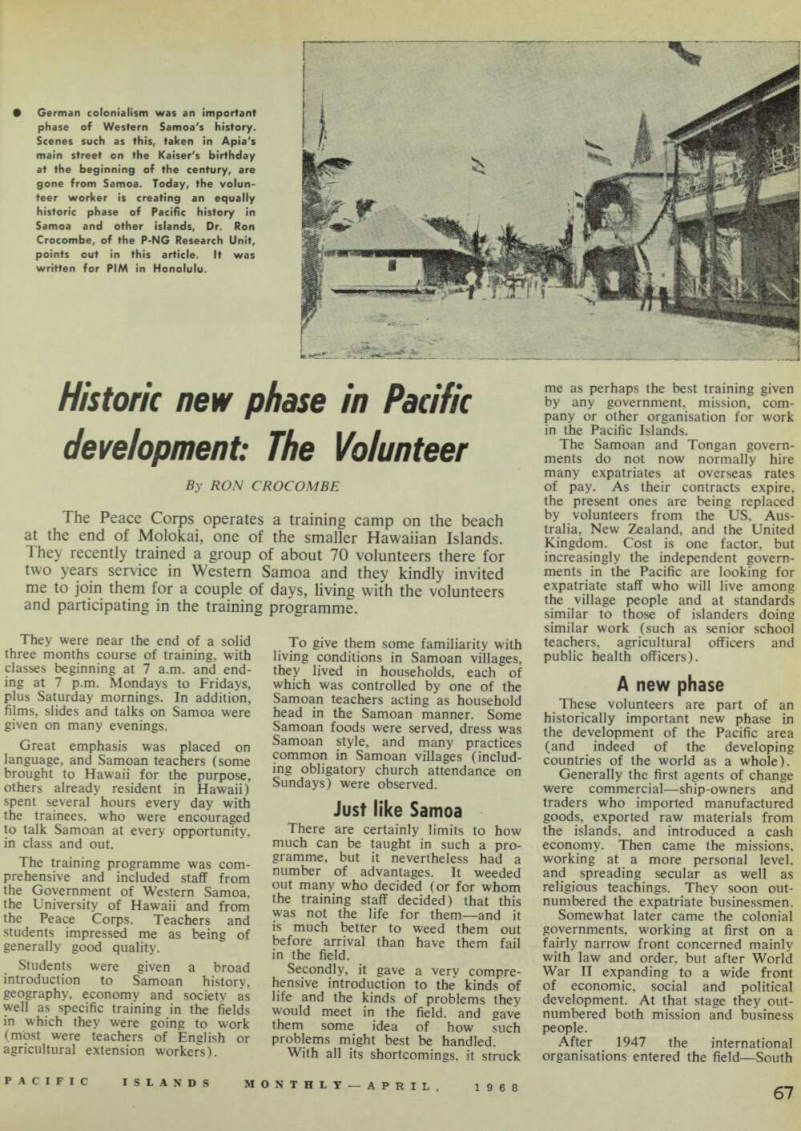
• German colonialism was an important phase of Western Samoa's history.
Scenes such as this, taken in Apia's main street on the Kaiser's birthday at the beginning of the century, are gone from Samoa. Today, the volun teer worker is creating an equally historic phase of Pacific history in Samoa and other islands, Dr. Ron Crocombe, of the P-NG Research Unit, points out in this article. It was written for PIM in Honolulu.
Pacific Commission, World Health, United Nations Development Fund, etc. Their staffs continue to increase.
But the latest group, which only began in the last few years, are the volunteers. They already outnumber the expatriates from business, missions, overseas governments and international agencies put together in Micronesia, Western Samoa and Tonga. Present trends indicate that this will also be the case in several other Pacific territories within the next year or two.
Five years ago there were less than a dozen volunteers working in the Pacific islands. By 1967 there were over 1,000. By the end of 1968 there will be nearly 2,000 from five different nations.
Change has been quick
All the sending organisations plan continuing increases in the numbers they are sending and other organisa tions from at least five other nations are planning to offer volunteers for service in the Pacific area.
This change has come about so quickly that many people have not caught up with it, or with its many implications. In the early 1960’s no one would have dreamed of this taking place, and even today it is difficult to keep up with the spread of the movement, and with the socio political changes both in the islands and abroad that are accelerating it all the time.
There is little doubt that the most pervasive outside influence in the Pacific islands in the 1970’s will be that of the voluntary worker.
Like the businessmen, missionaries and civil servants who preceded them (and who will continue working at the same time) the volunteers will make some mistakes and some enemies, along with doing much pro ductive work and making many friends.
And like their predecessors, being for them or against them is of little relevance: the historical fact is that they are here and increasing all the time. The important issue is how to get the most value from their presence.