You smile, but they
pp. 51-52 · Read in the full issue
don't smile back
re much appreciated by the Big Mambas, who, strangely enough, are ipe-smokers.
Being a pipe-smoker myself, and ery proud of the dozen Dunhills eatly lined up on a rack in the lain cabin, I was literally thrilled y the idea of adding a Big Namba ipe to my collection and maybe aving one of those show off sessions 'here, with an obvious false modesty, ou let the other man examine your est piece and you just say: “Oh, lis one? . . . Yes, not a bad pipe”.
We also have cameras and tape reorders on board. Plenty of them.
Claude’s equipment alone takes ne of the two fore-cabin bunks, ut it really doesn’t matter since e all spent the night in the cockpit, atching the coast of Efate slowly ass by.
Then we approached Malekula. fe could see the coastline clearly nee it was full moon.
Little by little we all got the feel ig that we were engaged in “some n'ng”.
The absence of lights and the dark all of the bush created eventually pleasant little fear in one’s heart hich brought back all the stories id legends that the New Hebrides d timers like to tell while sipping pastis at Edouard’s Snack Bar.
Commandos go ashore
Needless to say, all the stories have me connection with cannibalism.
There is no doubt that a few sars ago the Big Nambas were mnibals. The question now is: Are ey still or are they not?
I have asked this question of many ;ople in Vila. I have talked to the ficials and to the missionaries. The iswer was always the same; “We >n’t know. . . .”
At dawn, a pale sun showed us e coast of Malekula. We cooked eakfast, we even talked Claude to eating some delicious ham and gs, and we made him admit that >u are not necessarily a barbarian you eat in the morning (a shocking ing for a Frenchman to do), and ' the time we were arguing about tio was to wash the dishes, ephant Point was in view.
At 10 o’clock we saw some smoke id before noon we were at anchor front of the village. A canoe
came towards us and our guide interpreter jumped on board with a
friendly—“morning Masta!”
From then on I just sat and listened. Pidgin English is not my cup of tea.
Presently, the dinghy was put into the water and the first “commando unit” went ashore with a load of photographic and electronic equip ment that would make any Japanese feel proud of his country. The second group followed and, finally, after making sure that the anchor was holding, I made for the beach carry ing my $l4 Kodak made in the
Usa.
* * * They say first impressions are always the right ones.
My first impression of the Big Nambas was that they are rather unfriendly. So was my second impression. Even today I have not changed my mind.
As soon as I jumped ashore, I found myself escorted by two young men, each carrying a bow and arrow and when I gave them a big smile and that good old American “Hi there”, I had no response whatever.
I stopped. They stopped. I moved.
They moved.
In the village I saw my friends standing in a circle, in the middle of which was Claude, the interpreter,
and a Big Namba, who was obviously the chief.
They were having an animated conversation. The chief was speaking in his language. The interpreter trans lated this into Pidgin, and Claude translated that into English.
Something wrong?
It soon became clear to me that something was going wrong, since the chief was constantly moving his head from left to right. This means “no” in every language.
Personally, I was fascinated by the nambas.
A namba is the only thing a Big Namba will wear.
But what is a namba?
Well, it really isn’t easy to describe. It consists of a belt, about 12 inches wide, which is made of vegetable fibre, and which goes round a man’s waist.
The man’s penis is wrapped in a long tail or loose vegetable fibre of a different kind, made into an elaborate braid, and the whole thing is lifted up as high as it can go and is secured to the belt. That is all. The rest of the body is un covered.
Some men have shells and beads around the ankles. Others have a bone inserted in the nose. Almost
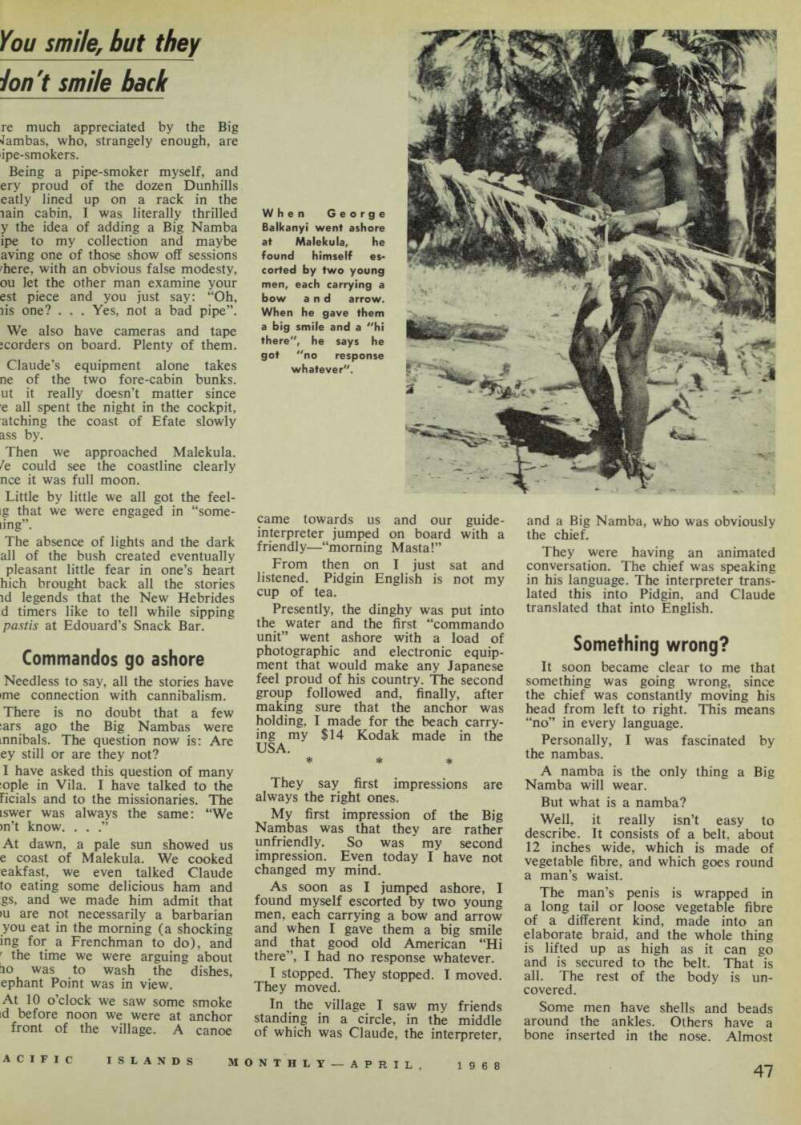
When George Balkanyi went ashore at Malekula, he found himself es corted by two young men, each carrying a bow and arrow.
When he gave them a big smile and a "hi there", he says he got "no response whatever".
everyone has an ornament in his ear lobe—a bone, a fish hook, a safety pin.
The men are thick set and their skin is dark. Their chests are hairy and some are bearded. They all have one thing in common—when you smile to them, they don’t smile back. * * * I looked around to see what the women were like, but I couldn’t see I learned later that they live in locked* 6 i?n ar when an( v' , h at tkey ’ are Women ™ v ‘ Slt °r® arrive. w °men are not even allowed to enf „h , n ' y n! 11 e e n" ar^ C 0 ? S,d f red pure enough to prepare the food.
I never found out who washes the ai vy s ’ ' ; . th . e ‘hree-way conversation was going on. said W rTand U e ‘° said Claude. said ’ h h ‘ m h 6 baCC °’
Claude looked embarrassed.
“I’ve already given it to him,” he said. “He just took it and keeps saying ‘no’ ”
I looked at the chief. He was a young man, well-built and in many ways different from all the other men. He was wearing, of course, the namba, a bone in his nose and a piece of fur in his earlobe. But in
addition to all this, he had a big comb, carved out of wood, in his hair. Everything in his attitude denoted authority, He was still shaking his head from left to right but it was obvious he was weakening, I could see in his eyes that the whole scene was amusing him and that sooner or later he would say “ves”
T ‘ tri w} , on
JgXZls seemed if hav^reached
e &JSS! hi 'xLTh.'ef u£d
his arm asking for silence and in a very c ear English pronounced these words: .. Qne ® ound V- We all looked at each other. The negotiations were re-established strictly on a financial basis and finally the “visitor’s team” had to surrender . The deal was: Qne picture nound' YeS ’ tbe 0nl V Words that *6 Big Nambas know of the English language are: “One pound”. r Strangely enough they learned it kta * ial m ° V j e makers of Mondo Cane who had no time to waste. They wanted to film the Big Nambas and their way of life—and *bey paid for it.
As far as the chief was con cerned, there was no reason why we shouldn’t do the same. But as far as we were concerned there was an
excellent reason—we did not feel disposed to pay one pound for each picture.
Yet what else could we do? Pick up the anchor and sail back to Vila without a picture? Face the boys at Edouard’s Snack Bar and listen to their “I told you so’s?”
Never!
We tried really hard. We tried in English, in French and in Pidgin.
The only answer we had was: One pound.
I shall not enter into the details.
Neither shall I report the terms of the conversation that the visiting team had before the complete, un conditional surrender. I shall only say that we took some pictures. Not many, but we took some.
I admit that I felt a strange com pulsion to go to the chief, shake his hand and say: “Good man! Don’t waste your time here in Malekula.
You should be in Madison Avenue selling advertising!”
From there on everything went quite well. When the pictures had been taken and the pounds had changed hands, a big spirit of fraternity descended upon all of us.
We were invited to share the chief’s dinner, which consisted of an excellent stew of . . . well ... of an excellent stew and rice.
We had hot tea, white and sweet, and we left, late in the evening, happy and penniless, with the same feeling that a child has the day he finds out that Santa Claus does not exist.
It had been an interesting trip, we had met interesting people, we had seen very little, and we had learned a good lesson. The days of tobacco sticks, mirrors and coloured ribbons are over. The new deal is: One picture, one pound. Take it or leave it.
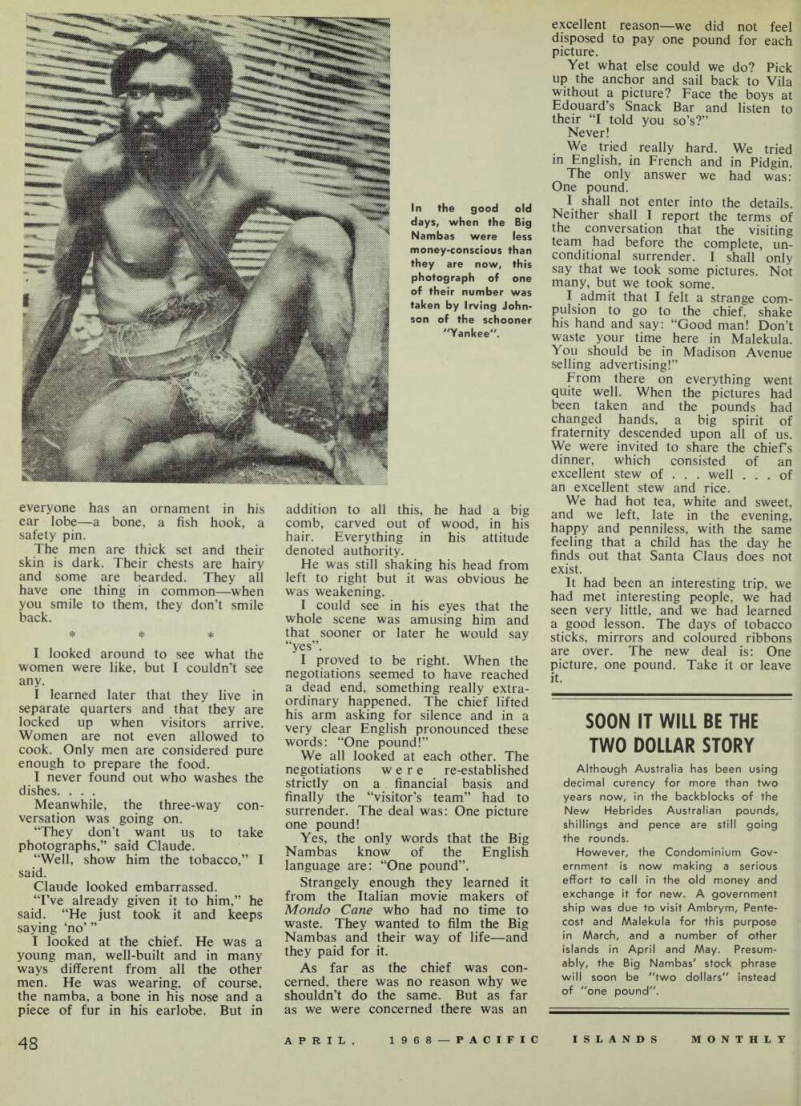
In the good old days, when the Big Nambas were less money-conscious than they are now, this photograph of one of their number was taken by Irving John son of the schooner "Yankee".