Tropicalities
pp. 32-33 · Read in the full issue
They danced the hula, drank kava (and other beverages), sang, talked, yelled, and really whooped it up Islands fashion, at the first social night of the Islanders Association of Sydney, held on March 23 at a Sydney community hall.
EVERY one of the 230-odd Islanders and friends obviously had a whale of a time, and certainly no one left until after an Island floor show had ended at about 1 a.m.
No one really knows just how many Pacific Islanders are living in Sydney these days, but there was no doubt they turned up in force to get this new Islands association off to a flying, if noisy, start.
Most of them were Fijians and their friends, but Samoans, Cook Islanders, Tongans and Tahitians also attended, many wearing colourful lavalavas, sulus or valas.
The almost non-stop attraction was music and fun from the “The Islanders”, a popular act well-known in Fiji and Australia.
Old-time residents from Fiji who attended the social night included Mr. and Mrs. Jack Curtis, Mrs. Emily Cubis and Mr. and Mrs. M. Griffen, all now living in Sydney. From Samoa came Mr. and Mrs. Gordon Bowan, and an old Tongan and Fiji hand was Mrs. Bonita Rounds.
Mr. Bob Major, the Fiji Govern ment Representative in Australia, was guest-of-honour. And, of course, we were there, too.
The floor show, which didn’t get going until after midnight, was worth waiting for.
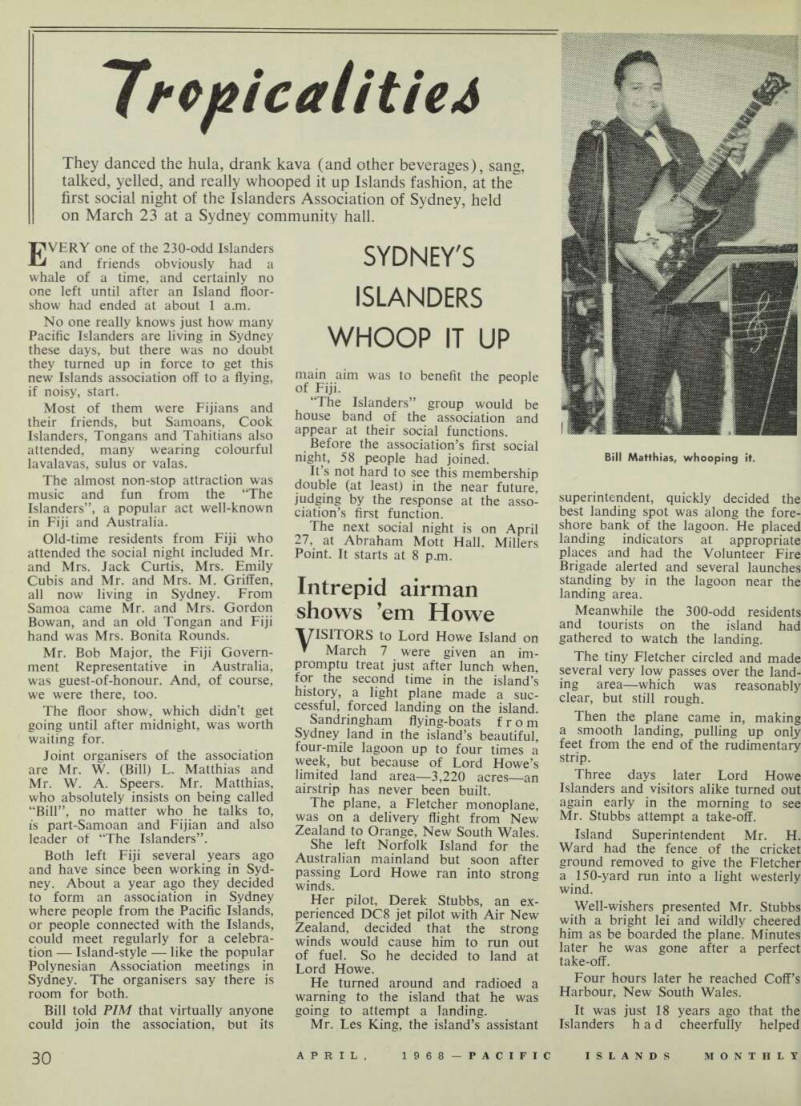
Joint organisers of the association are Mr. W. (Bill) L. Matthias and Mr. W. A. Speers. Mr. Matthias, who absolutely insists on being called “Bill”, no matter who he talks to, is part-Samoan and Fijian and also leader of “The Islanders”.
Both left Fiji several years ago and have since been working in Syd ney. About a year ago they decided to form an association in Sydney where people from the Pacific Islands, or people connected with the Islands, could meet regularly for a celebra tion Island-style like the popular Polynesian Association meetings in Sydney. The organisers say there is room for both.
Bill told PIM that virtually anyone could join the association, but its
Sydney's
Islanders
Whoop It Up
main aim was to benefit the people of Fiji, “The Islanders” group would be house band of the association and appear at their social functions.
Before the association’s first social night, 58 people had joined.
It’s not hard to see this membership double (at least) in the near future, judging by the response at the asso ciation’s first function.
The next social night is on April 27, at Abraham Mott Hall, Millers Point. It starts at 8 p.m.
Intrepid airman
shows ’em Howe
X/ISITORS to Lord Howe Island on ▼ March 7 were given an im promptu treat just after lunch when, for the second time in the island’s history, a light plane made a suc cessful, forced landing on the island.
Sandringham flying-boats from Sydney land in the island’s beautiful, four-mile lagoon up to four times a week, but because of Lord Howe’s limited land area—3,22o acres—an airstrip has never been built.
The plane, a Fletcher monoplane, was on a delivery flight from New Zealand to Orange, New South Wales.
She left Norfolk Island for the Australian mainland but soon after passing Lord Howe ran into strong winds.
Her pilot, Derek Stubbs, an ex perienced DCS jet pilot with Air New Zealand, decided that the strong winds would cause him to run out of fuel. So he decided to land at Lord Howe.
He turned around and radioed a warning to the island that he was going to attempt a landing.
Mr. Les King, the island’s assistant
superintendent, quickly decided the best landing spot was along the fore shore bank of the lagoon. He placed landing indicators at appropriate places and had the Volunteer Fire Brigade alerted and several launches standing by in the lagoon near the landing area.
Meanwhile the 300-odd residents and tourists on the island had gathered to watch the landing.
The tiny Fletcher circled and made several very low passes over the land ing area—which was reasonably clear, but still rough.
Then the plane came in, making a smooth landing, pulling up only feet from the end of the rudimentary strip.
Three days later Lord Howe Islanders and visitors alike turned out again early in the morning to see Mr. Stubbs attempt a take-off.
Island Superintendent Mr. H.
Ward had the fence of the cricket ground removed to give the Fletcher a 150-yard run into a light westerly wind.
Well-wishers presented Mr. Stubbs with a bright lei and wildly cheered him as be boarded the plane. Minutes later he was gone after a perfect take-off.
Four hours later he reached Coff’s Harbour, New South Wales.
It was just 18 years ago that the Islanders had cheerfully helped
Bill Matthias, whooping it.
mother aircraft —a Belgian mono tlane—on an unscheduled visit.
A former Island Superintendent, dr. J. Mcßean, told us that this jrcraft had left Goff’s Harbour en oute for New Zealand.
“The NZ pilot radioed he was run ling short of fuel,” Mr. Mcßean aid. “He landed fairly late in the fternoon on the beach and was very ortunate because the sand was hard md the tide low.
“It wasn’t long after flying-boats lad started bringing tourists over rom Sydney. I can remember people ying for a good vantage point to ee the landing. The pilot only stayed bout an hour and I don’t think he vas able to get any extra fuel. He ook off again along the beach.”
Talking of unusual landings. . . .
In mid-February a Piper Comanche "win landed at a private airstrip on iid-Pacific Fanning Island. It had teen flown from Honolulu (more han 1,000 miles away) in 8i hours, "he plane, owned by West Australian nterests, was being ferried from the Jnited States to Australia by Duane iwitzer, who was accompanied by lis wife, Joan. Some fourteen days fter landing on the island (it did ome survey work) the plane took off or Australia, carrying with it the irst airmail to go from Fanning sland to Australia. Among that first latch of airmal was this report for VM from old friend Phil Palmer, aanager of Fanning Island Planta ions Ltd. His private airstrip is lamed “Fil’s Field”.
Meeting of the
ways in P-NG
A ROMAN Catholic priest has taken a service in an Anglican hurch for what is believed to be the irst time in Papua-New Guinea. He
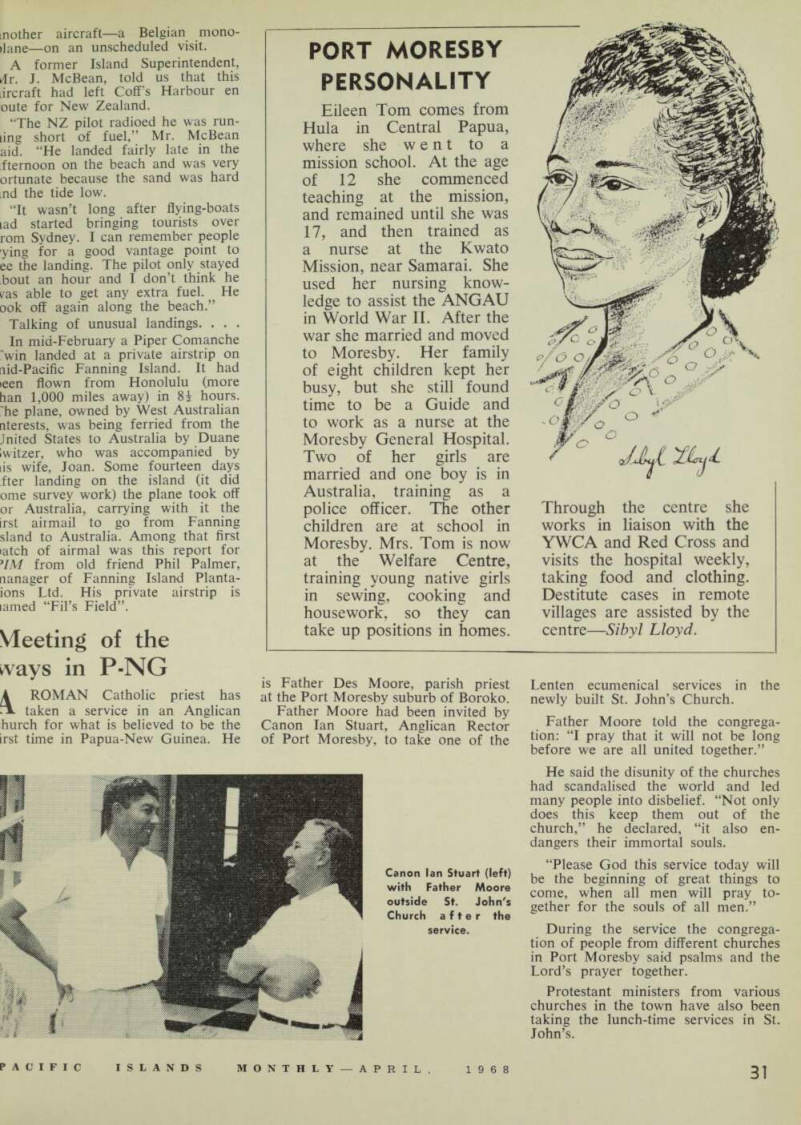
is Father Des Moore, parish priest at the Port Moresby suburb of Boroko.
Father Moore had been invited by Canon lan Stuart, Anglican Rector of Port Moresby, to take one of the
Lenten ecumenical services in the newly built St. John’s Church.
Father Moore told the congrega tion: “I pray that it will not be long before we are all united together.”
He said the disunity of the churches had scandalised the world and led many people into disbelief. “Not only does this keep them out of the church,” he declared, “it also en dangers their immortal souls.
“Please God this service today will be the beginning of great things to come, when all men will pray to gether for the souls of all men.”
During the service the congrega tion of people from different churches in Port Moresby said psalms and the Lord’s prayer together.
Protestant ministers from various churches in the town have also been taking the lunch-time services in St.
John’s.
Canon lan Stuart (left) with Father Moore outside St, John's Church after the service.