'enlivened by the radicals'
pp. 27-28 · Read in the full issue
The new Assembly will be 'enlivened by the radicals'
An election commentary by lAN DOWNS elected member of the P-NG legislature 1957-67.
No clear message comes through from the results of the New Guinea House of Assembly elections; but the results will have a profound effect upon the conduct of the House if for no other reason than that so many former members decided not to stand again and of those that did quite a high proportion were defeated.
The immediate problem will be to fill the Speakership with a man who has a confident knowledge of the House rules, the proper procedure and the standing orders which govern all debate. By tradition and practise the Speaker controls all activities within the House of Assembly and through the Clerk of the House the whole of the staff comes under his control.
Usually the job falls to a compe tent senior member who should be above the conflict of debate and beyond party or political ambition.
The Speaker of the House is virtually a law unto himself, and ranks high in precedence, alongside the Adminis trator and the Chief Justice.
In sporting terms, the Speaker is not only the referee but also the administrative head and the president of the league.
The defeat of three former mem bers whose main ambition in standing again was closely connected to a reasonable prospect that they would be nominated for the Speakership if elected to the House, has left the field open to endless speculation.
Who for Speaker?
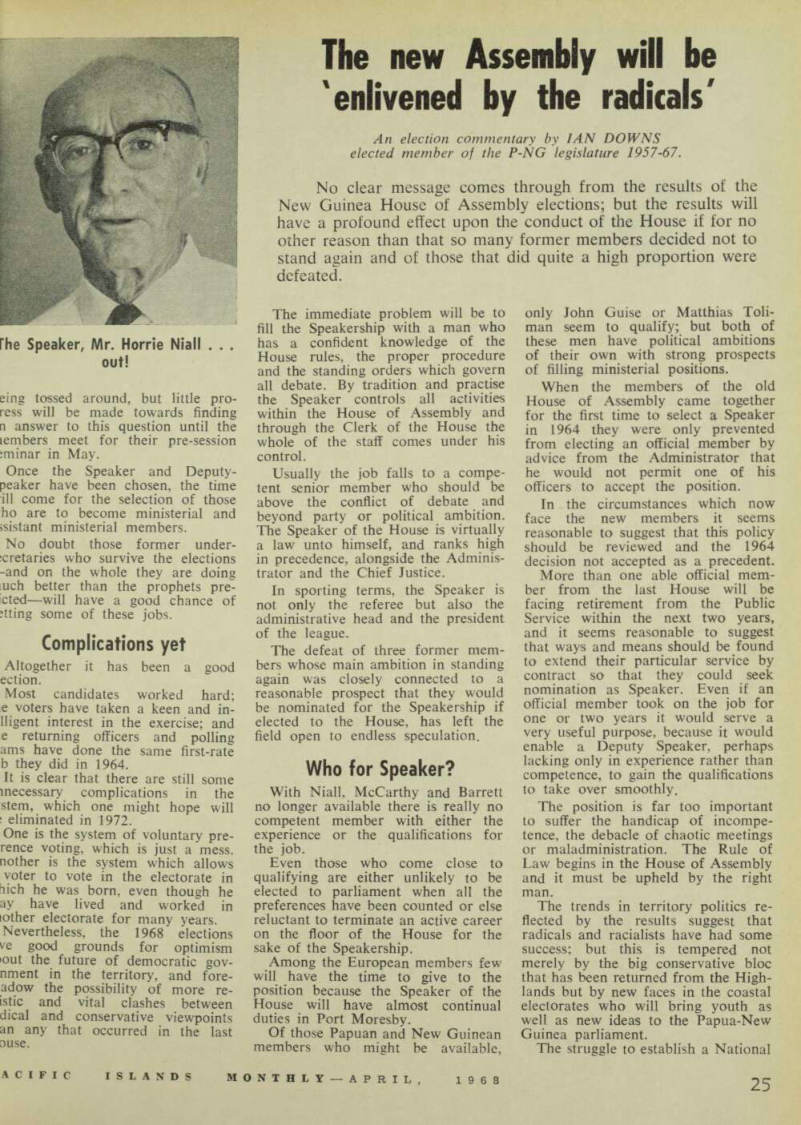
With Niall, McCarthy and Barrett no longer available there is really no competent member with either the experience or the qualifications for the job.
Even those who come close to qualifying are either unlikely to be elected to parliament when all the preferences have been counted or else reluctant to terminate an active career on the floor of the House for the sake of the Speakership.
Among the European members few will have the time to give to the position because the Speaker of the House will have almost continual duties in Port Moresby.
Of those Papuan and New Guinean members who might be available,
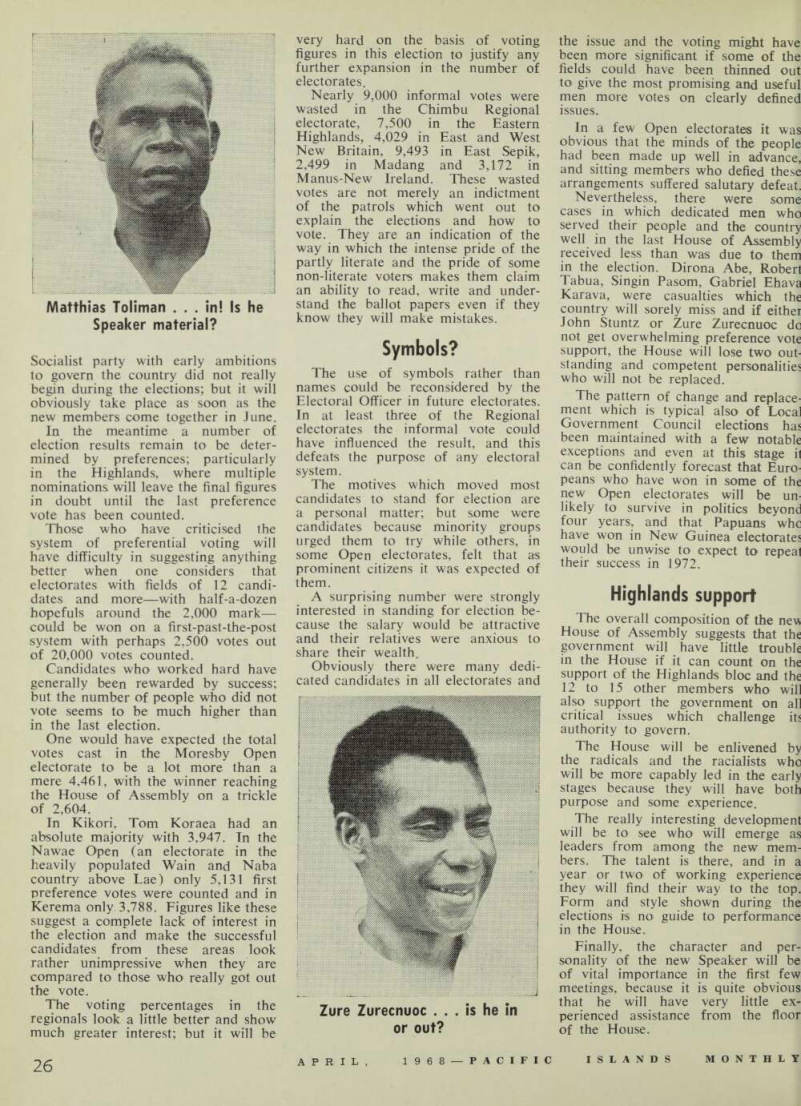
only John Guise or Matthias Toli man seem to qualify; but both of these men have political ambitions of their own with strong prospects of filling ministerial positions.
When the members of the old House of Assembly came together for the first time to select a Speaker in 1964 they were only prevented from electing an official member by advice from the Administrator that he would not permit one of his officers to accept the position.
In the circumstances which now face the new members it seems reasonable to suggest that this policy should be reviewed and the 1964 decision not accepted as a precedent.
More than one able official mem ber from the last House will be facing retirement from the Public Service within the next two years, and it seems reasonable to suggest that ways and means should be found to extend their particular service by contract so that they could seek nomination as Speaker. Even if an official member took on the job for one or two years it would serve a very useful purpose, because it would enable a Deputy Speaker, perhaps lacking only in experience rather than competence, to gain the qualifications to take over smoothly.
The position is far too important to suffer the handicap of incompe tence, the debacle of chaotic meetings or maladministration. The Rule of Law begins in the House of Assembly and it must be upheld by the right man.
The trends in territory politics re flected by the results suggest that radicals and racialists have had some success; but this is tempered not merely by the big conservative bloc that has been returned from the High lands but by new faces in the coastal electorates who will bring youth as well as new ideas to the Papua-New Guinea parliament.
The struggle to establish a National
Socialist party with early ambitions to govern the country did not really begin during the elections; but it will obviously take place as soon as the new members come together in June.
In the meantime a number of election results remain to be deter mined by preferences; particularly in the Highlands, where multiple nominations will leave the final figures in doubt until the last preference vote has been counted.
Those who have criticised the system of preferential voting will have difficulty in suggesting anything better when one considers that electorates with fields of 12 candi dates and more—with half-a-dozen hopefuls around the 2,000 mark— could be won on a first-past-the-post system with perhaps 2,500 votes out of 20,000 votes counted.
Candidates who worked hard have generally been rewarded by success; but the number of people who did not vote seems to be much higher than in the last election.
One would have expected the total votes cast in the Moresby Open electorate to be a lot more than a mere 4,461, with the winner reaching the House of Assembly on a trickle of 2,604.
In Kikori, Tom Koraea had an absolute majority with 3,947. In the Nawae Open (an electorate in the heavily populated Wain and Naba country above Lae) only 5,131 first preference votes were counted and in Kerema only 3,788. Figures like these suggest a complete lack of interest in the election and make the successful candidates from these areas look rather unimpressive when they are compared to those who really got out the vote.
The voting percentages in the regionals look a little better and show much greater interest; but it will be
very hard on the basis of voting figures in this election to justify any further expansion in the number of electorates.
Nearly 9,000 informal votes were wasted in the Chimbu Regional electorate, 7,500 in the Eastern Highlands, 4,029 in East and West New Britain, 9,493 in East Sepik, 2,499 in Madang and 3,172 in Manus-New Ireland. These wasted votes are not merely an indictment of the patrols which went out to explain the elections and how to vote. They are an indication of the way in which the intense pride of the partly literate and the pride of some non-literate voters makes them claim an ability to read, write and under stand the ballot papers even if they know they will make mistakes.
Symbols?
The use of symbols rather than names could be reconsidered by the Electoral Officer in future electorates.
In at least three of the Regional electorates the informal vote could have influenced the result, and this defeats the purpose of any electoral system.
The motives which moved most candidates to stand for election are a personal matter; but some were candidates because minority groups urged them to try while others, in some Open electorates, felt that as prominent citizens it was expected of them.
A surprising number were strongly interested in standing for election be cause the salary would be attractive and their relatives were anxious to share their wealth.
Obviously there were many dedi cated candidates in all electorates and
the issue and the voting might have been more significant if some of the fields could have been thinned out to give the most promising and useful men more votes on clearly defined issues.
In a few Open electorates it was obvious that the minds of the people had been made up well in advance, and sitting members who defied these arrangements suffered salutary defeat.
Nevertheless, there were some cases in which dedicated men who served their people and the country well in the last House of Assembly received less than was due to them in the election. Dirona Abe, Robert Tabua, Singin Pasom, Gabriel Ehava Karava, were casualties which the country will sorely miss and if either John Stuntz or Zure Zurecnuoc do not get overwhelming preference vote support, the House will lose two out standing and competent personalities who will not be replaced.
The pattern of change and replace ment which is typical also of Local Government Council elections has been maintained with a few notable exceptions and even at this stage it can be confidently forecast that Euro peans who have won in some of the new Open electorates will be un likely to survive in politics beyond four years, and that Papuans whc have won in New Guinea electorates would be unwise to expect to repeal their success in 1972.
Highlands support
The overall composition of the new House of Assembly suggests that the government will have little trouble in the House if it can count on the support of the Highlands bloc and the 12 to 15 other members who will also support the government on all critical issues which challenge its authority to govern.
The House will be enlivened by the radicals and the racialists who will be more capably led in the early stages because they will have both purpose and some experience.
The really interesting development will be to see who will emerge as leaders from among the new mem bers. The talent is there, and in a year or two of working experience they will find their way to the top.
Form and style shown during the elections is no guide to performance in the House.
Finally, the character and per sonality of the new Speaker will be of vital importance in the first few meetings, because it is quite obvious that he will have very little ex perienced assistance from the floor of the House.
Matthias Toliman ... in! Is he Speaker material?
Zure Zurecnuoc ... is he In or out?