[?]edding
p. 23 · Read in the full issue
They all lanced [?]t her [?]edding
From Betty Sanft,
in Nukualofa
Everyone loves a wedding—and Tongans are no exception.
In March, the Islanders enjoyed three days of feasting and re joicing to mark the first royal wedding in 21 years when Prin cess Fusipala, second daughter of Prince Tuipelehake, the Premier, and Princess Melenaite, was married to Hahano, only son of Vaha’i, noble of Fo’ui.
The Royal Chaplain, the Rev. G.
Harris, officiated. Guests from her Pacific territories and the outer ands gathered to take part in the lebrations.
The morning before the ceremony, e Registrar called at “Fatai”, home the bride’s parents, for the formal gistration of the marriage. At noon, e young couple walked from r atai” along the waterfront, to a sat feast on the malae (domain), aid a large, cheering crowd who ng and danced around the couple d their attendants.
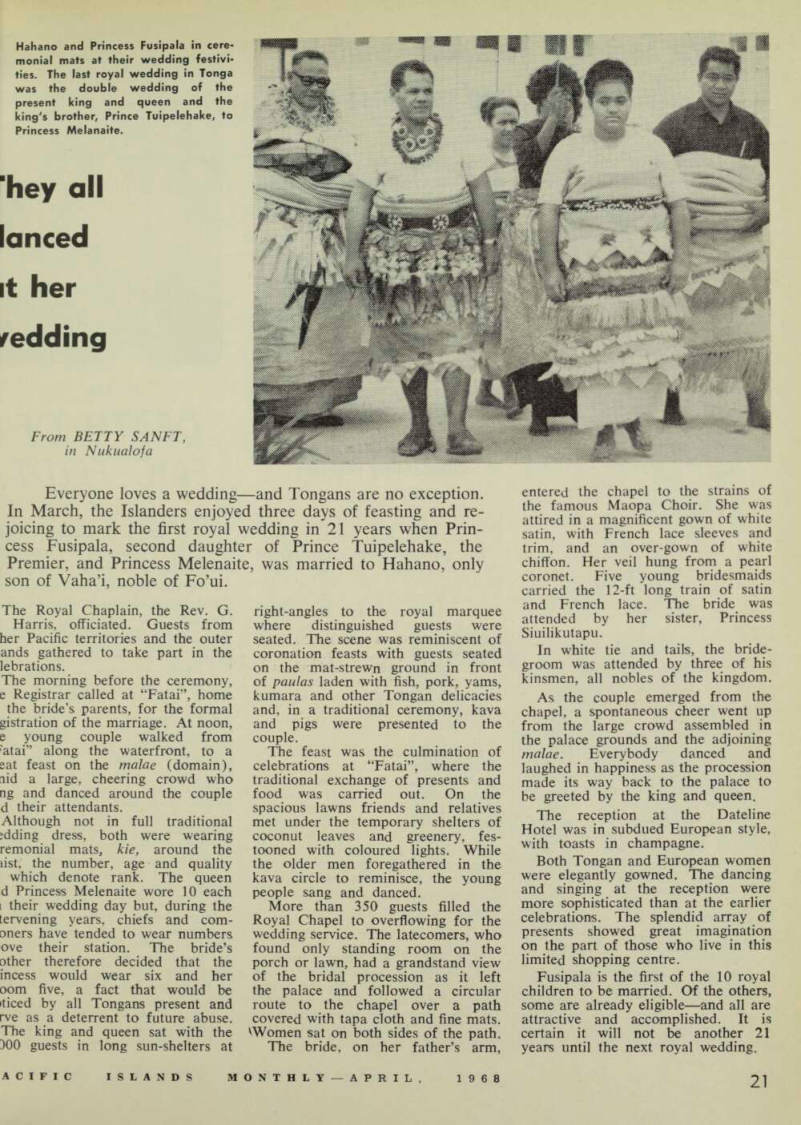
Although not in full traditional adding dress, both were wearing remonial mats, kie, around the list, the number, age and quality which denote rank. The queen d Princess Melenaite wore 10 each i their wedding day but, during the tervening years, chiefs and corn oners have tended to wear numbers ove their station. The bride’s other therefore decided that the incess would wear six and her oom five, a fact that would be ►ticed by all Tongans present and rve as a deterrent to future abuse.
The king and queen sat with the X)0 guests in long sun-shelters at
right-angles to the royal marquee where distinguished guests were seated. The scene was reminiscent of coronation feasts with guests seated on the mat-strewn ground in front of paulas laden with fish, pork, yams, kumara and other Tongan delicacies and, in a traditional ceremony, kava and pigs were presented to the couple.
The feast was the culmination of celebrations at “Fatai”, where the traditional exchange of presents and food was carried out. On the spacious lawns friends and relatives met under the temporary shelters of coconut leaves and greenery, fes tooned with coloured lights. While the older men foregathered in the kava circle to reminisce, the young people sang and danced.
More than 350 guests filled the Royal Chapel to overflowing for the wedding service. The latecomers, who found only standing room on the porch or lawn, had a grandstand view of the bridal procession as it left the palace and followed a circular route to the chapel over a path covered with tapa cloth and fine mats. vWomen sat on both sides of the path.
The bride, on her father’s arm,
entered the chapel to the strains of
f^ ous
attired in a magnificent gown or white satin? with French lace sleeves and trim,’ and an over-gown of white chiffon. Her veil hung from a pearl coronet. Five young bridesmaids carried the 12-ft long tram of satin sister attende y , amniKutapu.
I n w hite tie and tails, the bnde groom was attended by three of his kinsmen, all nobles of the kingdom, As the couple emerged from the chapel, a spontaneous cheer went up from the large crowd assembled in the palace grounds and the adjoining malae. Everybody danced and laughed in happiness as the procession made its way back to the palace to be greeted by the king and queen, „ re <:eption “I" 1 V w toasts in cha p gne.
Both Tongan and European women were elegantly gowned. The dancing an d singing at the reception were more sophisticated than at the earlier celebrations. The splendid array of presents showed great imagination ° n .the part of those who live in this limited shopping centre, Fusipala is the first of the 10 royal children to be married. Of the others, some are already eligible—and all are attractive and accomplished. It is certain it will not be another 21 years until the next royal wedding.
Hahano and Princess Fusipala in cere monial mats at their wedding festivi ties. The last royal wedding in Tonga was the double wedding of the present king and queen and the king's brother, Prince Tuipelehake, to Princess Melanaite.