problems are still ahead of her
pp. 32-34 · Read in the full issue
Off to a good, cautious start, but Nauru's problems are still ahead of her
By STUART INDER, who was a guest of the Nauruans for the independence ceremonies
February turned out to be a quiet month in the Republic of Nauru—almost a sleepy month.
But, then it really was a heck of a January! A period of recovery was needed after the captains and the kings departed from the independence celebrations of January 31. Time was required for the Nauruans to sit and think, and perhaps occasionally to wonder at the indisputable fact that Nauru really had won its bloodless revolution, and still had all its friends.
February was needed to savour in dependence, for clearly the Nauruans didn’t consider the celebrations them selves as the occasion for it.
Perhaps there were too many guests to be entertained, or perhaps there was no satisfaction in stressing the obvious, or there was a sombre re alisation that independence is a seri ous business, but anyway the absence of a “headiness” in the air, of flag waving and of large local crowds at the various functions puzzled many visitors.
Typical courtesy
Certainly it was an undemon strative independence week, different from the kind of emotional display the world has come to expect from new-born nations at the moment of release.
The full interpretation of this Nauruan reaction I will leave to those more skilled, but if their final diagnosis is that the Nauruans really
didn’t want independence then 1 won’t agree with them.
Nauru was quietly proud to greet its visitors, and turned on typical Nauruan courtesy and some first-rate organisation. Hotel-less Nauru, only 5,263 acres big, and much of that now filled with jagged coral pinnacles, stretched its resources and its heart to accommodate five chartered plane loads of guests in private houses, with meals arranged in special messes presided over by imported chefs.
Pretty hostesses answered queries, handed out attache cases stuffed with detailed maps and information on the extensive programme; cars and drivers were no farther than a telephone call to the efficient central control; the best seats at everything were kept for the visitors.
It all went very well—from the official reception, the Chinese New Year concert, the combined church service under the stars, the great fire works display, the inaugural meeting
of the Legislative Assembly, the flag raising ceremony, right up to the national games and sports, the com munity concert and the all-island barbecue (where 4,500 turned up oi a total population of 6,000, to joy fully polish off 3,000 lb of steak, chops and sausages and a shipload of canned soft drinks).
It was a well-balanced independ ence mixture, handled at all times with both dignity and warmth.
Backdrop of phosphate
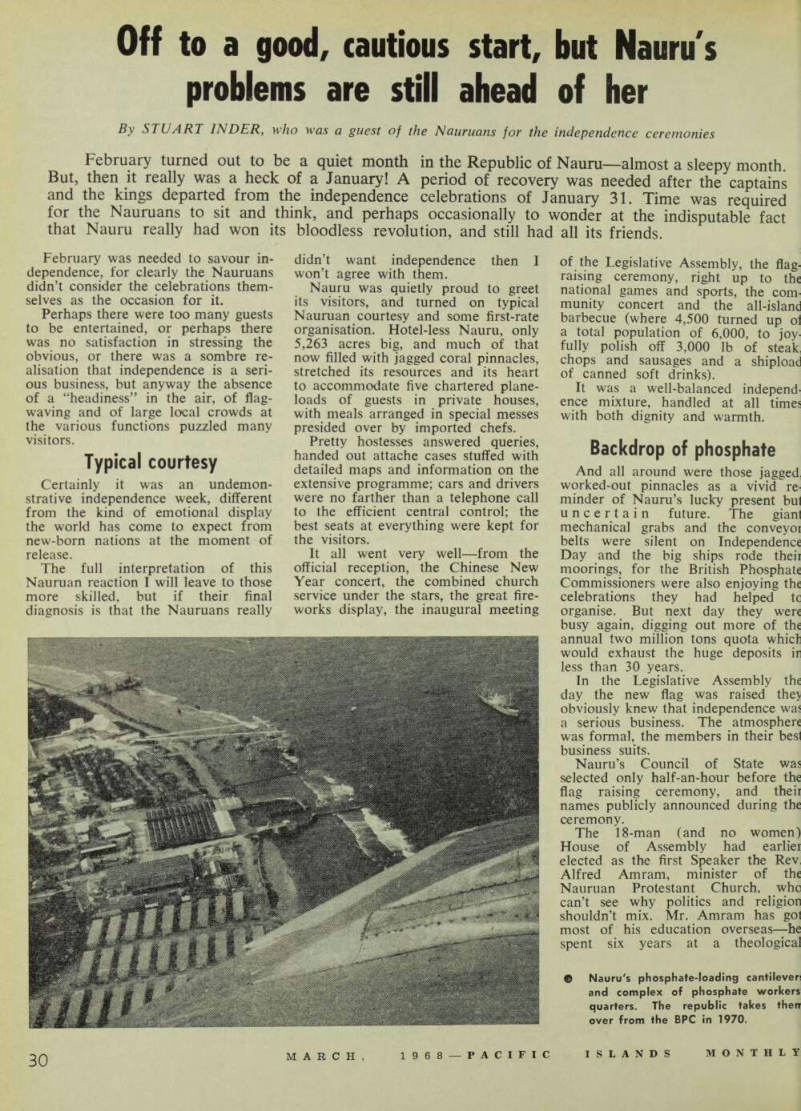
And all around were those jagged, worked-out pinnacles as a vivid re minder of Nauru’s lucky present bul uncertain future. The giant mechanical grabs and the conveyor belts were silent on Independence Day and the big ships rode their moorings, for the British Phosphate Commissioners were also enjoying the celebrations they had helped tc organise. But next day they were busy again, digging out more of the annual two million tons quota which would exhaust the huge deposits in less than 30 years.
In the Legislative Assembly the day the new flag was raised they obviously knew that independence was a serious business. The atmosphere was formal, the members in their best business suits.
Nauru’s Council of State was selected only half-an-hour before the flag raising ceremony, and their names publicly announced during the ceremony.
The 18-man (and no women) House of Assembly had earlier elected as the first Speaker the Rev.
Alfred Amram, minister of the Nauruan Protestant Church, who can’t see why politics and religion shouldn’t mix. Mr. Amram has got most of his education overseas—he spent six years at a theological
Nauru's phosphate-loading cantilevers and complex of phosphate workers quarters. The republic takes them over from the BPC in 1970.
allege in Sydney and another year n a scholarship in America—and r as considered by some Nauruans to e Council of State material. If so, is appointment as Speaker success jlly precluded anybody from ominating him for that august ircle.
Council of State
There were seven nominations for le five man council. There were le five “old guard”, whom I expec id to be nominated because these re the five who have been most :tive in everything leading to in spendence, and perhaps even any ting that is anything on Nauru, hese are Hammer Deßoburt, Austin ernicke, Buraro Detudamo, Joseph •etsimea and James Bop.
The two extra were Samuel Tsitsi id Victor Eoaeo, both members of le old Legislative Council. Victor oaeo promptly refused the nomina on, so that left the old guard plus sitsi in the ballot. With the maxi inm possible vote of 17 per man, le final score was: Deßoburt and ernicke 17 each, Detudamo 16, etsimea 13, Bop 12, and Tsitsi 10.
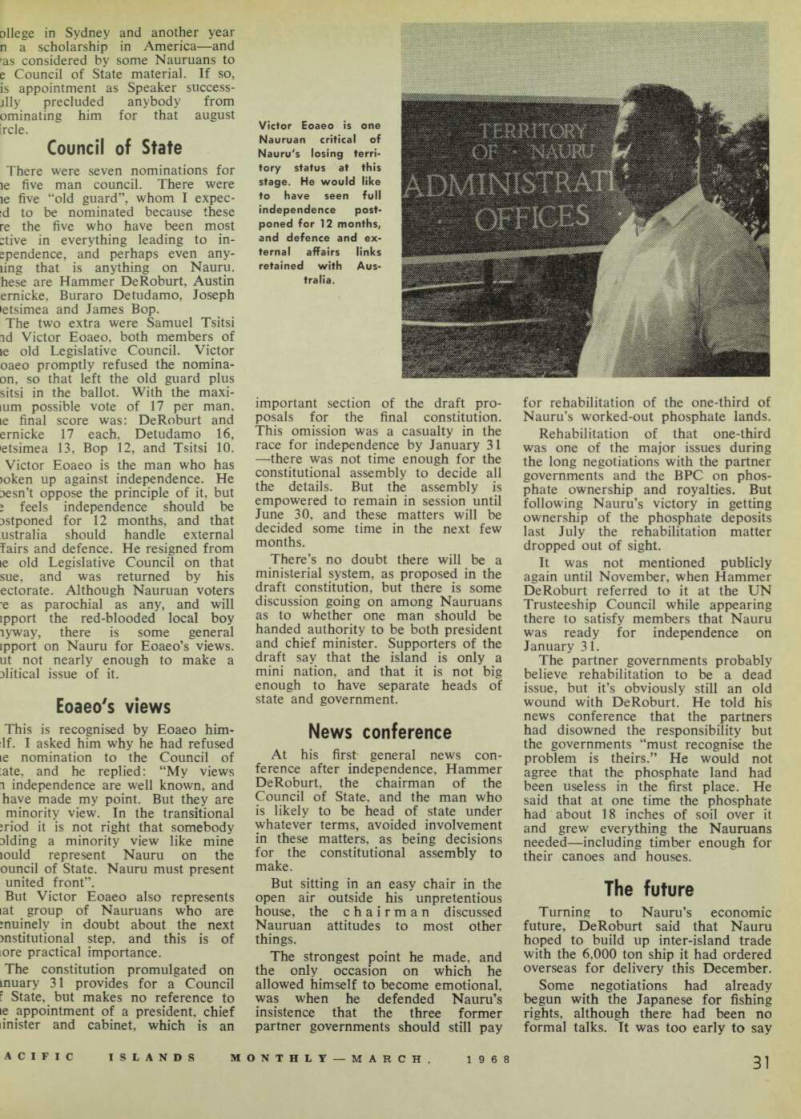
Victor Eoaeo is the man who has >oken up against independence. He aesn’t oppose the principle of it, but j feels independence should be Dstponed for 12 months, and that ustralia should handle external fairs and defence. He resigned from le old Legislative Council on that sue, and was returned by his ectorate. Although Nauruan voters e as parochial as any, and will ipport the red-blooded local boy iyway, there is some general ipport on Nauru for Eoaeo’s views, ut not nearly enough to make a alitical issue of it.
Eoaeo's views
This is recognised by Eoaeo him lf. I asked him why he had refused ic nomination to the Council of ;ate, and he replied: “My views i independence are well known, and have made my point. But they are minority view. In the transitional ;riod it is not right that somebody aiding a minority view like mine lould represent Nauru on the ouncil of State. Nauru must present united front”.
But Victor Eoaeo also represents tat group of Nauruans who are muinely in doubt about the next institutional step, and this is of ore practical importance.
The constitution promulgated on muary 31 provides for a Council ! State, but makes no reference to te appointment of a president, chief linister and cabinet, which is an
important section of the draft pro posals for the final constitution.
This omission was a casualty in the race for independence by January 31 —there was not time enough for the constitutional assembly to decide all the details. But the assembly is empowered to remain in session until June 30, and these matters will be decided some time in the next few months.
There’s no doubt there will be a ministerial system, as proposed in the draft constitution, but there is some discussion going on among Nauruans as to whether one man should be handed authority to be both president and chief minister. Supporters of the draft say that the island is only a mini nation, and that it is not big enough to have separate heads of state and government.
News conference
At his first general news con ference after independence, Hammer Deßoburt, the chairman of the Council of State, and the man who is likely to be head of state under whatever terms, avoided involvement in these matters, as being decisions for the constitutional assembly to make.
But sitting in an easy chair in the open air outside his unpretentious house, the chairman discussed Nauruan attitudes to most other things.
The strongest point he made, and the only occasion on which he allowed himself to become emotional, was when he defended Nauru’s insistence that the three former partner governments should still pay
for rehabilitation of the one-third of Nauru’s worked-out phosphate lands.
Rehabilitation of that one-third was one of the major issues during the long negotiations with the partner governments and the BPC on phos phate ownership and royalties. But following Nauru’s victory in getting ownership of the phosphate deposits last July the rehabilitation matter dropped out of sight.
It was not mentioned publicly again until November, when Hammer Deßoburt referred to it at the UN Trusteeship Council while appearing there to satisfy members that Nauru was ready for independence on January 31.
The partner governments probably believe rehabilitation to be a dead issue, but it’s obviously still an old wound with Deßoburt. He told his news conference that the partners had disowned the responsibility but the governments “must recognise the problem is theirs.” He would not agree that the phosphate land had been useless in the first place. He said that at one time the phosphate had about 18 inches of soil over it and grew everything the Nauruans needed—including timber enough for their canoes and houses.
The future
Turning to Nauru’s economic future, Deßoburt said that Nauru hoped to build up inter-island trade with the 6,000 ton ship it had ordered overseas for delivery this December.
Some negotiations had already begun with the Japanese for fishing rights, although there had been no formal talks. It was too early to say
Victor Eoaeo is one Nauruan critical of Nauru's losing terri tory status at this stage. He would like to have seen full independence post poned for 12 months, and defence and ex ternal affairs links retained with Aus tralia.
No Nauruan Plans Yet For Phosphate
whether the Japanese wanted to bring a canning factory to Nauru, or merely to freeze and export fish, but Nauru would probably be more in terested in a cannery than a freezer, because it wanted jobs for workers, not profits.
Nauru would not join the United Nations, but it would apply to join the South Pacific Commission as a full, paying member. Nauru’s problems were not the same as those in other territories in the South Seas, and it would not expect to take a leading part in the SPC. He be lieved that all South Pacific territories would get closer together in the next five years, but he said he was unable to make any firm predictions as to how this would be done because he was not “well versed” in these matters.
Phosphate corporation
Engaged for years in fighting his own battles with the partner govern ments, it seems to me that Hammer Deßoburt has no firm line yet on Nauru’s external affairs—or any great knowledge of the problems in the rest of the Pacific. He will no doubt play it by ear.
Touched on only briefly at that news conference was the vital matter of establishing the Nauruan Phos phate Corporation. Under last year’s agreements the corporation will be set up to take over management of the phosphate workings from the British Phosphate Commissioners, and guarantee the loading of two million tons of phosphate per year in BPC ships.
The BPC executives themselves agree that there is nothing difficult about managing the phosphate busi ness—competent experts can be found from many places. But obviously the BPC has had more experience with the Nauru operation than anybody else, and it is in Nauru’s interest to make use of as much of the existing operation as possible.
To make the changeover painless, the BPC have already offered guarantees of redundancy pay to their staff, so that if they are to lose their jobs they will have a nest egg to enable them to look around for some thing else. This pay is generous. One stenographer I spoke to who will have been on the island for four years when the Nauruan Phosphate Corporation finally takes over, will leave, if she chooses, with 12 months’ salary. Payments depend on the length of service and position.
"Wait and see"
The BPC wants to see the NPC take over a going concern in June, 1970, and they say they are not likely to want any more than about five key personnel for duties else where when the times comes. There is no reason, the BPC think, why the others wouldn’t be content to remain on Nauru under the same terms and conditions.
The prevailing attitude of the Europeans employed by the BPC seems to be “wait and see”. There is no particular apprehension about Nauru’s sudden plunge into indepen dence, but most employees appear to
have one ear cocked to hear hov* the Nauruans manage in the nex two years.
They don’t expect the Nauruan: will become too involved in phos phate economics in the meantime because they think they will be to( busy getting on top of the politica and social changes.
The Gilbert and Ellice Islanders who make up an important part o the phosphate work force (they ar< particularly efficient with mechanica equipment) mainly appear anxiou: only that their jobs should continue and on the same conditions. When they come from, jobs are too scarc< for them to afford to lose job oppor tunities on Nauru. One hears som< apprehension expressed about hov the Gilbertese and the Nauruans wil get on after independence, but ; don’t see any trouble arising so lonj as the Gilbertese aren’t irritated b? any new and unnecessary immigratioi restrictions, which would make then feel inferior.
The Chinese take roughly the sairu view as the Gilbertese or perhap; are a little bit more cautious.
Deßoburt has meanwhile statec publicly that Nauruans are eager tc keep present BPC staff on the islanc after the corporation takes over anc he has said that those who remair “will be shown every consideration”
He recognises that there wil always be phosphate work for senio: qualified expatriates, because of th( island’s small population. There an only 1,100 adult Nauruans.
Must get it started
The fact remains that little has ye been done by the Nauruans tc establish their phosphate corporator —an organisation which will contro their life blood for the next 25 yean or more, and be the source of theii wealth.
Close observers agree that £ general manager and a good financial director should be sought withoui delay, so they can work closely with the BPC in this important change over period.
Nauruan independence without ar efficient phosphate industry would be nothing but a sham.
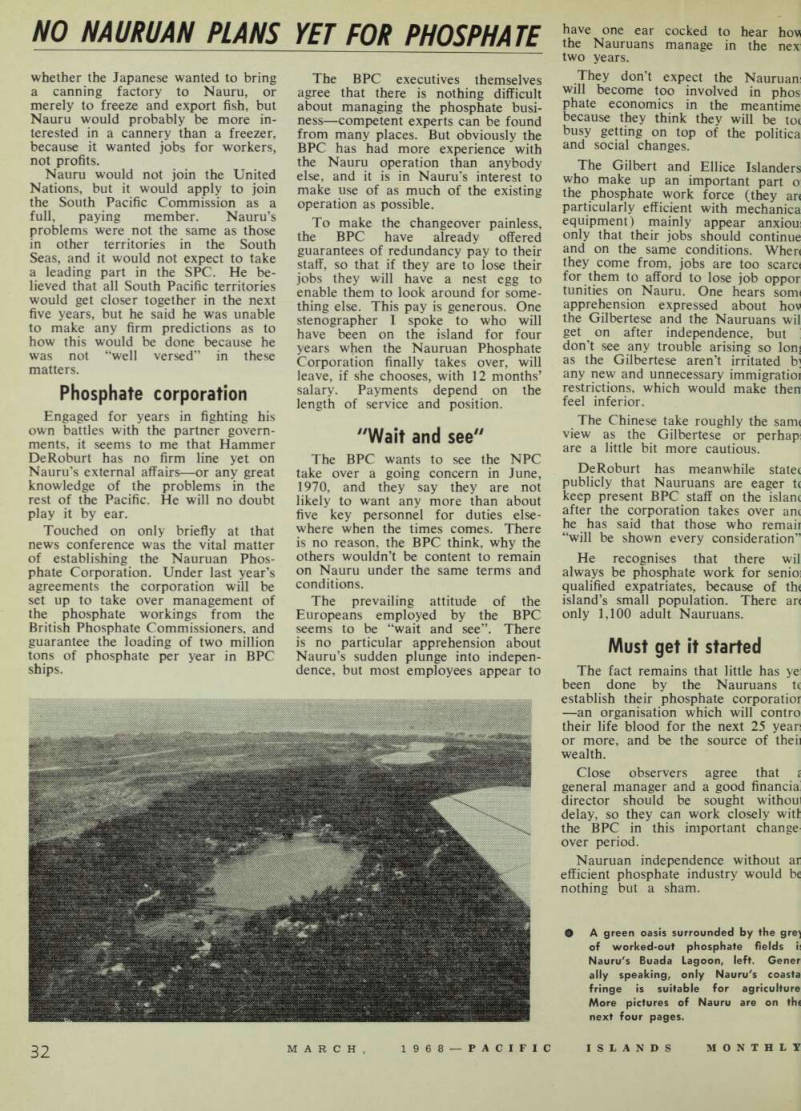
O A green oasis surrounded by the grey of worked-out phosphate fields is Nauru's Buada Lagoon, left. Gener ally speaking, only Nauru's coasta fringe is suitable for agriculture More pictures of Nauru are on the next four pages.