They Suffer
pp. 30-31 · Read in the full issue
Nobly For
Science
The university sent Mr. D. G.
Reynolds, an experienced researcher in this field, who for the past three months has been trying three different parasites, any of which may have the desired effect if successfully estab lished.
Present indications are hopeful, but the picture will only fully emerge when he returns for a further examination toward the end of 1968.
A successful outcome of this strictly laboratory experiment will lead to field trials in the countries of greater filariasis infestation, and perhaps to an eventual massive assault on the disease.
Meanwhile, mosquito spraying has now resumed on Nauru, to the relief of the locals.
Was the diet too
much for Meg?
AMEGAPODE bird from Tin Can Island almost made her debut at the Honolulu zoo on February 22. “Meg” was a gift to the zoo from Kitione Mamata, the Tin Can Island tele graph operator.
For almost a year now, Mamata, had been sending megapode eggs to the Honolulu zoo by Matson Lines’ tin can mail and the Monterey. But none of them completed incubation at the zoo.
On January 27, Mamata sent Meg aboard the Monterey, regretting that her mate had died. Those aboard didn’t know what the bird’s natural diet consisted of, so an international menu was kept in her corral and changed daily.
Meg quickly expressed her prefer ence for food in the following peck ing order; Australian rock-melon.
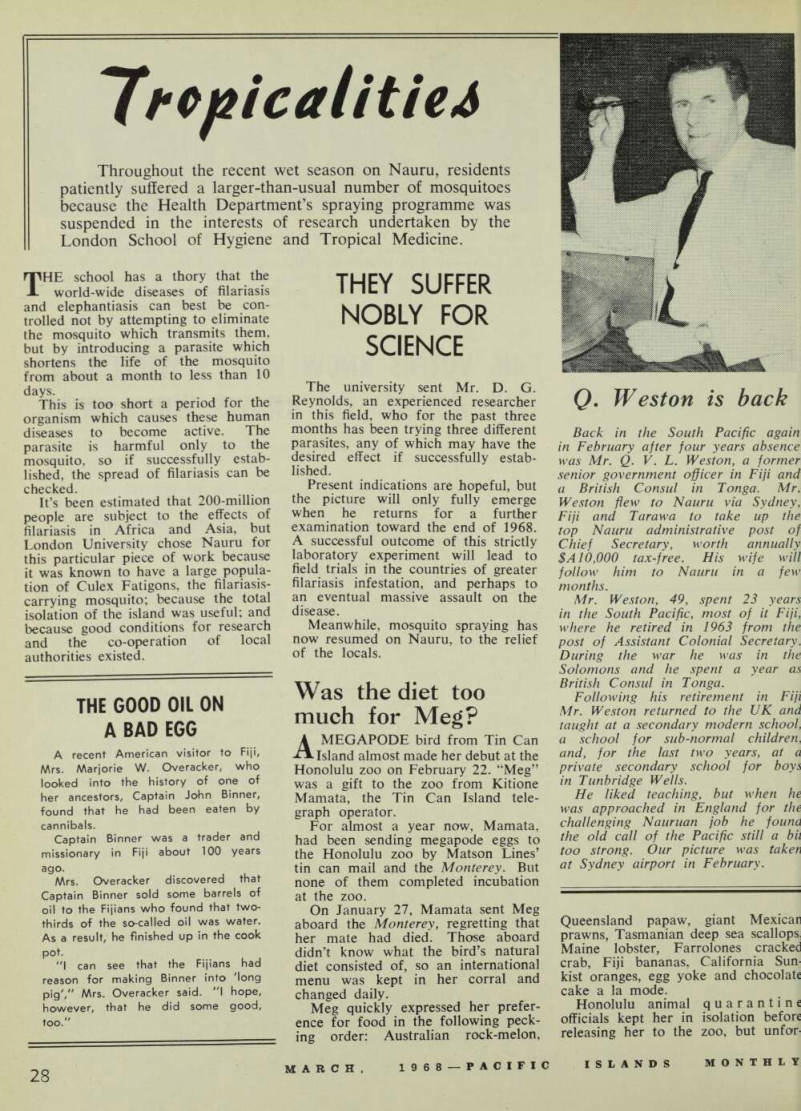
Q. Weston is back
Back in the South Pacific again in February after four years absence was Mr. Q. V. L. Weston, a former senior government officer in Fiji and a British Consul in Tonga. Mr.
Weston flew to Nauru via Sydney, Fiji and Tarawa to take up the top Nauru administrative post of Chief Secretary, worth annually $ A10,000 tax-free. His wife will follow him to Nauru in a few months.
Mr. Weston, 49, spent 23 years in the South Pacific, most of it Fiji, where he retired in 1963 from the post of Assistant Colonial Secretary.
During the war he was in the Solomons and he spent a year as British Consul in Tonga.
Following his retirement in Fiji Mr. Weston returned to the UK and taught at a secondary modern school, a school for sub-normal children, and, for the last two years, at a private secondary school for boys in Tunbridge Wells.
He liked teaching, but when he was approached in England for the challenging Nauruan job he found the old call of the Pacific still a bi[?] too strong. Our picture was taken at Sydney airport in February.
Queensland papaw, giant Mexicar prawns, Tasmanian deep sea scallops Maine lobster, Farrolones cracked crab, Fiji bananas, California Sun kist oranges, egg yoke and chocolat* cake a la mode.
Honolulu animal quarantine officials kept her in isolation before releasing her to the zoo, but unfor
nately she quietly died during this riod.
The megapode is of interest mainly naturalists because of her huge gs which she lays in the sand, iving the warmth of the sun to tch them. She has cousins in New linea and the Solomons and is also ated to the Australian bush turkey, iw her forebears managed to get remote Niuafo’ou in the long ago n past is anybody’s guess, and she’s ;ting rare there because her eggs ; a favourite food of the islanders.
rogress by-passes
ic housegirl
IHE age of the housegirl is coming to an end on Niue. Housegirls ; difficult to get these days. Wages : them are higher than they have ;r been, but girls don’t want to housegirls any more.
And now, a group of new houses ing built by the Administration Fualahi, in the vicinity of Niue’s ejected airstrip, and some that have ;n recently completed at Aliluki, ve no quarters for housegirls.
The new houses are easier run than ; old ones. They are smaller, they ve solar water-heaters and bottled » stoves.
The elimination of the wood stove, ich has been general in Niue Iministration-built houses, is locally jported.
The wood stove almost requires ; attention of a housegirl of its n, plus a garden boy to chop DUgh wood to keep its hungry ;-box fed.
lome to Nauru —
Eter 52 years
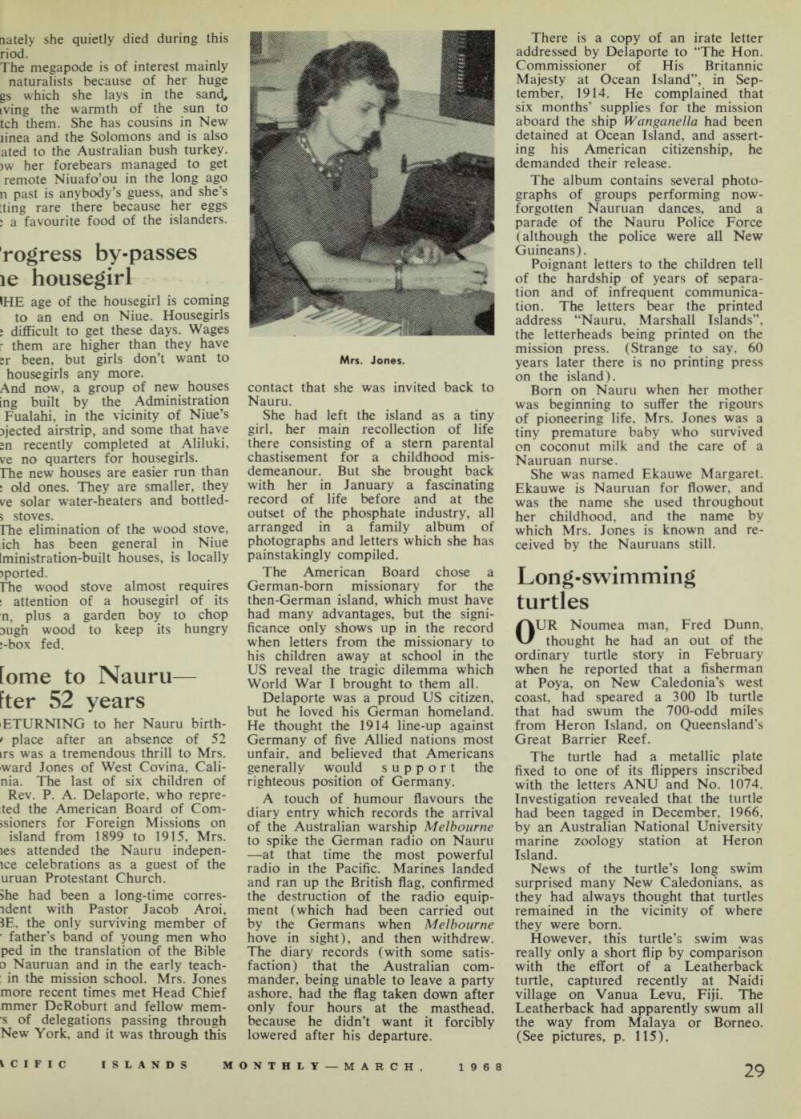
ETURNING to her Nauru birth > place after an absence of 52 irs was a tremendous thrill to Mrs. ward Jones of West Covina, Cali nia. The last of six children of Rev. P. A. Delaporte, who repre ted the American Board of Com ssioners for Foreign Missions on island from 1899 to 1915, Mrs. les attended the Nauru indepen ice celebrations as a guest of the uruan Protestant Church. >he had been a long-time cores ident with Pastor Jacob Aroi, lE, the only surviving member of ■ father’s band of young men who ped in the translation of the Bible o Nauruan and in the early teach : in the mission school. Mrs. Jones more recent times met Head Chief mmer Deßoburt and fellow mem s of delegations passing through New York, and it was through this
contact that she was invited back to Nauru.
She had left the island as a tiny girl, her main recollection of life there consisting of a stern parental chastisement for a childhood mis demeanour. But she brought back with her in January a fascinating record of life before and at the outset of the phosphate industry, all arranged in a family album of photographs and letters which she has painstakingly compiled.
The American Board chose a German-born missionary for the then-German island, which must have had many advantages, but the signi ficance only shows up in the record when letters from the missionary to his children away at school in the US reveal the tragic dilemma which World War I brought to them all.
Delaporte was a proud US citizen, but he loved his German homeland.
He thought the 1914 line-up against Germany of five Allied nations most unfair, and believed that Americans generally would support the righteous position of Germany.
A touch of humour flavours the diary entry which records the arrival of the Australian warship Melbourne to spike the German radio on Nauru —at that time the most powerful radio in the Pacific. Marines landed and ran up the British flag, confirmed the destruction of the radio equip ment (which had been carried out by the Germans when Melbourne hove in sight), and then withdrew.
The diary records (with some satis faction) that the Australian com mander, being unable to leave a party ashore, had the flag taken down after only four hours at the masthead, because he didn’t want it forcibly lowered after his departure.
There is a copy of an irate letter addressed by Delaporte to “The Hon.
Commissioner of His Britannic Majesty at Ocean Island”, in Sep tember, 1914. He complained that six months’ supplies for the mission aboard the ship Wanganella had been detained at Ocean Island, and assert ing his American citizenship, he demanded their release.
The album contains several photo graphs of groups performing now forgotten Nauruan dances, and a parade of the Nauru Police Force (although the police were all New Guineans).
Poignant letters to the children tell of the hardship of years of separa tion and of infrequent communica tion. The letters bear the printed address “Nauru. Marshall Islands”, the letterheads being printed on the mission press. (Strange to say, 60 years later there is no printing press on the island).
Born on Nauru when her mother was beginning to suffer the rigours of pioneering life, Mrs. Jones was a tiny premature baby who survived on coconut milk and the care of a Nauruan nurse.
She was named Ekauwe Margaret.
Ekauwe is Nauruan for flower, and was the name she used throughout her childhood, and the name by which Mrs. Jones is known and re ceived by the Nauruans still.
Long-swimming
turtles
OUR Noumea man, Fred Dunn, thought he had an out of the ordinary turtle story in February when he reported that a fisherman at Poya, on New Caledonia’s west coast, had speared a 300 lb turtle that had swum the 700-odd miles from Heron Island, on Queensland’s Great Barrier Reef.
The turtle had a metallic plate fixed to one of its flippers inscribed with the letters ANU and No. 1074.
Investigation revealed that the turtle had been tagged in December. 1966, by an Australian National University marine zoology station at Heron Island.
News of the turtle’s long swim surprised many New Caledonians, as they had always thought that turtles remained in the vicinity of where they were born.
However, this turtle’s swim was really only a short flip by comparison with the effort of a Leatherback turtle, captured recently at Naidi village on Vanua Levu, Fiji. The Leatherback had apparently swum all the way from Malaya or Borneo. (See pictures, p. 115).
Mrs. Jones.