[?]Major Part
pp. 141-147 · Read in the full issue


The Practical Planter
[?]Ences Play A
[?]N Stock
Planning
Fences for agricultural purposes are one of the most fundamental of all farm struc tures but are essential for containing stock on the property and, what may be a more im portant aspect, the efficient subdivision of the property.
)St Agriculturists Are
liliar with the various types of ces available, their construction I erection, but one feature of fenc which outweighs the possible vantages of one type of fence over )ther is the layout or planning of cing schemes. 7 ar too often fences are erected ply because a smaller sub ision is required for some specific pose without taking into account effect on the overall layout of property. )n badly planned properties, fences i to follow an erratic pattern of i progressively cleared of timber, are laid out according to a metric pattern which may look >d on paper but disregards the blems initiated by bad placement. ; present limits of cultivation also ;rmine the positioning of fences many cases but any expansion cropping will necessitate another :eline. well-erected fence can have a ful life of 40 years but if it has n badly placed, 40 years of in venience will ensue. Soil erosion be caused directly by the in fect placement of fences or it may interfere with erosion control i the same disastrous effect, 'ences are by no means a cheap
investment on a property, but this capital outlay can be wasted entirely if the positioning of fences damages the structure of the property and lowers its initial value. Fences should be an improvement and increase a property’s value.
Because fences form a more or less permanent feature of a property, their placement should be thoroughly planned with particular attention be ing paid to the erosion aspect. A few important points to be considered when planning a fence layout are outlined in this article. If fences on your property need replacing or if you have not yet fenced, these points should serve as a basis for your plan.
Fencing purpose
The basic reason for fences is adequate stock management wnich entails access to both feed and water as well as stock movement from paddock to paddock or to yards with a minimum of trouble. This basic relationship between fences and stock should be adhered to in any planning scheme.
Erosion is the next important aspect of a fencing plan. Fences
can cause erosion by determining the artificial limits of cultivation, access tracks, firebreak positions and some stock pad positions.
These four factors tend to con centrate the natural water flow and give rise to serious erosion of the soil if the fences are badly placed.
Correct placement along with some secondary measures overcome this problem.
Cultivation
When fences are sited without due thought for water disposal areas, in terference with erosion control occurs and, in our present state of knowledge, contour working with or without banks is generally necessary to control erosion on cultivated land.
Therefore, a fence positioned acutely across the contour becomes a real problem every time the area is cultivated. To make matters worse, such a fence prevents contour banks being discharged into a natural de pression.
In this latter respect, either the
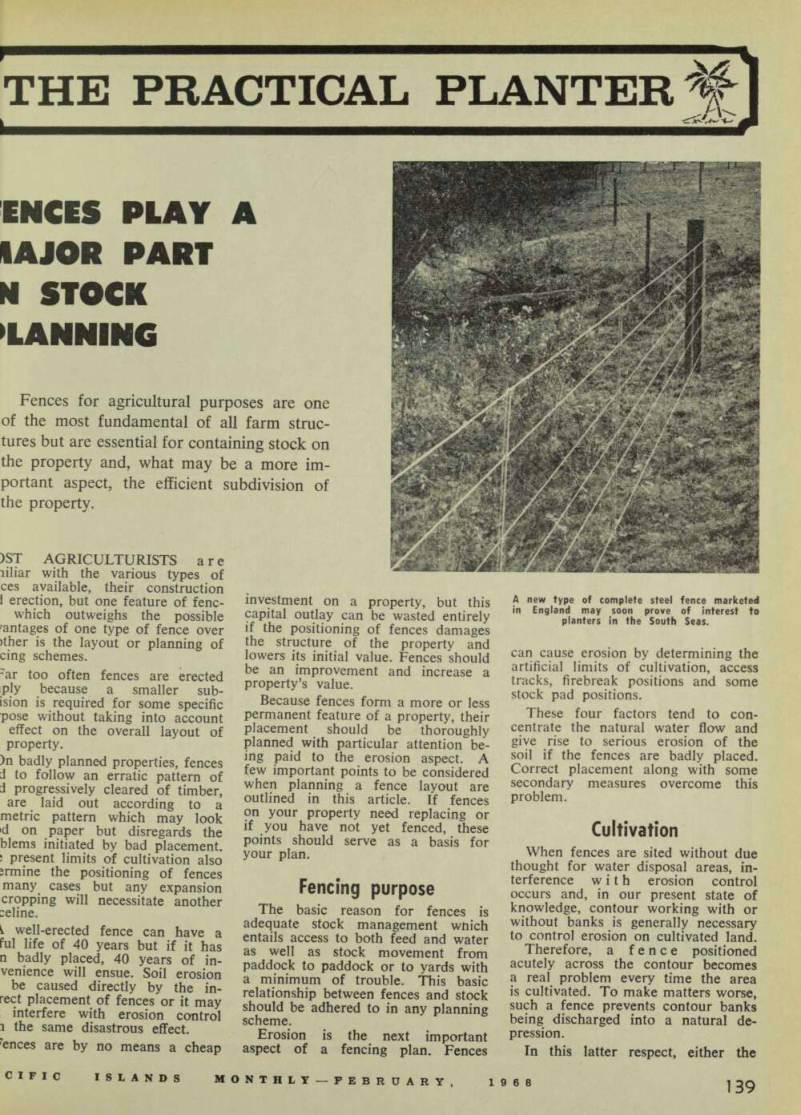
A new type of complete steel fence marketed in England may soon prove of interest to planters in the South Seas.
ice has to be opened up or an ificial waterway has to be built, ither alternative is attractive.
Fences and associated gates de mine the access tracks around a )perty. Badly located tracks can ste time, cause bogging and ision in wet weather and are ex mely difficult to maintain in good ler.
Firebreaks
[t is normally necessary to have :breaks follow the fences, but the *e ground required for a firebreak es rise to high run-off during n. Severe gullying will result with isequent damage to the fence if ivision is not made for this run to be discharged at frequent in vals.
Fhe position is aggravated where fence is placed acutely across illow depressions. In these cases, firebreak usually acts as a ersion drain and takes the full ter flow with the result that the :break is scoured out and the ce undermined.
Pronounced stock pads caused by stock consistently walking along fences, suffer the same effects as the firebreaks with the scouring out and subsequent undermining of the fence.
However, the previous inference that a fence must be placed on the contour to be correctly positioned is not always the case. Contour fences are harder to build and maintain than straight fences and are therefore re commended last of all.
Fences on the contour have a place only in subdividing cultivation, where paddocks cannot be made small enough by other fence positions.
Planning points
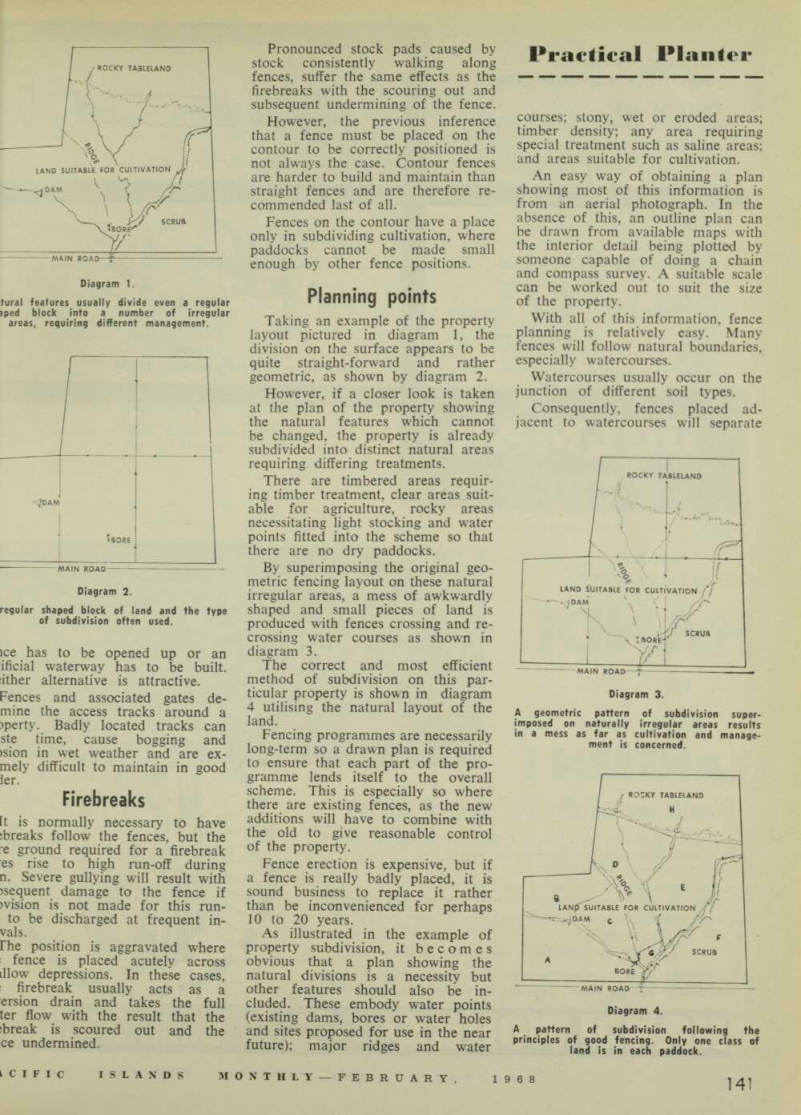
Taking an example of the property layout pictured in diagram 1, the division on the surface appears to be quite straight-forward and rather geometric, as shown by diagram 2.
However, if a closer look is taken at the plan of the property showing the natural features which cannot be changed, the property is already subdivided into distinct natural areas requiring differing treatments.
There are timbered areas requir ing timber treatment, clear areas suit able for agriculture, rocky areas necessitating light stocking and water points fitted into the scheme so that there are no dry paddocks.
By superimposing the original geo metric fencing layout on these natural irregular areas, a mess of awkwardly shaped and small pieces of land is produced with fences crossing and re crossing water courses as shown in diagram 3.
The correct and most efficient method of subdivision on this par ticular property is shown in diagram 4 utilising the natural layout of the land.
Fencing programmes are necessarily long-term so a drawn plan is required to ensure that each part of the pro gramme lends itself to the overall scheme. This is especially so where there are existing fences, as the new additions will have to combine with the old to give reasonable control of the property.
Fence erection is expensive, but if a fence is really badly placed, it is sound business to replace it rather than be inconvenienced for perhaps 10 to 20 years.
As illustrated in the example of property subdivision, it becomes obvious that a plan showing the natural divisions is a necessity but other features should also be in cluded. These embody water points (existing dams, bores or water holes and sites proposed for use in the near future); major ridges and water
courses; stony, wet or eroded areas; timber density; any area requiring special treatment such as saline areas; and areas suitable for cultivation.
An easy way of obtaining a plan showing most of this information is from an aerial photograph. In the absence of this, an outline plan can be drawn from available maps with the interior detail being plotted by someone capable of doing a chain and compass survey. A suitable scale can be worked out to suit the size of the property.
With all of this information, fence planning is relatively easy. Many fences will follow natural boundaries, especially watercourses.
Watercourses usually occur on the junction of different soil types.
Consequently, fences placed ad jacent to watercourses will separate
Diagram 1. tural features usually divide even a regular [?]ped block into a number of irregular areas, requiring different management.
Diagram 2. regular shaped block of land and the type of subdivision often used.
Diagram 3.
A geometric pattern of subdivision super imposed on naturally irregular areas results in a mess as far as cultivation and manage ment is concerned.
Diagram 4.
A pattern of subdivision following the principles of good fencing. Only one class of land is in each paddock.
>ils requiring different management id will not interfere with water sposal from cultivation, access acks, firebreaks and stock pads, [any awkward creek or gully cross es will be eliminated.
Since water points, bores and dams e frequently on watercourses, nces placed adjacent to these make ie best possible use of available ater facilities. Of course, all fences innot be placed near watercourses it other convenient natural posi ms can be utilised.
One such suitable position is along e ridge lines. Located in this posi in, a fence will not interfere with »ntour cultivation as it cuts the intour at right angles. Another im >rtant aspect to this method is the ck of collected water on a ridge tracks and firebreaks are fairly fe from erosion. Any water that ics accumulate can easily be dis »sed of by spur drains.
Suitable position
Other suitable locations are on the ntour or directly down the slope, isitioning fences either parallel or right angles to contour working d not causing awkwardly shaped ids.
By referring back to diagram 4, the inciples just outlined can be applied, ie only contour fence needed is the e between paddocks B and C where sre is no natural subdivision. Con ir fences can sometimes be built mg the top of a contour bank, but is proves difficult especially in acking soils.
It is preferable to place a contour ice in a series of straight lines im ;diately below a contour bank or tween two banks spaced wider than rmal. The latter arrangement ows for longer spans of straight ice.
Paddock H, which is rocky and ht carrying country, can be handled o ways. If the dams are per ment waters, the land can be htly stocked throughout the year, liereas, if the dam sites are small, ; land should be heavily stocked ule the winter lasts and when dry, ; stock can be withdrawn to another ;a with permanent water which s been spelled.
The small paddock G with water can be utilised as a holding paddock.
Since paddocks C, D, E and F all join G, mobs can be easily trans ferred from one to the other through G. The inclusion of a small set of yards in this paddock would be a decided advantage.
From the foregoing, it will be seen that the use of natural features on a property is a simple, yet effective, method of planning a fencing scheme but variations will have to be drawn up to suit individual needs and cir cumstances. It will be appreciated, however, that a little planning leads to more efficient working around the property.
Fences in general
Most agriculturists are familiar with the various types of fences, con struction materials and erection, so the actual types of fencing schemes will not be discussed in this article as they would prove too innumerable and impossible to condense success fully. However, some general points will be covered.
Several factors determine the type of fence erected on any given pro perty, or more exactly, on any given part of a property. The requirements of a fence influence the type or style of fence normally erected, however, certain other aspects such as avail ability and cost of materials and ease of construction play a big part. In fact, all four factors should be con sidered together when new fencing schemes are envisaged.
The main two factors of the above mentioned would be the requirements or efficiency of the fence for a par ticular purpose, and the costs.
Efficiency is self-explanatory, as an inefficient fence is a waste of capital.
Fences must be durable and stock proof so that animals can be retained in their respective paddocks.
On the other hand, any attempt to reduce costs by erecting fewer posts per mile, for example, would be bad
economy if maintenance expenses were increased or the fence lost its efficiency.
Materials
Materials employed for fencing cover a wide and diverse range but, whichever material is chosen, it must suit the job. Points to be considered in the selection of fencing material are costs, erection, durability and freight.
The first three points are straight forward considerations in any type of undertaking, but freight is one that is often overlooked. One type of material may be regarded as the cheapest satisfactory material on paper, but with freight taken into account, it may work out dearer in the long run than a more durable or more easily erected type that is avail able locally.
Therefore, when fencing is pro posed, consider all aspects before making a final decision on materials.
Fence posts can be of timber, steel or concrete construction depending on the most economic proposition.
Timber for posts depends largely on local supply, the size for the require ments of the fence and availability.
There are numerous species of timbers used, either as split or round posts.
The main points to consider when selecting timber for fencing purposes are strength, resistance to decay, white ants and fire.
Steel posts are available as pro prietary lines and when used in con junction with timber or concrete posts, a strong, substantial fence can be constructed. Costs of steel fences are higher than timber but durability is high.
Concrete posts are becoming popular especially where timber is scarce and suitable sand and gravel
A typical application of grazing utilising an electric fence for positive retention of cattle.
Further details on this equipment can be obtained from The Oaken Corporation Pty. Ltd., of Sydney.
Cattle fence.
Sheep fence.
Cattle, sheep and lamb fence.
; obtainable. A sound concrete post, her as a fence, strainer or gate st, is dearer than its timber and el counterparts but is virtually srlasting, and can be used solely in combination with steel, irability of the concrete post is its tin advantage, being resistant to fire d white ants and possessing a low untenance cost.
Timber treatment
With the continuing depletion of ' naturally durable fence post ibers, the treatment with pre vatives of less durable timbers is v gaining momentum. These ated posts are proving cheaper, mger and longer-lasting than split >ts of naturally durable timbers.
Experimental field tests have shown t preservative treated posts are 1 in sound condition after 40 irs, and it has been estimated that average service life of some of treated posts will be about 75 rs. This estimate, of course, would y with the type of preservative d and how it was applied. The intity of preservative applied per iic foot influences the life expect y. fliysical losses, such as fire, have n estimated to account for less n one per cent, of treated fence ts, the main failure is breakdown Dugh decay or termites. mentioned before, preservative 2 and application vary consider /- Coal tar creosote has been emas a wood preservative for r a hundred years now, and is i where protection against rot and nites is required but paintability cleanliness is unimportant. Most this preservative is insoluble and not be leached from the post rain water.
Electrified fences
he water-borne preservatives, con ing copper, chromium and arsenic 5, on the other hand, are ex ally clean and paintable. Because he greater inherent toxicity, these 5 are effective at much lower lings than cresosote and are fixed lin the timber by a chemical re on, rendering the toxic cem ents insoluble. ome methods of application are replacement, hot and cold bath tment, cold soak processes or the sure treatment. The first three
methods can be achieved by the pro perty owner himself with the simplest of tools, but pressure treatment re quires special equipment.
Virtually all fences are strung with steel wire being a cheap and easily erectable material for the purpose of stock-proofing and subdivision. Steel wire being a good conductor of elec tricity, is ideally suited to electrifica tion for the positive retention of stock within their allotted paddock.
The added deterrent in the electric charge enables less capital to be in vested in fencing, as the number of strung wires can be reduced and yet still effectively control cattle and to a lesser extent, sheep and lambs.
On present indications, the main use for electric fences is in con junction with strip grazing of fodder.
This enables a single wire fence to be erected across a large paddock, and grazed progressively across the paddock with complete control of stock within the strip being grazed.
These two methods of use for elec tric fences utilise different equip ment and therefore should not be confused. The controllers used for strip grazing are not suitable for multi-strand fence charging, bu t special low impedence controllers are available to meet the special elec trical problems which are not en countered in the usual single line earth return installations. " ■
A typical fence constructed of pressure treated fence posts from Hicksons Timber Impregna tion Co., of Sydney.