Yachts Yachts
pp. 103-114 · Read in the full issue
Pacific Shipping And Yachts Yachts
“Bulolo" Withdrawn
From Service
End Of An Era
For New Guinea
Shipping
After a total of nearly 20 years’ service and 161 return trips between Australia and Papua-New Guinea, Bums Philp and Company Limited’s distinguished 6,500-ton flagship MV Bulolo was withdrawn from service after she arrived in Sydney on January 18.
After discharging her cargo at her sual berth at Walsh Bay, the Bulolo dll go to an anchorage off Blues oint in Sydney Harbour. BP paid her
crew one week’s pay for each year’s service on January 22, and then dis missed them.
The Bulolo’s last master, Captain Brett Hilder, has been given com mand of another BP ship, the 5,000ton passenger-cargo vessel Braeside.
The Braeside, which carries 12 passengers and twice as much cargo as the Bulolo, left Sydney for New Guinea ports on January 31. She is on a regular Sydney-New Guinea ports run.
The Braeside’s former master, Captain Malcolm Lawson, is on leave.
The Bulolo is a 29-year-old veteran of the Sydney-New Guinea trade.
Without use she will deteriorate rapidly. Shipping circles believe there is a chance the Australian National Line, which runs two big passenger ships from the Australian mainland to Tasmania, may buy the Bulolo for passenger services to New Guinea.
If not, scrap value seems the Bulolo’s destined end.
Since late 1948 no ship has been
more popular on NG shipping runs.
Up to her retirement she carried some 750,000 tons of cargo, 40,000 passengers (many of them “round trippers”) and travelled 885,000 miles.
Built in Great Britain in 1937-38, she left Sydney on her first run to New Guinea in November, 1938.
Between then and the start of World War II she made eight such trips.
After years of complaints by ter ritorians that BP cared little or nothing about the comfort of pas sengers, the white, luxurious Bulolo, with her streamlined bar and glass sided swimming pool, surprised many regular travellers and made cynics suspicious.
Her dining room was air-con ditioned by “thermotank installation” and living space (for over 200 people) throughout was ventilated by the “punkah-louvre” system—both innovations for that period.
Some territorians dubbed her “an interior decorator’s masterpiece”—
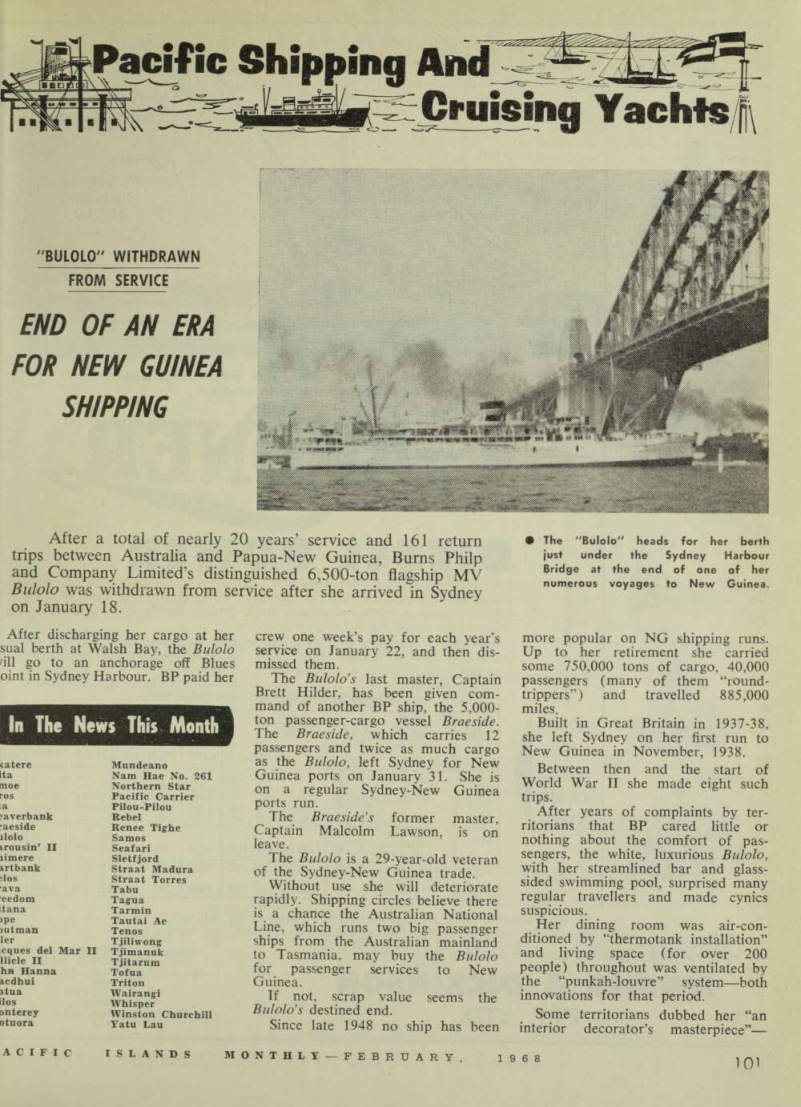
• The "Bulolo" heads for her berth just under the Sydney Harbour Bridge at the end of one of her numerous voyages to New Guinea.
iot an Islands ship at all, but a liner designed for tourists. “The whole lace is cluttered up with round rippers”, one traveller said.
TTie British Admiralty requisi oned the Bulolo when World War II roke out in September, 1939. She /as repainted black and armed for aval operations.
The Bulolo played an important art in the Allied invasion of North ifrica and Sicily, the Anzio land ig and Dunkirk. As a headquarters hip she was visited by King George T, Sir Winston Churchill and Field larshal Smuts.
While several BP ships, notably le Macdhui, found a watery grave uring the war, the Bulolo, in the lick of things throughout, led a harmed life.
After World War II she was and re-entered the NG run n August 18, 1948. This time she r as finally “accepted” by territorians s a true Islands ship— not to lention the thousands of tourists who avelled in her.
Exactly three years after she re ommenced her run, a serious fire roke out in a cargo of copra in Jo. 3 hold while she was near ydney. Beached in Sydney Harbour, le Bulolo’s fire was controlled, but ot before £200,000 worth of amage was done.
But three months later, with all epairs completed, she sailed again :>r NG.
Several well-known skippers com landed the Bulolo. Her first captain 'as “Sandy” Campbell. Best known r as “Wild Bill” Wilding. Captain lilder was her skipper for the last >ur years.
BP bought the Bulolo with an eye ) the tourist trade and she did in act carry many tourists, but for 90 er cent, of her commercial life she an at a financial loss, due to high
crew and stevedoring wages and troubles with maritime unions.
Since February, 1950, rumours had circulated that she was up for sale.
For several years, BP would dearly liked to have found a buyer. This problem remains.
It is extremely unlikely that a European-worked ship of her size, run by private enterprise, will appear again in NG. Few firms can afford to keep running non-paying ships indefinitely— not even BP.
New Trading Ship
For Fiji
The Maritime Shipping Co-op.
Association, of Lau, Fiji, has bought a ship in Norway to replace the locally-built Yatu Lau, which has done yeoman service for many years.
The new ship, the Alta, will be the biggest local trading ship in Fiji waters.
Of 699 tons gross, she has a speed of about 12 knots, and a cargo capacity for 350 tons, plus 25 tons of freezer cargo.
The owners plan to combine “off beat” tourist cruises with the normal commercial work of the Alta .
There will be accommodation for 30 first class passengers in 13 two berth cabins, two single cabins and a two-berth suite.
In the second class section there will be accommodation for 27 passengers in nine three-berth cabins.
In addition modifications will be made to provide seating accom modation in a deck house for about 40 deck passengers.
The Alta is equipped with modern navigational aids, including radar.
Five Ships Aground
N Separate Mishaps
The island trader Jacques del Mar II had to undergo three weeks’ re pairs to her hull in the Newcastle Dockyards in January and February after she went aground on a reef off Norfolk Island on January 7.
She was the most badly damaged AUa of five shi P s which went a B round briefly in separate mishaps in the Pacific Islands in less than four weeks du ™* , DeCember . and accidents occurred, in order, at Gizo, Papeete, Norfolk Island and ort Moresby, Jacques del Mar 11, a 1,950-ton passenger-cargo vessel, was entering Kingston anchorage at Norfolk Island when she hit a reef which was not known previously to extend as far out to sea as it does, Her well-known master, Captain
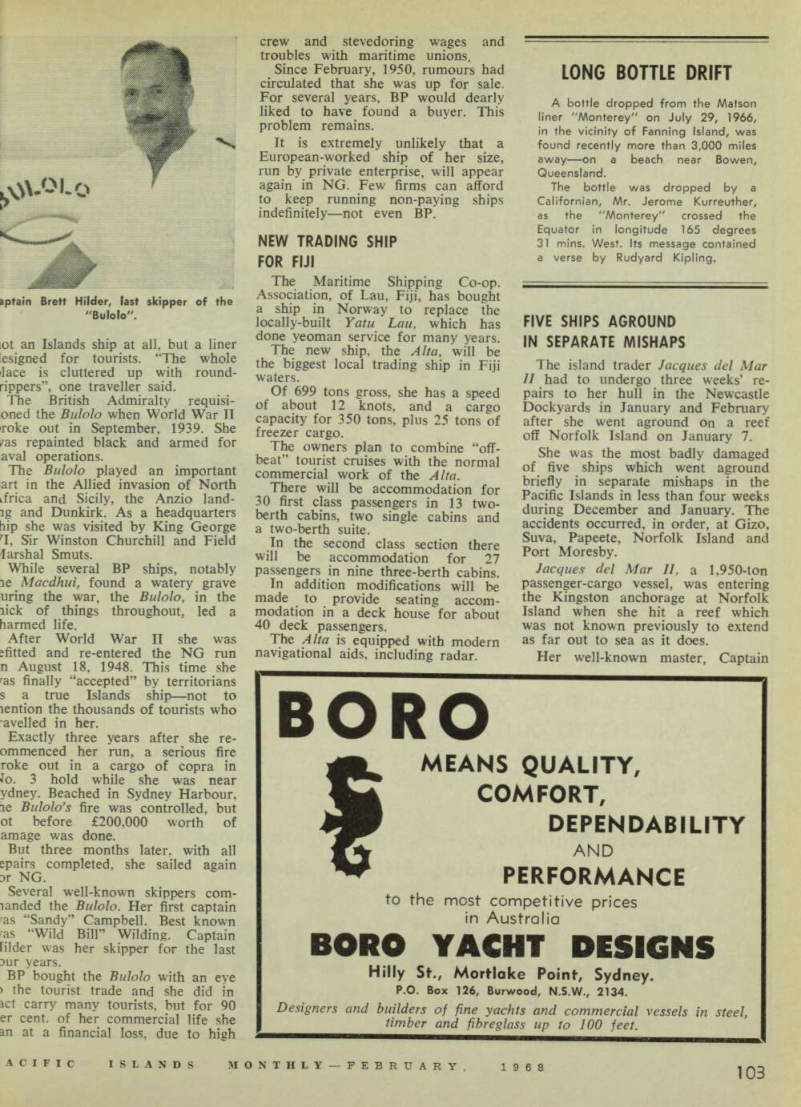
[?]aptain Brett Milder, last skipper of the "Bulolo".
Emile Savoie, discharged most of he cargo to lighters.
The ship remained on the reef for day while her Sydney agents, F. H. ►tephens Pty. Ltd., had divers and alvage experts flown from Sydney o carry out temporary repairs.
She then sailed to Newcastle, /here she was docked. Repairs are xpected to be finished on February , when the vessel will resume her egular run.
To replace the Jacques del Mar II jmporarily on her Lord Howe dand-Norfolk Island-Noumea run, ie Karlander New Guinea Line’s ,300-ton passenger-cargo vessel letfjord extended her regular New juinea run and left Sydney for Lord [owe Island and then Norfolk Island n January 20.
The Jacques del Mar II is owned y the Societe Maritime Cale onienne, of Noumea.
On December 15, the 5,990-ton ank Line freighter Beaverbank, titering Gizo Harbour to pick up Dpra, went aground near an island t the harbour entrance.
The Beaverbank was freed four days later and she continued her run to Suva, Nukualofa, Apia and Tarawa.
Another Bank Line freighter, the 6,461-ton Dartbank spent 20 hours stranded on Tatana Reef, in Fairfax Harbour, Port Moresby, after she hit the reef on January 9.
With the help of high tide and her own power, she was refloated the next morning.
Port Moresby diver, Mr. Harry Heath, inspected her hull and found little damage. She left for Samarai and Lae soon afterwards with vehicles, machinery and cement from London.
The 600-ton tanker Pacific Carrier. registered in Port Moresby, went aground on a reef on the east side of the main Suva Passage on Dec ember 16.
Suva diver Stan Brown and his assistant Josefa Aisea dived under the ship while she was aground to check her hull. They reported little damage.
The following day the ship was refloated at high water under her own steam, and with the help of the tugs, Tui Nakoba and Shell 50.
Her Sydney agents, Berg and Com pany, told PIM she was not holed and received only minor dents.
On December 19, the 24,000-ton Shaw Savill Line ship Northern Star, leaving Papeete for Acapulco, Mexico, struck a reef less than a 100 feet from a black buoy, which marks the pass into Papeete Harbour.
It was reported the ship developed steerage difficulties just before the grounding, which occurred in high seas and torrential rain.
Northern Star’s bow rested on the reef and her stern swung around.
A correspondent in Papeete said many would-be rescuers rushed out to help the stricken ship.
“Skippers and crew of the 20-odd yachts tied stern to the Papeete quay,
• The "Jacques del Mar II", photo graphed by Fred Dunn in Noumea last year just after she had begun operating on the Lord Howe Island— Norfolk Island —Noumea run.
[?] new "Ninsa II", owned by the New Ireland Transport Society Ltd., of Kavieng, New Ireland, is now servicing the New Guinea Islands, including Manus, New Britain, [?]ugainville, and, of course New Ireland. She is 70 ft long, cost $140,000, and carries general cargo and island produce.
jumped into action,” he said. “Yachts tenders, skiffs, dinghys and even i couple of inflatables were launched.
Dars and outboards were placed in appropriate positions and ‘the fleet’ sped toward the distressed liner.
“Those not going to sea, shouted hrough cupped hands, instructions :o the ship’s pilot, who at this time appeared to need help.
“By the time the yacht tug fleet vas alongside and ready to receive ines, the Northern Star had managed o get free and was slowly making aer way back to the dock.”
Repairers carried out immediate vork on the minor damage and the Northern Star sailed on December 21.
Fop Architect Designs
R Ugboat For Niue
Niue will soon have a new 27 ft teel tugboat, designed by a top naval irchitect, Mr, Warwick J. Hood, of Jydney, to make lighterage work at Mofi easier and more efficient.
The tugboat will cost more than >NZS,OOO, without design costs, and vill be in service early this year. It s being built by Niue Islanders, under he supervision of Niue’s Department )f Public Works. Steel plates have >een imported from Australia and he small quantity of timber in the mat has come from New Zealand.
Mr. Hood is best-known as the lesigner of the elegant yacht Dame l attie, the Australian challenger for he America’s Cup. He has also lesigned Peter Warner’s crayfishing mat Ata, which left for Tonga re
cently (see below), and crayfish and tuna boats in New Zealand and South Australia.
His brother, Mr. Peter Hood, also a boat designer, recently spent several months in Rabaul re-designing the yacht Kathleen Gillett for the Sydney-to-Hobart yacht race.
Mr. Warwick Hood told PIM that the tugboat would have to be light enough to be lifted on to Niue’s Alofi Wharf. The wharf’s derrick could take loads of up to seven tons and the boat would weigh about four tons.
It also should not be longer than 30 ft or have a beam wider than nine ft. Its draught would be five ft.
The tugboat would be able to tow four lighters, with up to eight tons of cargo in each, or would be able to tow a barge with a 20-ton load, The tugboat’s engine would be a Lee’s marine conversion of a Ford son engine, which is standard in many tractors. As there were several already on Niue it saved the cost of importing a new engine and its accompanying parts.
The tug will replace one of Niue’s three wooden launches which was damaged early last year when it was washed on to a reef in heavy seas.
It was deemed uneconomical to repair it.
The tug is the second designing
ob that Mr. Hood has done for 'Jiue, Three years ago, he designed the )rototype for a fleet of five steel ighters to replace the island’s con certed surfboats used in loading Work started on these in October, [965.
The final cost was £Stg 1,050 each, without design costs.
The first lighter was launched on November 13, 1965. The last of four >thers was completed in January.
Ie Who From A
Hurricane Runs Away . . .
When warnings of the approach >f December’s devastating hurricane n the Cook Islands were issued in larotonga on December 17, the kippers of two small motor vessels, vhich were tied up in Avatiu Jarbour, decided that: He who from a hurricane runs away Lives to sail another day.
According to the available neteorological information, the two hips would be safest if they got away rom Rarotonga and sailed north. So he skippers of both wasted no time i putting to sea.
The two ships are the Akatere, of 01 tons, belonging to A. B. Donald
Ltd., and skippered by Archie Pickering; and the 169-ton Tagua, working for the Cook Islands Trading Company and skippered by Don Silk.
The Akatere, with no cargo and only her drums of fuel acting as ballast, steamed about 50 miles north of Rarotonga—and sailed into winds estimated at 100 knots. The barometer reading was 9.70 mbs.
Big seas smashed the port naviga tion light and stove in the port windows of the bridge. At one stage the ship almost capsized, but she came up slowly.
Captain Pickering ran before winds from the south which drove him north and away from the storm which
was moving south. “We sped like a surfboard,” he said afterwards. “Now we know all about that particular sport.”
The Tagua was more fortunate.
She sailed about 30 miles north of Rarotonga, and although Captain Silk reckoned that he got into the centre of the hurricane and encountered winds of over 100 knots, his vessel was not damaged. However, seas broke over the bridge and the barometer dropped to 9.68 mbs.
The full force of the hurricane hit Rarotonga about 8.30 a.m. on December 18, by which time the Akatere and Tagua were well out at sea. If they had remained in harbour,
the chances are that they would have been pounded to pieces against the wharf as the top rails of the harbour pmngs were torn off by the heavy
Where To Fish At
Tutuila
Experts from American Samoa’s Agricultural Department finished a three-month investigation of Tutuila’s fishing grounds in early January aboard the government’s new 33 ft fishing boat Tautai Ae.
They found that off-shore fishing is best on the west and south-west sides of Tutuila.
The top spots are Cape XaputapUj Leone Bay and Steps Point, which js Ia n b d e most southerly P oint of the The Tautai Ae was launched last September in an effort—the latest of many—to entice American Samoans to set up their own commercial fish ing business (P/M, Oct., 1967, p. 103). She immediately began look ing for fish round Tutuila.
Mr. Dick Holloway, fisheries development officer, and Pemerika Tauili’ili, market manager, said the crew of the Tautai Ae found night fishing on the whole more productive than day fishing.
At night a 25 or 50 watt light bulb had been suspended over the boat’s side, weighted with lead to make it sink and with its sockets covered with electrician’s tape for waterproofing.
They found the two best baits were cuttlefish and skipjack tuna or bonito.
The fish caught were much the same at all spots—mu, malai, savangi, white tuna, barracuda and aku.
This year the Division of Fisheries planned to develop a prototype com mercial fishing boat subject to exact costs, Mr. Holloway said.
He estimated that for such a project an initial cash investment of SUS 11,400 would be needed. This would include $6,000 down payment on the boat, $2,400 for fishing equip ment, and $3,000 for other expenses.
Annual operating costs would be $27,177 and the potential annual profit about $17,280 before taxes.
Crayfish Boat
Leaves For Tonga
Australia’s newest crayfish process ing ship. Ata, left Sydney on January 6 for Tonga.
The Ata is owned and skippered by wealthy Australian industrialist Mr. Peter Warner.
She is designed to stand close in shore so she can turn her floodlights along the tops of reefs, so that fishermen can gather in the crays when they come up to feed.
The vessel was designed by Mr.
Warwick J. Hood, who has designed lighters and a tugboat for Niue in recent years (see p. 107).
Three New Ships In
Service To Fiji
Royal Interocean Lines, the Dutch owned shipping company, has in troduced three bigger passenger-cargo vessels on its Far East-New Zeland run, via Fiji.
The ships are the 6,000-ton vessels Straat Torres and Straat Madura, and the 4,000-ton Houtman. They will increase the line’s cargo capacity by 50 per cent, on this run and enable the line to enter the wet salted hides export business from Fiji to the Far East.
Straat Torres took her first con signment of 40 tons of hides from Fiji to Hong Kong recently.
The new ships replace the Tjimanuk, Tjiliwong and Tjitarum.
Eight Die In
Slipway Explosion
Seven Asian seamen and a Fijian ilipway worker died in January from jurns received when a bucket of paint hinner exploded in a small work nen’s washroom at the Public Works Department slipway at Walu Bay, Suva, on January 13.
Seven of the dead men were in a *roup of nine inside the washroom it the time. A Formosan sailor was leaning oil-stained clothing with a mcket of paint thinner, a volatile luid.
Suddenly there was a flash as the vapour ignited and searing flames shot through the washroom, envelop ng the men.
The ground outside shook and lames forked out of the louvred vindows. Rescuers pulled open the vashroom doors and the nine men :ell outside, a few still burning.
Two men, Koreans, died the same lay. The other six men died within 13 days. The Koreans were from the Ishing vessel Nam Hae 271, in Suva ; or an overhaul from her base in Pago Pago, American Samoa.
Dead were Jin Keum Chul, 28, 21hoi Byung Soon, 25, Lee II Woo, 15, Lim Moo Sup, 30, Oh Sun Wy, 19, and Lee Sang To, 26, all of Korea,
and Tacaka Turagakula, a Fijian PWD slipway worker.
The Formosan sailor, who was using the fluid when the fire started, died on January 26. He was Chuang Mou.
Two other injured in the fire, Sailosi Nasau, 37, a Fijian, and Jotama Mani, a Rotuman, were in a satisfactory condition at the hos pital. One of these was outside the washroom when the explosion oc curred.
Increase Likely In
Australia-P-Ng Freights
Freight charges on Australia-New Guinea shipping routes seem certain
to go up later this year, according to Islands shipping authorities.
A good bet for the time of the increase, which will be at least 7i per cent., will be near June 30, when Burns Philp and Company Ltd. lose their right to carry all copra out of the territory into Australia.
Many territory interests, particu larly the powerful, Rabaul-based Planters’ Association, are expected to vigorously oppose any increase in freight charges.
The Planters’ Association is a big importer of foodstuffs, especially rice, and an equally-big exporter of Islands produce such as cocoa, coffee and copra. (Over)
BP’s two major competitors on the New Guinea shipping routes—the Australia-West Pacific Line and Karlander New Guinea Line—will be after a healthy slice of the valuable backloading of copra to Australia.
Between them they almost duplicate BP services to the rich copra producing centres of Rabaul, Madang, Kieta and Wewak.
Both feel the BP charge of $l7 a ton for copra, pegged for over six years, is too low. BP will share this view when it no longer has the monopoly on the freighting of copra from the territory.
BP is also anxious to make up for the $400,000 Australian Government subsidy to run its ships with Aus tralian crews which it is also losing this year ( PIM, Nov., p. 24).
The company is already saving money by withdrawing the un profitable flagship Bulolo from the New Guinea run. With a big Euro pean crew of seamen and stewards it was said Bulolo’s running costs took about $4,000 a day out of the BP till.
China Navigation Company, which runs a service from Sydney to Port Moresby and Samarai, and return, should be able to move in on the
copra business to a lesser extent With many ships serving the Soutl Pacific from the Far East, Chim Navigation could even increase it return services to New Guinea fron Australia.
Shippers feel a freight rise woulc be justified because of increasec stevedoring costs and also genera rises in all shipping expenses. Ii many instances it is cheaper to shij goods from Britain to New Guine; than from Australia to New Guinea Salt is $lO a ton cheaper fron Britain to Rabaul than from Adelaidi to Rabaul.
Cocoa costs $26 a ton, includinj transhipment, from Rabaul to Hobart via Hong Kong, whereas via Sydne; or Melbourne, the same ton of cocoi costs $6O.
New Ship To
Call At Lae
MV Milos, a fast, containerise< Swedish vessel plying between Aus tralia and the Far East, will mak( her first New Guinea appearanc when she calls at Lae on Februar 7 with foodstuffs, motor vehicles am general goods from Australia.
She will then continue on he regular run to Manila, Taiwan am Hong Kong.
The Milos is a s3i million, 6,787 ton vessel, which started operatinj between Australia and Japan las August for the Australia-Wes Pacific Line (PIM, Sept., 1967, p 101).
The company’s Sydney agents Wilh. Wilhelmsen, told PIM tha Lae would be included on mos future runs by the Milos. Other Nev Guinea stops, such as Rabaul am Port Moresby were being considered they said.
To service the Milos, and the othei Australia-West Pacific Line vessel which call at Lae (Aros, Delos Samos and Tenos ), Watkins (Over seas) Ltd,, of Lae, will build s $150,000 freight terminal for th< company.
Work began in January on the terminal at the corner of Macdhu: and Montoro Streets.
When completed on May 20 it will include 29,000 square feet of ground space and will have a capacity ol 700,000 cubic feet.
The new shed should improve Lae wharf facilities which have frequently been critised by local importers. They claim big quantities of in-store goods at the wharfs, particularly rice, have been pilfered because it is hard tc lock many shed doors.