desiccated coconut business
pp. 63-65 · Read in the full issue

New Guinea gets back into the desiccated coconut business
By staff writer KEN McGREGOR, recently in Rabaul
Papua-New Guinea is back again in the desiccated coconut industry—this time in a big way. It’s the first development in this field since such an industry collapsed soon after World War II following a health scare. The new promoters have gone into the industry scientifically and have no worries about the future.
The promoters are the W. R.
Carpenter Group, who have begun producing desiccated coconut on their New Britain plantation of Ulaveo, 24 miles from Rabaul, on colourful Blanche Bay.
The plant has been established at a cost of more than $500,000 by Coconut Products Ltd., a Carpenter subsidiary.
Ulaveo is owned by another Carpenter subsidiary, Island Estates Ltd., which is administered locally by CPL.
Work started on the factory’s four acre site in February, 1967. It is already bigger than a similiar project in Tonga, and it will be the biggest desiccated coconut factory south of the Equator.
35-minute drive
Coconut Products hope to sell their desiccated coconut under the brand name of “Desikoko”, initially on the growing Australian market.
Later it aims to service the much bigger European markets.
The company is less hopeful about breaking into the United States markets because cargoes of desiccated coconut, being perishable, could be adversely affected by extra periods spent in tropical waters because of poor shipping connections.
While in New Britain in December
I took a 35-minute drive from Rabaul to Ulaveo along the winding Kokopo Road. The factory is a few hundred yards from the waters of Blanche Bay and is surrounded by old, tall coconut palms. It was bristling with activity.
Besides installing recently-arrived equipment, CPL was carrying out a learn-to-work programme for most of its shelters and peelers from NG’s Highlands.
By the end of January, 280 High landers, mostly from the Western and Southern Highlands, were to
have arrived at Ulaveo on two-year contracts.
In addition, local Islanders will be hired as carpenters, machine opera tors, equipment operators and mechanics.
The project’s success will depend to a very great extent on the efficiency of the hired Highlanders.
To train them, special permission has been given by the P-NG Admin istration to import four Filipinos for six months.
All from Pangasinan Province, 140 miles north of Manila, they are Esperidion Biado, 23, Vincente Gutierrez, 26, Rudolfo Soriano, 23, and Pepito Calictan, 21.
Each is capable of peeling and shelling about 1,200 coconuts a day.
Mr. Hans J. Rothkirch, the factory manager, told me that some of the Highlanders were already handling
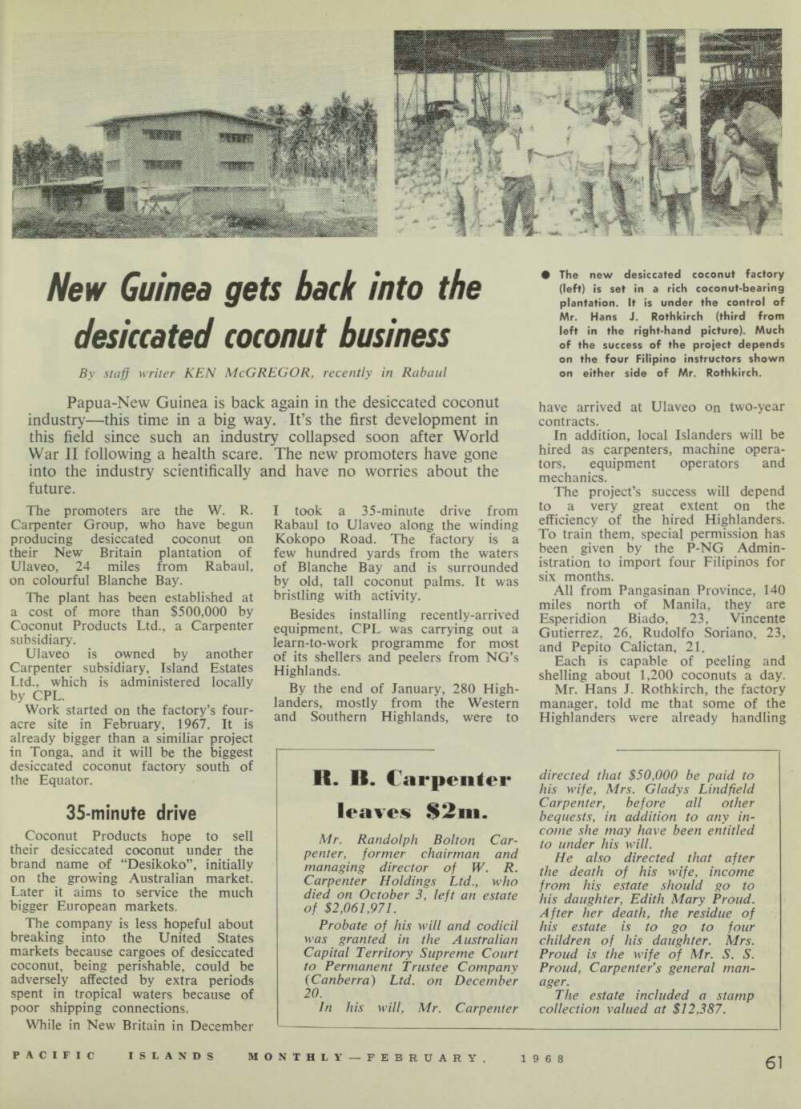
• The new desiccated coconut factory (left) is set in a rich coconut-bearing plantation. It is under the control of Mr. Hans J. Rothkirch (third from left in the right-hand picture). Much of the success of the project depends on the four Filipino instructors shown on either side of Mr. Rothkirch.
nuts at the rate of about 600 a day for short periods. However, it was not certain yet if this rate could be sustained.
There is little chance of the factory running out of nuts. Set in the heart of what is the richest copra area in New Guinea, coconut supplies will come from CPL plantations (and there are several big ones nearby) other company plantations and local growers.
Certainly it will provide another market for New Guinea Islands nuts.
Fuel
About 300,000 nuts, or about three days’ supply, will always be kept on hand in bins adjacent to the covered shelling area. Coconut husks and shells will be the only fuel used in the big factory boilers.
When production started, the nuts were moved into individual peelers’ and shellers’ bins by mechanical conveyor belts. Nuts were shelled and peeled and the coconut meat put on another set of conveyor belts to be transferred to the production area.
Then all meat was systematically sorted for quality or damage, then trimmed, sterilised, dried and screened or separated into particle sizes, com monly known as coarse, medium, macaroon or fine.
The desiccated coconut is packed into 100 lb bags which are sealed on the inner lining with polythene to stop moisture coming in from the outside and oil losses from the inside.
Employees working in the pro duction area (and these number about 25) have to observe rigid regulations on body cleanliness.
They are provided with specially-
washed uniforms (T-shirts, shorts and berets), and must have a hot shower before entering the production area.
Must wash
If they leave their positions they must wash their faces and hands before returning, Mr. Rothkirch, who has had 30 years’ experience with desiccated coconuts in the Philippines, said the health precautions would meet the requirements of any country in the world.
Work at the factory started with one shift, but it is hoped to have this stepped up to two and then three by mid-1968.
World competition among desic cated coconut producers is very keen.
Five big desiccators in the Philip pines have extensive markets already set up, particularly in the United States.
Used for candy fillers, biscuits and pies, NG desiccated coconut could be a big money-earner for the ter ritory in the late 1960’s and through the 1970’5.
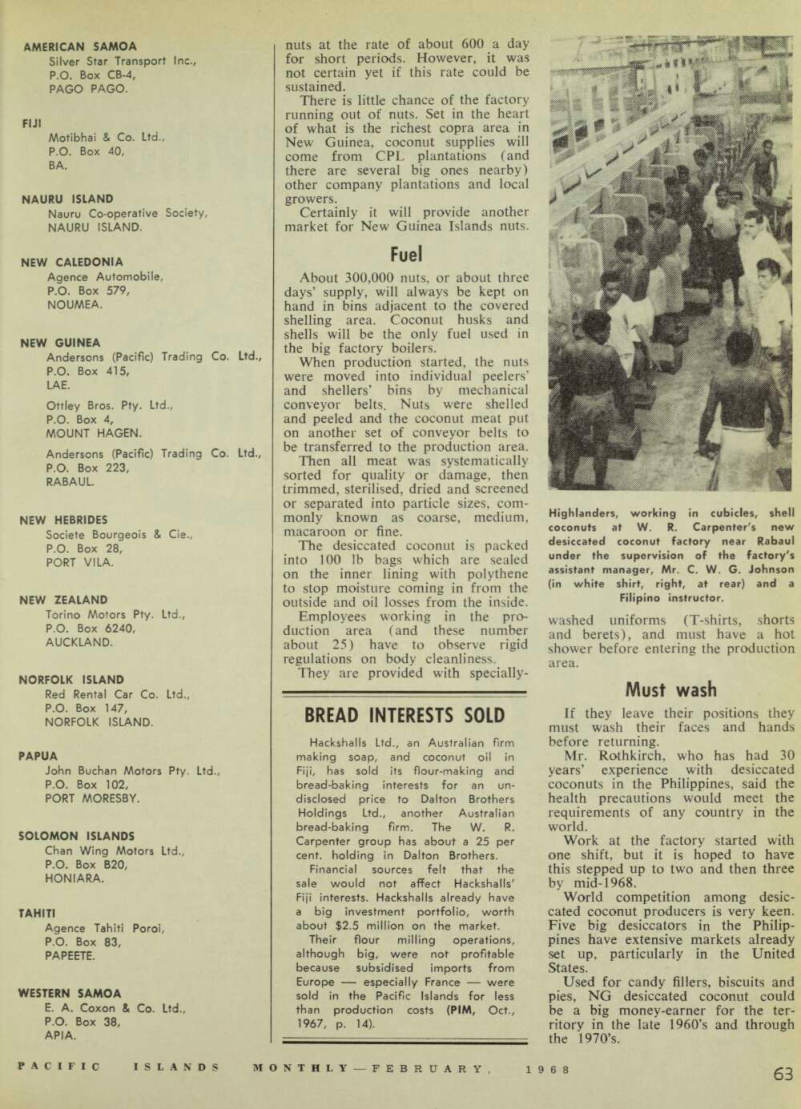
Highlanders, working in cubicles, shell coconuts at W. R. Carpenter's new desiccated coconut factory near Rabaul under the supervision of the factory's assistant manager, Mr. C. W. G. Johnson (in white shirt, right, at rear) and a Filipino instructor.