Social eruption on Tin Can Island
pp. 56-58 · Read in the full issue
By William H. Dame
Eruption-prone Tin Can Island has exploded again. This time, however, instead of the usual destructive lava confined to the environs of the tiny island itself, the eruption was started by a magazine article that circled the earth and created interest in the island in 185 countries! This was the lead article, the publisher’s column, in an issue of Time magazine.
The article told how the 37 English reading residents of Tin Can Island received Time in the tin can mail from Matson Line’s SS Monterey, how these readers translated the news to their 600 or so Tongan speaking friends and how, finally, the pictures were cut out to decorate their homes while the remainder of the magazines was used to cover pupils’ exercise books.
How the article was published and what happened then make an interest ing story.
Wide reaction
For over six years I’ve been manager of the gift shop on the Monterey, and for the past three years I’ve sent my used Times ashore at TCI (really Tonga’s Niuafo’ou) and have often wondered what hap pened to them. So I enclosed a questionnaire which was answered by voluble Kitione Mamata, the island’s telegraph operator.
I condensed his 31-page letter to five pages, which I submitted to Time with a picture of the actual tin can mail transfer at TCI. I expected a line or two at most in some future article dealing with unique delivery
problems, and asked that the tin can method be contrasted with Eskimo dog sled delivery up north or delivery by flying saucer to Planet Pincus No. 7, if Time had any readers there.
But Time did a longer piece and the excitement began!
Telephone calls and letters came from all directions. Some of the letters were requests for Tin Can Island stamps, but others, plus personal comments from passengers
and crew, made me either chuckle or cringe. A few of the choicer ones were: Sir: That island’s the perfect place to escape the bomb. How do I get there?
Sir: Is this man (Mamata) a mis sionary?
Sir: He’s Rousseau’s Noble Savage.
Please don’t corrupt him with our civilisation.
Sir: What’s the point? You expose those natives to all that ex pensive advertising and they can’t buy a thing.
Sir: How much did Matson have to pay for that blurb?
Sir: If you can get my name and product mentioned in “Time”,
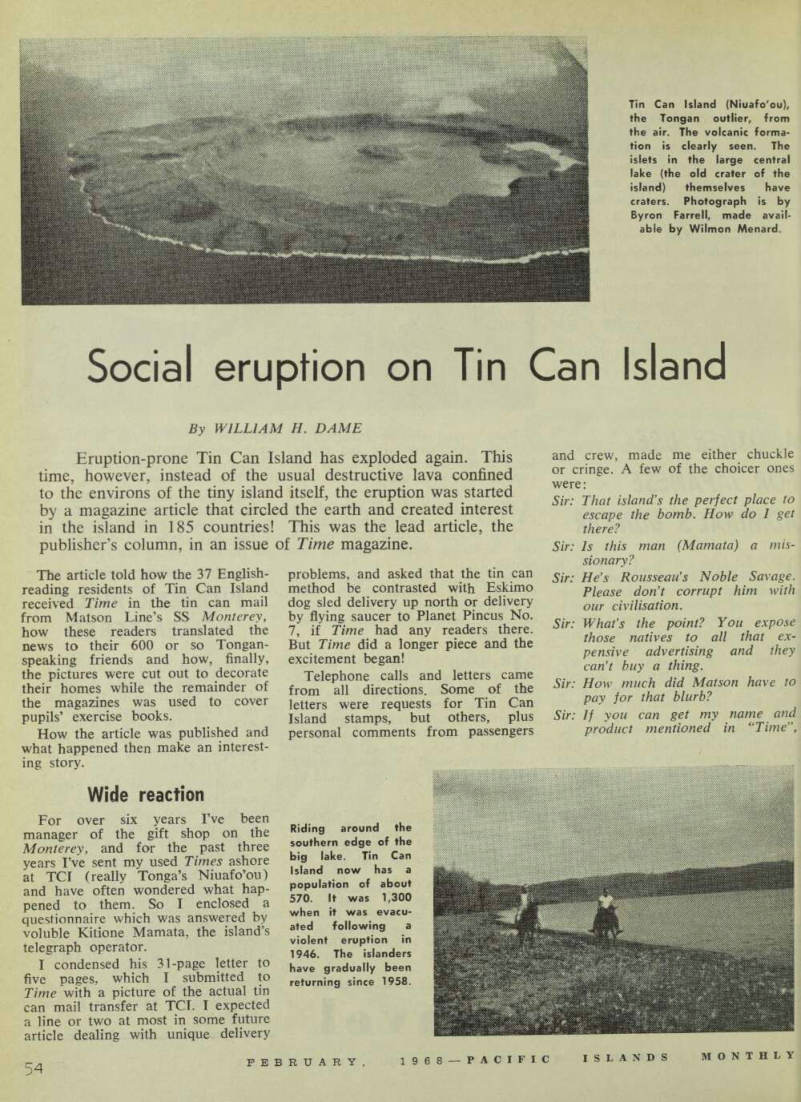
Tin Can Island (Niuafo'ou), the Tongan outlier, from the air. The volcanic forma tion is clearly seen. The islets in the large central lake (the old crater of the island) themselves have craters. Photograph is by Byron Farrell, made avail able by Wilmon Menard.
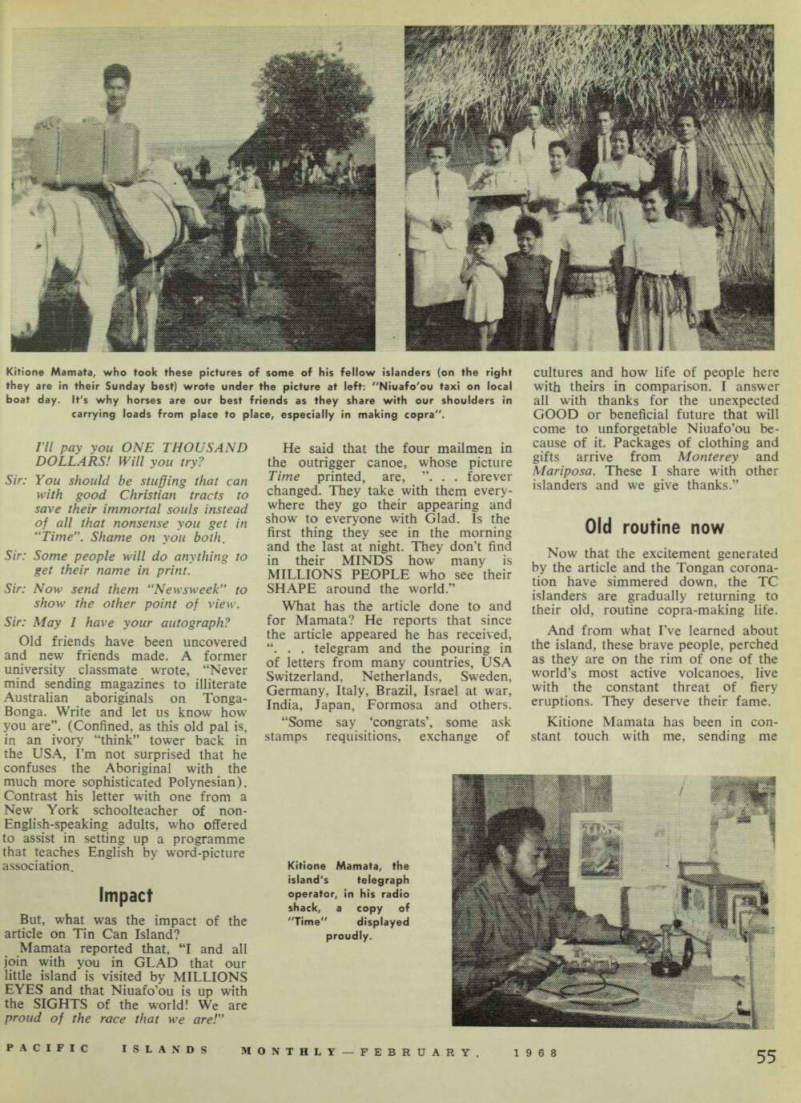
Riding around the southern edge of the big lake. Tin Can island now has a population of about 570. It was 1,300 when it was evacu ated following a violent eruption in 1946. The islanders have gradually been returning since 1958.
I’ll pay you ONE THOUSAND DOLLARS! Will you try?
Sir: You should be stuffing that can with good Christian tracts to save their immortal souls instead of all that nonsense you get in "Time”. Shame on you both.
Sir: Some people will do anything to get their name in print.
Sir: Now send them "Newsweek" to show the other point of view.
Sir: May I have your autograph?
Old friends have been uncovered and new friends made. A former university classmate wrote, “Never mind sending magazines to illiterate Australian aboriginals on Tonga- Bonga. Write and let us know how you are”. (Confined, as this old pal is, in an ivory “think” tower back in the USA, I’m not surprised that he confuses the Aboriginal with the much more sophisticated Polynesian).
Contrast his letter with one from a New York schoolteacher of non- English-speaking adults, who offered to assist in setting up a programme that teaches English by word-picture association.
Impact
But, what was the impact of the article on Tin Can Island?
Mamata reported that, “I and all join with you in GLAD that our little island is visited by MILLIONS EYES and that Niuafo’ou is up with the SIGHTS of the world! We are proud of the race that we are!”
He said that the four mailmen in the outrigger canoe, whose picture Time printed, are, . . forever changed. They take with them every where they go their appearing and show to everyone with Glad. Is the first thing they see in the morning and the last at night. They don’t find in their MINDS how many is MILLIONS PEOPLE who see their SHAPE around the world.”
What has the article done to and for Mamata? He reports that since the article appeared he has received, “. . . telegram and the pouring in of letters from many countries, USA Switzerland, Netherlands, Sweden, Germany, Italy, Brazil, Israel at war, India, Japan, Formosa and others.
“Some say ‘congrats’, some ask stamps requisitions, exchange of
cultures and how life of people here with theirs in comparison. I answer all with thanks for the unexpected GOOD or beneficial future that will come to unforgetable Niuafo’ou be cause of it. Packages of clothing and gifts arrive from Monterey and Mariposa. These I share with other islanders and we give thanks.”
Old routine now
Now that the excitement generated by the article and the Tongan corona tion have simmered down, the TC islanders are gradually returning to their old, routine copra-making life.
And from what I’ve learned about the island, these brave people, perched as they are on the rim of one of the world’s most active volcanoes, live with the constant threat of fiery eruptions. They deserve their fame.
Kitione Mamata has been in con stant touch with me, sending me
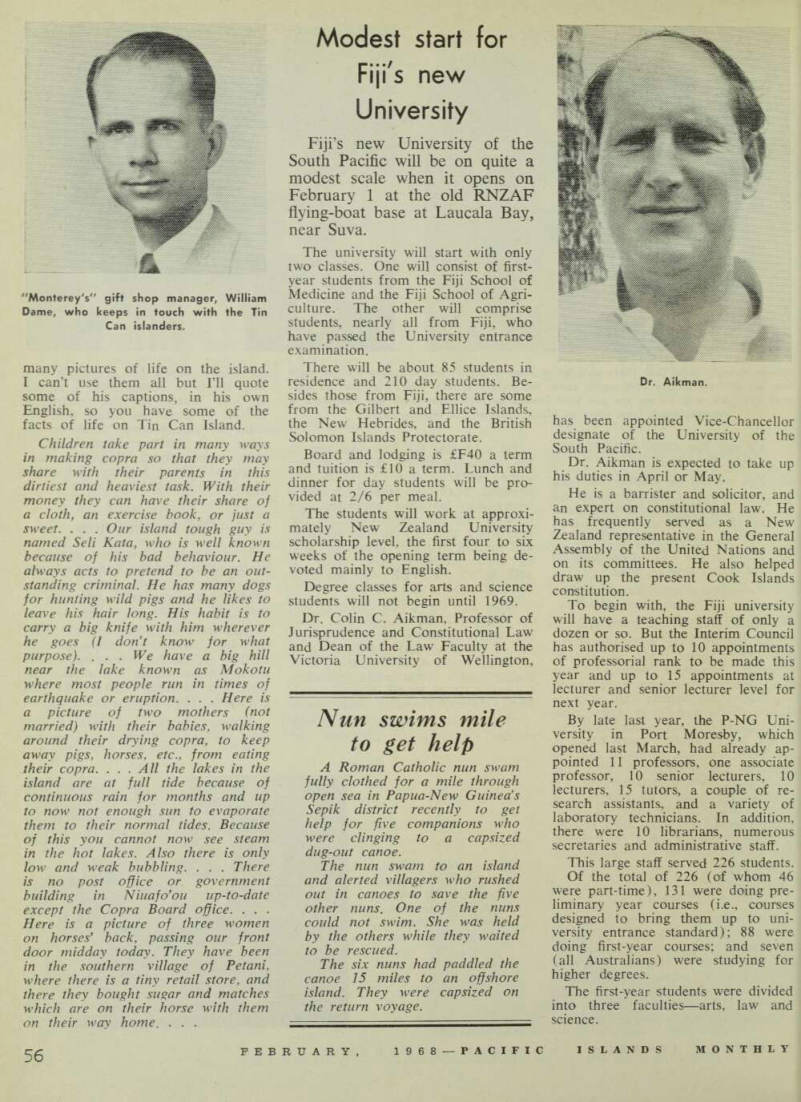
Kitione Mamata, who took these pictures of some of his fellow islanders (on the right they are in their Sunday best) wrote under the picture at left: "Niuafo'ou taxi on local boat day. It's why horses are our best friends as they share with our shoulders in carrying loads from place to place, especially in making copra".
Kitione Mamata, the island's telegraph operator, in his radio shack, a copy of "Time" displayed proudly.
many pictures of life on the island.
I can’t use them all but I’ll quote some of his captions, in his own English, so you have some of the facts of life on Tin Can Island.
Children take part in many ways in making copra so that they may share with their parents in this dirtiest and heaviest task. With their money they can have their share of a cloth, an exercise book, or just a sweet. . . . Our island tough guy is named Seli Kata, who is well known because of his bad behaviour. He always acts to pretend to be an out standing criminal. He has many dogs for hunting wild pigs and he likes to leave his hair long. His habit is to carry a big knife with him wherever he goes (I don’t know for what purpose). . . . We have a big hill near the lake known as Mokoiu where most people run in times of earthquake or eruption. . . . Here is a picture of two mothers (not married) with their babies, walking around their drying copra, to keep away pigs, horses, etc., from eating their copra. . . .All the lakes in the island are at full tide because of continuous rain for months and up to now not enough sun to evaporate them to their normal tides. Because of this you cannot now see steam in the hot lakes. Also there is only low and weak bubbling. . . . There is no post office or government building in Niuafo’ou up-to-date except the Copra Board office. . . .
Here is a picture of three women on horses’ back, passing our front door midday today. They have been in the southern village of Petani, where there is a tiny retail store, and there they bought sugar and matches which are on their horse with them on their way home. . . .
"Monterey's" gift shop manager, William Dame, who keeps in touch with the Tin Can islanders.