Nauruans find indepedence is
pp. 37-138 · Read in the full issue
good for their Constitution
From a Nauru correspondent
January 21.
Here on Nauru it’s been a frantic, frantic month before independence. At times, one wonders how we will ever get Nauru’s new flag flying on time. Has any republic ever been born so quickly?
It was, of course, no surprise to the Nauruans that the Head Chief was completely successful in wring ing out of the Australian Government a complete capitulation to his demands for absolute independence on the day of his choosing—January 31, 1968. The pattern had been so well tried and proven—decide with the aid of professional advisers, the most that can be asked for at the time, ask for it, and sit tight with the assurance that pressure from UN will result in the demands being met.
Now that the mini-state of Nauru has to chart its own course, its lonely situation in the Pacific may become symbolic of a self-chosen loneliness in the great world of politics.
The mechanics of it
Head Chief Hammer Deßoburt is confident that he has power enough, albeit a different kind of power, to protect the interests of his people from that he exercised in the days of playing the field in the UN Trusteeship Council. Now the influence must be purely economic, the raw purchasing power of an awful lot of still-valuable phosphate.
The Nauruans have taken with gusto to the mechanics of setting up their own republic. While their representatives in Canberra were frantically at work with the legal draftsmen to prepare a draft con stitution, they nominated no less than 10 per cent, of their eligible selves for election to the Constitu tional Convention. That is, 96 nominations were made for 27 places on the convention, while the number of registered voters was slightly less than 1,000. With the nine elected members of the Legislative Council ex-officio, the convention numbered 36.
A bizarre note was struck by Councillor Victor Eoaeo, who has in recent times won a reputation for being the fly in the ointment of peaceful independence-making. Coun cillor Eoaeo has spoken out against
the haste with which the hand-over is taking place, and even went to the trouble of appealing (too late) to the UN to slow things down.
He is not opposed to the principle of independence (he is at pains to point out) only to the rush, which he believes could be unfavourable to a good settlement of many problems concerned with indepen dence. Goaded by some taunts from the supporters of the “do-it-now” policy. Councillor Eoaeo resigned from the Legislative Council, and nominated for election to the con vention as an ordinary member. He received the vote of confidence he was seeking, coming out at the top of the poll in his electorate.
It then looked as if the convention would be one member short, as the closest date chat a by-election could be held for the vacant Legislative Council seat was January 6. At that stage someone must have read the small print, for it was announced that a mistake had been made; those who were councillors as at November 21, 1967, were automatically on the convention, and Councillor Eoaeo had resigned on November 30.
Recount
A quick recount resulted in another outside member being declared elected to the convention, while the temporarily ex-councillor took his ex-officio place all the same.
When the Constitutional Conven tion got under way an January 3, the Legislative Council Chamber strained to an undignified crush to contain the crowd. The Administrator, Brig.
L. D. King opened the proceedings, and then left them in the hands of Councillor Hammer Deßoburt, pre viously appointed bv the councillors to be the convention’s chairman. The first session, a merely mechanical one to adopt standing orders and elect a steering committee, saw the dele gates in a mood to try out their new debating prowess, and hours passed while amendment and gag. formal motion and informal con-
fusion, went gaily round and round, until at last Standing Orders emerged triumphant and unscarred, just as they had been submitted at the out set. The session ended so late at night that the next morning’s working session had to be cancelled to allow the steering committee time to meet.
While a number of the members of the convention appeared a little out of their depth, a good and sufficient number were able and willing to wrestle with the difficulties of constitution making.
The convention showed a remark able tenacity for discussion, and avid interest in the principles which were to shape the island’s future govern ment, and so the timetable ran sadly awry.
On January 19 about two thirds of the articles of the proposed con stitution had been dealt with, and so a close finish between the con vention and Independence Day seemed assured.
Professor J. W. Davidson, the constitutional adviser, had hoped to get back briefly to his desk at the Australian National University before actually taking part in the Indepen dence Day celebrations on January 31, but he decided to stay on and see the debate through to the end.
Professor's part
Had he been obliged to leave, the convention would have changed markedly in character, for up to that point, he had, by invitation, found himself the main speaker. Until then a quarter of all the words spoken in the convention had probably been spoken by Professor Davidson.
It is perhaps a measure of the degree of influence of the adviser.
On the introduction of every new major item (and one gathers most
(Continued on p. 136)
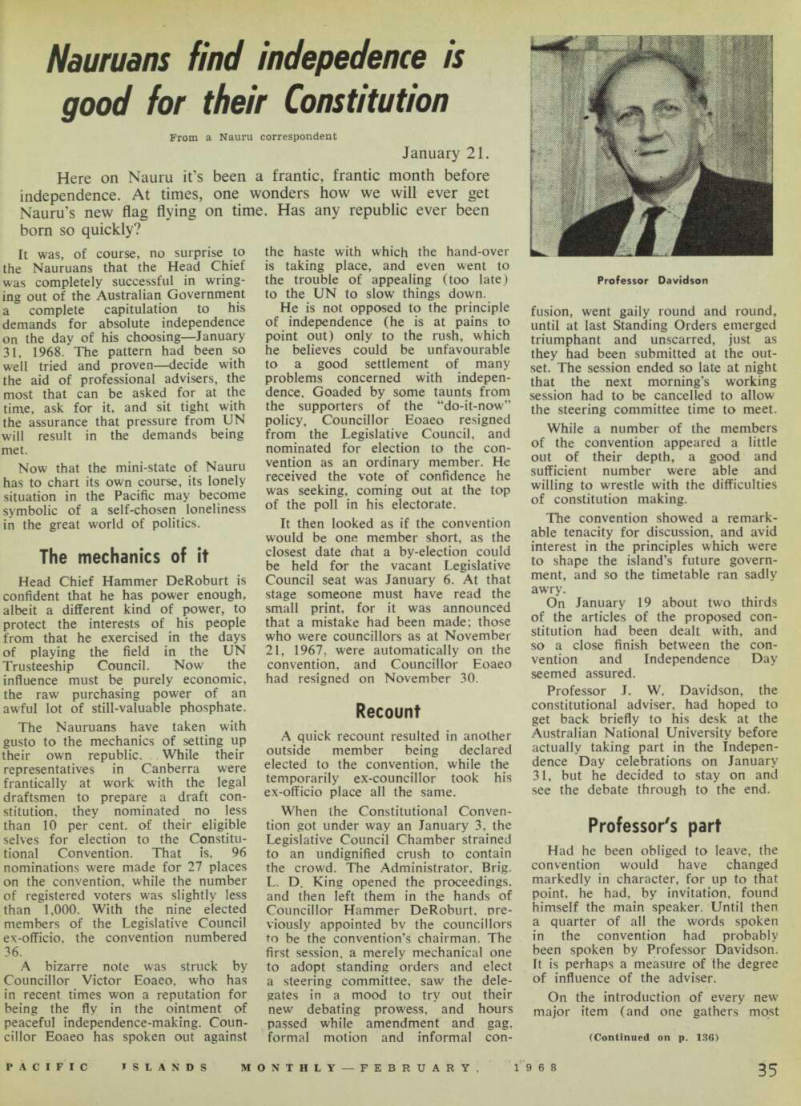
Professor Davidson
items in a constitution may be thus described) the professor was called upon to elucidate and amplify the provisions, and on many occasions to answer questions put by members who wanted to gain a clearer grasp of the issues or to have explained the legal implications of a word or phrase.
The professor sat for this purpose at a small table on the rostrum at the chairman’s right hand, and was joined a little after proceedings had begun by Miss R. Armstrong, a con stitutional law draughtsmen from the Australian Attorney-General’s Depart ment, who also sat in at the invita tion of the convention.
Except for the secretary, Mr. I.
Bowditch, who was also the Nauru Administration’s legal officer, the remainder of persons involved in the convention were Nauruans. The members came from a wide variety of trades and professions. Looking around the cramped Legislative Council chamber one could see doctors, a dentist, an engineer, a minister of religion, radiographer, various people in technical and clerical administrative posts—but all were men.
Capital punishment
Early in the proceedings, under provisions for the protection of the individual’s right to live, keen dis cussion took place on the subject of capital punishment. There is, as one member stated, a strong aversion to capital punishment among Nauru ans, so even if it is not banned by the constitution, it seems unlikely that a Nauruan Legislative Assembly of the future will give it a place on the statute book. One member pointed the moral of the French king who used the guillotine as an instru ment of policy, and suffered its use upon himself.
At another point a member some what pedantically said that the phrase “citizen of Nauru” sounded wrong to him, and that it ought to read “Nauruan citizen”. Another member said that he couldn’t see the point of the distinction. Mr. Lagumot Harris, who contributed considerably to much more weighty points at other times, rose to clarify, saying that nobody used the term “house of the dog” but the term “dog house” was quite well known.
One of the undercurrents of Nauruan life came close to the
surface when, under the article guaranteeing freedom of religion, a member sought to have provision inserted for state support for denomi national schools.
There is already a measure of such support given in Naum, but the proposal was to make an increase mandatory upon certain approval being given by the Government. After keen debate the amendment was narrowly defeated—ls to 12, in a house of 36. Several members ab stained from the vote.
Finance was a subject which aroused the hackles of some members.
Per capita, there is plenty of it in Nauru, but nevertheless there was criticism of the proposed expenditure on salaries for the six new secretaries of the Government departments, all to be newly-imported expatriates, it is understood.
Even more were heard the rumblings of owners of phosphate lands, who did not say, but whose contributions to the debate on funds derived from phosphate sales implied that they thought that they could make better use of the money than the government. But then, what tax payer anywhere has ever thought differently?