Tropicalities
pp. 30-32 · Read in the full issue
The swimming pool at Port Moresby’s Ela Beach has its uses—not the least of them lately as a recreation centre for the town’s native unemployed. You will find them there late at night.
SOME recent visits of ours to the pool at about 11 p.m. appear to indicate that different tribal groups of the out-of-works occupy the pool each night. As though by mutual consent, when one group is in oc cupation the others stay away.
We got to talking to some of them.
On one night the pool was occupied by men from Lese, in the Gulf District, who had been in Port Moresby without work for periods of from a few weeks to three years.
They had sought out the bright lights, knowing that other members of their tribal group in the town would find accommodation for them until they got a job. There were seven in the group we spoke to, and none had jobs.
The next night we found nine Finschhafen men who had come to Moresby looking for domestic work and found none. These nine had been out of work for more than two years.
On another evening a group of 10 were from Goroka, and all had lost their jobs in domestic service—mostly because their employers had resigned, had retired or been transferred with out making any provision for them either to get new work or to return home.
These two groups, like the first, were being kept by their tribal con nections in Port Moresby.
Faceless
Such groups as these may be found in all of the territory’s major settle ments. How many there are nobody knows. They are faceless, the Admin istration seems to be making no real effort to find out about them; it does not know for instance whether these people are exercising their right to vote, or whether they are avoiding taxation or their othei obligations.
This body of unemployed is the submerged portion of the iceberg, and for all anybody knows it could be just as dangerous as an iceberg in the event of a collision.
As more residents in the towns
Action needed on
Moresby's /
of unemployed
replace domestic servants with wash ing machines, the number of these unemployed will surely rise. Tribal obligations are nowadays nowhere as strong as they once were, and they are fast becoming weaker.
Shouldn’t this problem of unem ployment be identified and tackled?
Certainly P-NG’s Department of Labour officials cannot be expected to spend their nights at the Ela Beach swimming pool. But if they called in there occasionally, it might give them some leads on what they are up against.
NG’s “Monty” Stobo
goes south
WHEN Mr. and Mrs. “Monty”
Stobo left Rabaul in early January, Rabaul lost two of its best behind-the-scenes community workers.
Unobtrusively, in his modest way, Mr. Stobo had done a lot to keep Rabaul one of the prettiest and cleanest towns in the South Seas.
Mrs. Stobo, through her work on th© Rabaul Horticultural Society and also the Girl Guides, will be long remembered.
For nearly eight years Mr. Stobo, known to all his friends as “Monty”, had been Rabaul manager for Burns Philp (NG) Ltd. Then, last Sep tember, ( PIM, Oct., 1967, p. 101) he was appointed shipping manager at head office, Sydney.
Mr. Stobo arrived in Sydney on January 18 on the last voyage of the Bulolo (see p, 101) and started work in his new job the next day. He told us he hoped to buy a house on Sydney’s north side.
BP in Rabaul prospered with “Monty” at the helm —the retail store
had a facelift; a supermarket and an automotive section were opened and the big firm pulled away from its competitors on the lucrative retail front.
But “Monty” Stobo will be better remembered for encouraging the plantings of frangipanis along Rabaul’s streets, introducing clean low-cost homes for New Guinean employees, improving the working conditions of stevedores and co operating with the District Commis sioners as much as possible.
The Stobos gained a widespread reputation for hospitality—visitors, plantation owners, businessmen were all welcome at the Stobo home, some to the extent of a bed for the night.
Using BP transit labour, Mrs.
Stobo personally supervised the clearing of about six acres of govern ment and BP land near their Rabaul home, converting it into a beautiful park for orchids, bananas and pine apples. The Stobo home was often open to charity fetes, garden parties and other community activities.
Mr. Stobo’s business career is not unusual for a BP man. He joined Sydney head office as a junior in the Island agencies department in 1926 and was first sent to Port Moresby as an acting accountant for the BP sub sidiary, BNG Trading Co., in 1934.
He followed this up with two years as acting accountant at Samarai and in 1938 he was transferred to the travel department at Sydney. He enlisted in the army in 1940 and spent three years in the NG Islands.
In 1951 he was permanently back in NG as BP branch inspector.
He met his wife Joan while they were both travelling in the com pany’s ship, Bulolo.
Honiara Club
shows how
CYNICS who doubt that Pacific Islanders can run their own licensed club and make a success of it ought to take a good look at the Honiara Club on Guadalcanal in the Solomons.
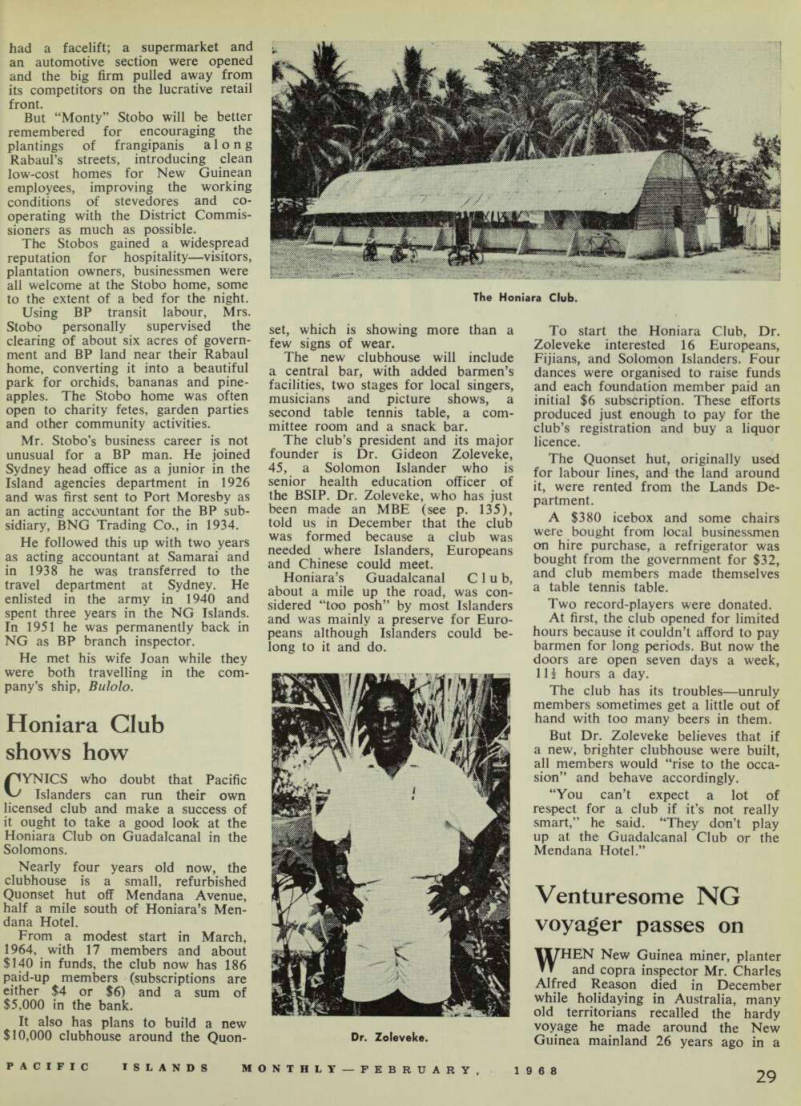
Nearly four years old now, the clubhouse is a small, refurbished Quonset hut off Mendana Avenue, half a mile south of Honiara’s Men dana Hotel.
From a modest start in March, 1964, with 17 members and about $l4O in funds, the club now has 186 paid-up members (subscriptions are either $4 or $6) and a sum of $5,000 in the bank.
It also has plans to build a new SIO,OOO clubhouse around the Quon-
set, which is showing more than a few signs of wear.
The new clubhouse will include a central bar, with added barmen’s facilities, two stages for local singers, musicians and picture shows, a second table tennis table, a com mittee room and a snack bar.
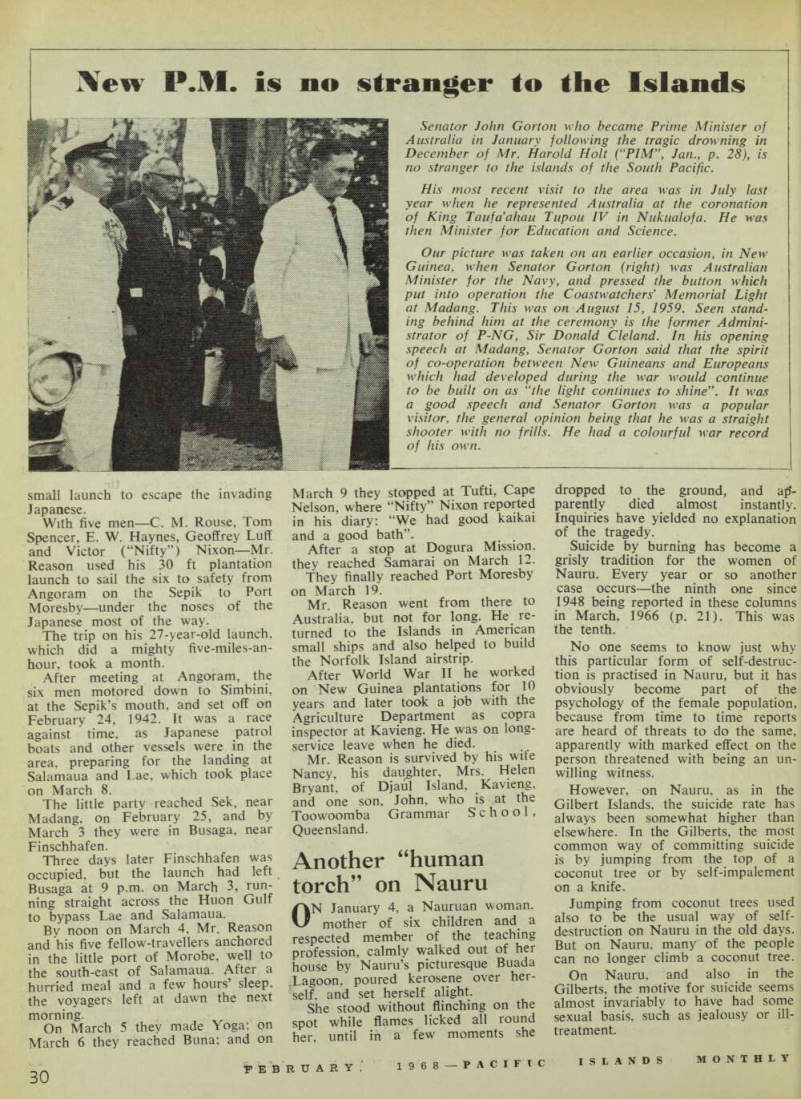
The club’s president and its major founder is Dr. Gideon Zoleveke, 45, a Solomon Islander who is senior health education officer of the BSIP. Dr. Zoleveke, who has just been made an MBE (see p. 135), told us in December that the club was formed because a club was needed where Islanders, Europeans and Chinese could meet.
Honiara’s Guadalcanal Club, about a mile up the road, was con sidered “too posh” by most Islanders and was mainly a preserve for Euro peans although Islanders could be long to it and do.
To start the Honiara Club, Dr.
Zoleveke interested 16 Europeans, Fijians, and Solomon Islanders. Four dances were organised to raise funds and each foundation member paid an initial S 6 subscription. These efforts produced just enough to pay for the club’s registration and buy a liquor licence.
The Quonset hut, originally used for labour lines, and the land around it, were rented from the Lands De partment.
A $3BO icebox and some chairs were bought from local businessmen on hire purchase, a refrigerator was bought from the government for $32, and club members made themselves a table tennis table.
Two record-players were donated.
At first, the club opened for limited hours because it couldn’t afford to pay barmen for long periods. But now the doors are open seven days a week, 111 hours a day.
The club has its troubles—unruly members sometimes get a little out of hand with too many beers in them.
But Dr. Zoleveke believes that if a new, brighter clubhouse were built, all members would “rise to the occa sion” and behave accordingly.
“You can’t expect a lot of respect for a club if it’s not really smart,” he said. “They don’t play up at the Guadalcanal Club or the Mendana Hotel.”
Venturesome NG
voyager passes on
WHEN New Guinea miner, planter and copra inspector Mr. Charles Alfred Reason died in December while holidaying in Australia, many old territorians recalled the hardy voyage he made around the New Guinea mainland 26 years ago in a
Dr. Zoleveke.
The Honiara Club.
small launch to escape the invading Japanese.
With five men—C. M. Rouse, Tom Spencer, E. W. Haynes, Geoffrey Luff and Victor (“Nifty”) Nixon—Mr.
Reason used his 30 ft plantation launch to sail the six to safety from Angoram on the Sepik to Port Moresby—under the noses of the Japanese most of the way.
The trip on his 27-year-old launch, which did a mighty five-miles-an hour, took a month.
After meeting at Angoram, the six men motored down to Simbini, at the Sepik’s mouth, and set off on February 24, 1942. It was a race against ' time, as Japanese patrol boats and other vessels were in the area, preparing for the landing at Salamaua and Lae, which took place on March 8.
The little party reached Sek, near Madang, on February 25, and by March 3 they were in Busaga, near Finschhafen.
Three days later Finschhafen was occupied, but the launch had left Busaga at 9 p.m. on March 3, run ning straight across the Huon Gulf to bypass Lae and Salamaua.
By noon on March 4, Mr. Reason and his five fellow-travellers anchored in the little port of Morobe, well to the south-east of Salamaua. After a hurried meal and a few hours’ sleep, the voyagers left at dawn the next morning.
On March 5 they made Yoga: on March 6 they reached Buna: and on
March 9 they stopped at Tufti, Cape Nelson, where “Nifty” Nixon reported in his diary: “We had good kaikai and a good bath”.
After a stop at Dogura Mission, they reached Samarai on March 12.
They finally reached Port Moresby on March 19.
Mr. Reason went from there to Australia, but not for long. He re turned to the Islands in American small ships and also helped to build the Norfolk Island airstrip.
After World War II he worked on New Guinea plantations for 10 years and later took a job with the Agriculture Department as copra inspector at Kavieng. He was on long service leave when he died.
Mr. Reason is survived by his wife Nancy, his daughter, Mrs. Helen Bryant, of Djaul Island, Kavieng, and one son, John, who is at the Toowoomba Grammar School,
Queensland.
Another “human
torch” on Nauru
ON January 4, a Nauruan woman, mother of six children and a respected member of the teaching profession, calmly walked out of her house by Nauru’s picturesque Buada Lagoon, poured kerosene over her self, and set herself alight.
She stood without flinching on the spot while flames licked all round her, until in a few moments she
dropped to the ground, and ap parently died almost instantly.
Inquiries have yielded no explanation of the tragedy.
Suicide by burning has become a grisly tradition for the women of Nauru. Every year or so another case occurs—the ninth one since 1948 being reported in these columns in March, 1966 (p. 21). This was the tenth.
No one seems to know just why this particular form of self-destruc tion is practised in Nauru, but it has obviously become part of the psychology of the female population, because from time to time reports are heard of threats to do the same, apparently with marked effect on the person threatened with being an un willing witness.
However, on Nauru, as in the Gilbert Islands, the suicide rate has always been somewhat higher than elsewhere. In the Gilberts, the most common way of committing suicide is by jumping from the top of a coconut tree or by self-impalement on a knife.
Jumping from coconut trees used also to be the usual way of self destruction on Nauru in the old days.
But on Nauru, many of the people can no longer climb a coconut tree.
On Nauru, and also in the Gilberts, the motive for suicide seems almost invariably to have had some sexual basis, such as jealousy or ill treatment.