Tonga looks
pp. 29-138 · Read in the full issue
With Coronation Year in the past...
Tonga looks to a rosier future
From a Nukualofa correspondent Tonga is now looking back on Coronation Year—the beginning of the Taufa’ahau Era—and the impression it gets is that 1967 was probably the turning point in Tonga’s economy It was a year of big changes and of progress.
Today, there is a feeling of prosperity, and visiting businessmen say they feel that Tonga is on the verge of a boom. This is despite the fact that there is nothing concrete to support their view. But many business ventures in the last 12 months have been successful; a group of local businessmen are about to begin a factory to make banana cases from local and imported timber; two firms are interested in establishing canning factories; and there is a report— unconfirmed—that a brewery has obtained land, and plans to' brew in Tonga. Bee-keeping, an industry which is flourishing on Niue, may be introduced
New records
Meanwhile, the 1967 output of copra and bananas was a record.
Vavau, which was crippled by the 1961 hurricane, is getting back into agricultural production and has found an eager market for her initial vanilla exports.
The tourist trade, with the publicity it got from the coronation, looks like having a bright new year. More than 100 tourist group tours have booked for 1968. They are mostly arriving by air, each group numbers about 28, and the average stay of each will be about three days. The P and O Line will have eight cruise
ships visiting Tonga, and the new overseas wharf, which was opened in coronation year, will obviously attract more cruises.
There is to be duty-free shopping for Nukualofa, and the Peace Corps people have already opened a travel bureau in the Dateline Hotel and produced a brochure on things to see and do. The offshore island of Onevai is being developed for tourists, with facilities for swimming, boating and fishing, and tours will be made to it with a recently-purchased craft.
Sterling reperCUSSionS
. » V There is talk of a regular New f^ a t nd ; To " ga ya £ ht Jf ce an 4 a tentative inquiry has been received from Australia about golf tourna ments. Some observers would like Tonga to build a full championship golf course and thus attract inter national competition of the kind Hawaii does. Tonga’s climate for golf is surely the best in any Pacific territory.
As against this development, de valuation of sterling in 1967 certainly had some serious repercussions.
There was a drop in the value of Tongan investments in London and New Zealand, and it affected banana prices. Tonga must work harder agriculturally.
gut repayment of overseas loans, particularly for the wharf, will be easier. Already essential consumer goods, noticeably butter and meat which come from New Zealand, have dropped in price and lower prices are expected on all imports from New Zealand and Britain including vehicles, heavy machinery, timber and building materials, Tongan merchants will benefit from their greater buying power in New Zealand as will Tongan families w ho send their children there for secondary or university education.
Devaluation means that New Zealand will do better trade with Tonga and presumably take trade away from Australia. Although Aus t h y t k few of Xo , npa J%oods she j the kingdom ’ s leading supplier’ ® • Australia s reputation is high m Tonga despite this balance of pay ments. Although Australia possibly as more to B am by concentrating greater efforts on South-east Asia and Papua-New Guinea, she found the time in 1967 to send a six-man par hamentary delegation to Tonga, and *bis fact-finding mission was success ful from everybody’s point of view, e delegation saw evidence of Aus trahan aid in the Telegraphs and Postal departments, and in schools
(Continued on p. 136)
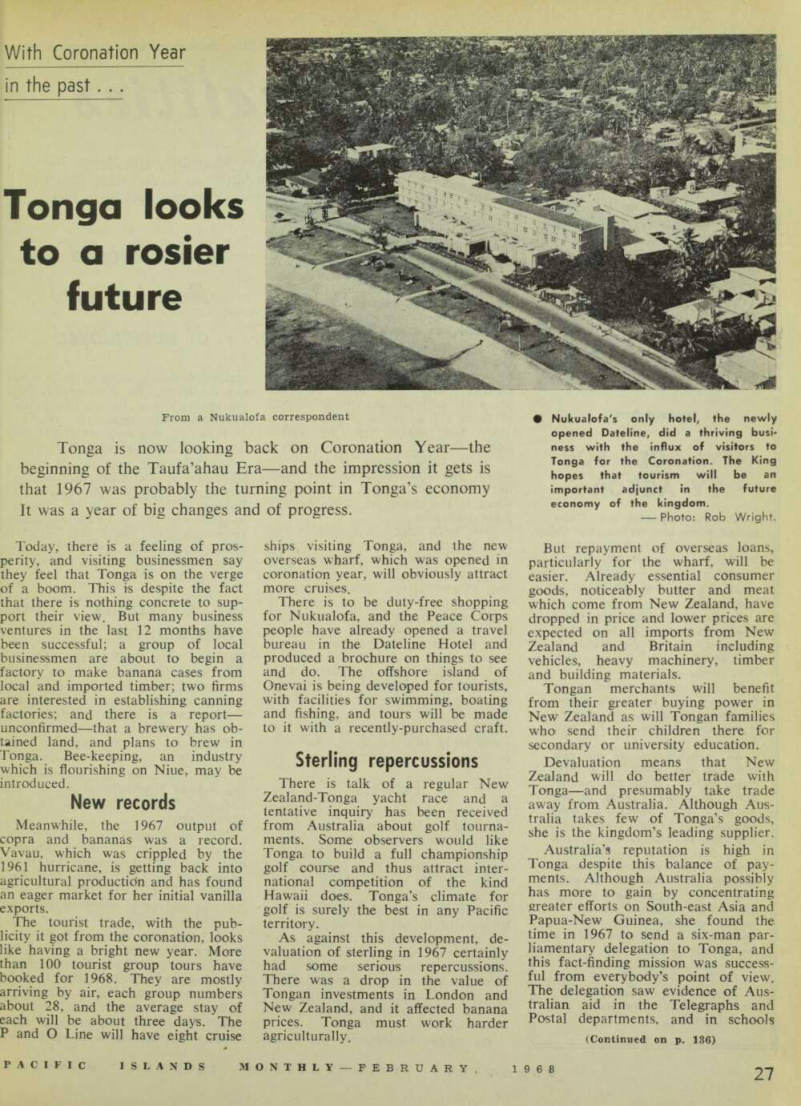
• Nukualofa's only hotel, the newly opened Dateline, did a thriving busi ness with the influx of visitors to Tonga for the Coronation. The King hopes that tourism will be an important adjunct in the future economy of the kingdom.
Photo: Rob Wright.
where technical wings had been built, equipped and staffed with Australian help.
Aid was timely
The timing of this aid came at the half-way mark of the kingdom’s five year development programme, when Tonga’s financial resources were stretched to capacity, and Australia’s gesture in accelerating agricultural and trade training in Tonga has brought much goodwill.
The kingdom meanwhile con tinues to absorb the American Peace Corps aid which arrived in 1967.
The Corps is settling down to the various projects. The first 39 volun teers included nurses, sanitation workers, a fish farming biologist, an architect, a journalist (who has al ready given the local weekly govern ment paper a facelift) and executives to help with public relations and tourism. In January a further 90 volunteers, mostly teachers, arrived.
Working alongside the Americans is a smaller, compact team of young New Zealanders from the NZ Volun teer Service Abroad Scheme. They have been here much longer, and 10 of them in nursing and teaching pro fessions have impressed with their quiet, efficient dedication. Very soon their first big team effort in forestry and cattle farming will transform life on the volcanic island of Eua.
The South Pacific Commission also gave a big hand to Tonga during 1967. There was a comprehensive seminar on health education, aimed at teaching primary school children the basic rules of hygiene, and a training school in animal husbandry,
with special emphasis on pig and poultry raising, in which the East- West Center and the Tongan Govern ment were additional sponsors.
Tonga has been years behind other islands in animal breeding and management techniques.
There was also a seminar on mother and child care and family planning—important, because family planning is an urgent problem in Tonga. There are now more people than land available for their agri cultural needs.
Britain's help
Britain, of course, is doing as much as she ever was in Tonga. Recently Nukualofa was visited by Sir Arthur Galsworthy, an envoy of the Com monwealth Office, who had further talks about the Treaty of Friendship between Britain and Tonga. The Treaty, signed in 1958, is currently being revised, and the changes are ex pected to be ratified soon. Sir Arthur, who, twoand-a-half years ago, put in motion the integrated five-year development plan, was impressed with the real progress made since his last visit—on the new wharf, the coconut replanting scheme, the new hospital and police training school, the airport terminal building, and the scheme for expanded power and tele phone services.
Britain has provided a number of the experienced advisers in the fields of finance, economics, agriculture, civil aviation and law revision—and thus also greatly helped in making much of Tonga’s concurrent progress possible.