How To Control Rats
pp. 141-148 · Read in the full issue


The Practical Planter
Effectively
Rats are a serious economic and health hazard in the Pacific Islands. Rat damage to coco nuts and cocoa may, for example, account for more than 25 per cent, of the crop. The informa tion on the following pages is digested from Rat Control in the South Pacific, a South Pacific Commission handbook prepared by F. P. Rowe, and recently praised by American Samoa’s Gov ernor, Owen Aspinall, as “one of the best productions the Commission has brought out”. As it is now out of print it is reproduced in this form as a service to planters.
Nesting Habits
Rats prefer to live as close as possible to food and shelter. Inside buildings they nest in such places as the spaces between walls, under neath the floor, and in the roof.
Rubbish left lying around in, and near the home encourages them to live nearby.
Outside buildings rats can be found living in places like rubbish tips, in banks, between rocks, and in coconut and cocoa plantations, among rotting tree stumps, piles of husks, fallen fronds, tall grass, and beneath the roots and in the tops of trees.
Rats are mainly nocturnal and like to feed under cover. Generally, they do not travel long distances, and in habitats where they are able to live permanently close to food, water, and shelter, they may not travel much more than 200 feet from their nesting site during their whole lifetime.
Breeding And Development
In the warm climate of the Pacific rats breed at most times of the year.
Pregnancy in the rat lasts only 21 or 22 days, and the young develop very quickly and become inde pendent of their mother at about three to four weeks of age. Females, three to four months old, are capable of having their own young.
Rats produce an average of six to seven young in each litter.
The Food Of Rats
Rats are omnivorous and eat many different kinds of food ranging from all kinds of cereals to weed seeds, grass, fruit, fish, and meat.
They also feed off growing crops such as coconut, cacao, sweet potato,
papaya, taro, rice, sugar-cane, and peanuts. In addition, rats supplement their diet by eating various insects, snails, slugs, and crabs. Rats thrive best and have most young when they are able to feed off the variety of foodstuffs found in piles of waste garbage from the home and on refuse tips.
Rat Traces
Usually, rats can be detected quickly in buildings. If they are numerous they will almost certainly be either seen or heard. Rats also leave traces behind them. The kind of rat present and the approximate number can often be estimated from the shape of the droppings and their abundance. In dirty, dusty places, the footprints made by the rats and the marks made by their tails can often be seen. Dirty, sticky smears are another sign that rats are present.
The smears are made when the grease and dirt on the fur of the rat is rubbed off on a much-used run way.
The incisor teeth of rats grow continuously throughout life, and, to prevent them from becoming too long, rats gnaw frequently. Small chips of fresh wood or other materials is another clear sign of their presence. Out of doors, damage to growing crops is often the first indication that rats are present.
The control of rats
Improved Sanitation
By removing food sources and harbourage rat populations can be permanently reduced. In the home, food should be protected either in such containers as metal bins or glass jars, or stored in wire-mesh
containers. These containers will also keep out flies.
Rats are attracted by refuse, and food scraps should never be left lying around or thrown away out side the home. Waste food should be placed in a covered metal bin (which cannot he overturned) until it can be removed.
Chickens and pigs should be fed well away from the home or, better still, kept in their pens. On atolls, pig pens can often be sited over open water so that the tidal flow carries away the waste food. Under no circumstances should pigs and chickens be fed late at night.
Open refuse tips can become major rat-breeding sites and can result in the spread of rats over a wide area.
The garbage dumped in tips should therefore be compacted and covered with earth each day.
Rats obtain much of the water they need from the moisture in the foods they eat. The common rat in particular, however, likes an ample supply of free water. It is impossible to deny rats access to water in the field, but in the home, drinking water should be covered with a tight fitting lid.
Shelter for rats in the home is provided by rubbish that is allowed to accumulate. It should be re moved. The space underneath homes which are raised off the ground should also be kept clean; the surrounding grass should be kept short.
In fields and plantations the grow ing crops provide harbourage for rats. In coconut or cocoa plantations additional cover is provided by piles of coconut husks and rocks and thick vegetation, and, particularly on atolls, by crab holes. Groves and
plantations deep in litter are most likely to support the highest rat po pulations and it is important to eliminate the potential rat-breeding places in them.
Trapping
Break-back or kill traps can be used to control small populations of rats living in buildings, and to clear up the survivors of poison treat ments; they can also be used in situations where the use of poison is dangerous.
For the best results plenty of traps should be set close together for a few days rather than a few traps operated for weeks at a time.
Although some rats will be caught by traps baited and set immediately, trapping is more effective if the traps are baited but left unset until the bait is being eaten regularly.
In setting traps it should be re membered that rats prefer to run behind cover—against walls and along rafters—rather than in open places. The traps should be set at right angles across the runways and not on the open floor. Baits used to trap rats include breadcrumbs, flour, oatmeal, banana, and cubes of coconut or sweet potato.
Traps can be set in the field in such places as at the base or trunk of trees, among roots underneath shrubs, and between rocks. They are not, however, an effective or econo
mical control method when large areas have to be covered.
Proofing
It is not possible to prevent rats from entering open island-type houses, but they can be excluded from modern buildings and ware houses by adequate proofing. Doors and windows or louvres should fit tightly and, if window screens are fitted, they should be made of i-inch woven metal wire (not plastic) and should also be close-fitting. Roof rats, particularly, enter buildings at roof height either by climbing the walls or descending from overhang ing trees. They can be prevented from doing so by carefully covering the space between the eaves and the walls with i-inch wire mesh. Open ings as small as half an inch will admit young rats.
In warehouses it is important to make sure that rats are not carried into the building in sacks of copra, rice, or other foods. Any holes or cracks in the walls or around pipes should be stopped up with cement and the loading doors should be maintained in good condition.
Ventilator holes and the insides of windows should be fitted with heavy, i-inch wire-mesh screens, and 20-gauge metal pipe guards project-
Pradiral Planter
ing about 9 inches should be fitted to the down pipes.
The cables of ships tied up in port should be fitted with circular or cone guards.
The inside of the warehouse should be kept clean and the stored food should be raised off the floor on wooden platforms and stacked at walking distance away from the walls. Any rats living inside the building can then usually be detected quickly by looking for their foot prints in a 6-inch band of French chalk or similar powder laid along the floor next to the walls and around the stacks.
Copra, sun-dried on open plat forms, can be protected from rats by raising the platform 3 feet off the floor on posts covered by an aluminium-alloy metal. It is im portant to remove rubbish from the drying platform and to ensure that rats cannot drop on to the platform from overhanging trees.
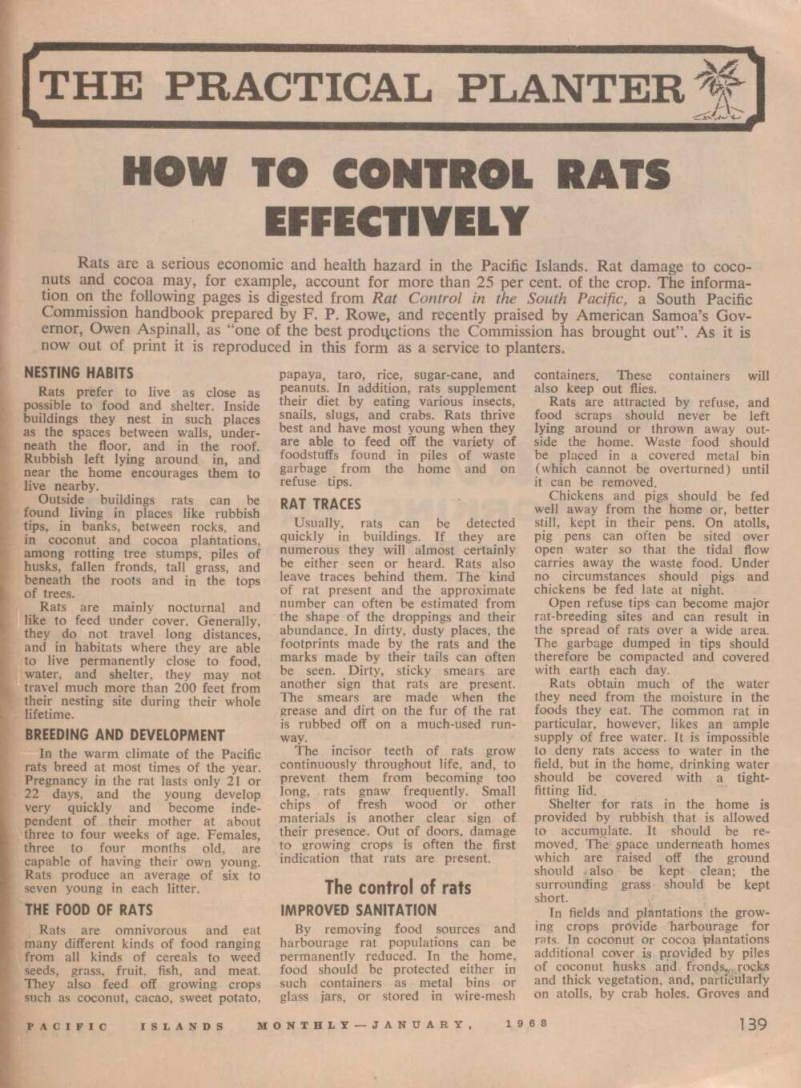
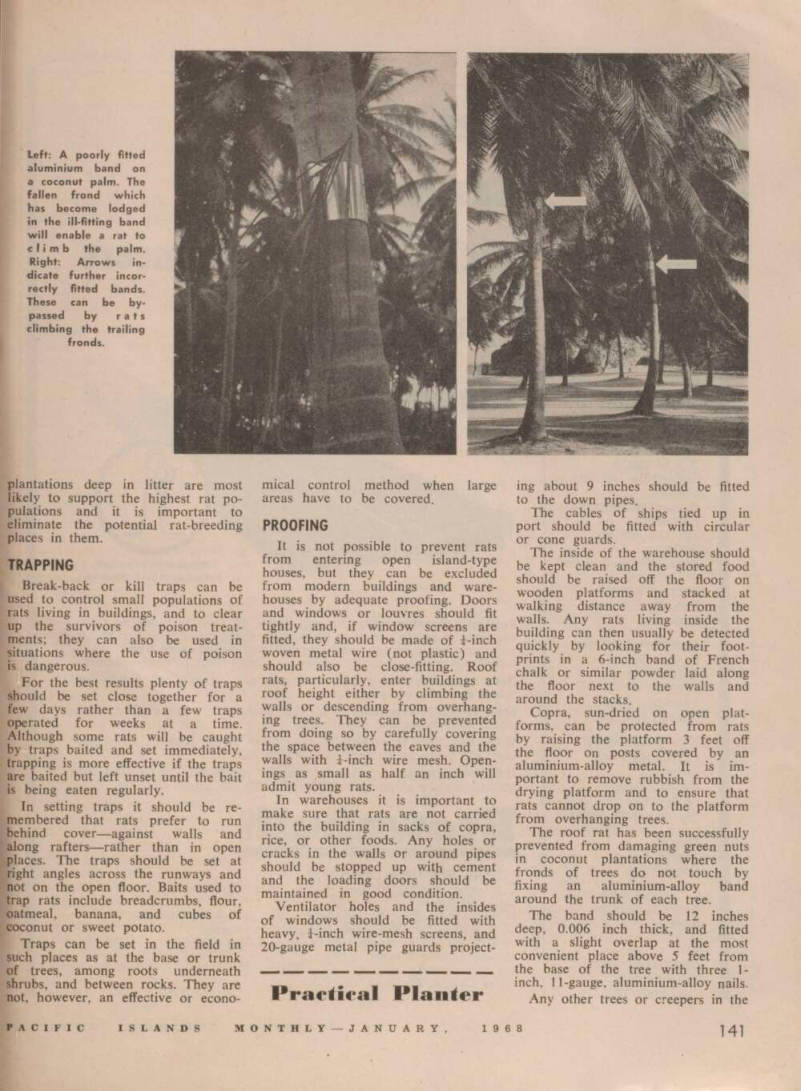
The roof rat has been successfully prevented from damaging green nuts in coconut plantations where the fronds of trees do not touch by fixing an aluminium-alloy band around the trunk of each tree.
The band should be 12 inches deep, 0.006 inch thick, and fitted with a slight overlap at the most convenient place above 5 feet from the base of the tree with three 1inch, 11-gauge, aluminium-alloy nails.
Any other trees or creepers in the
left: A poorly fitted aluminium band on a coconut palm. The fallen frond which has become lodged in the ill-fitting band will enable a rat to climb the palm.
Right: Arrows in dicate further incor rectly fitted bands.
These can be by passed by rats climbing the trailing fronds.
plantation which permit rats to reach or jump across to the fronds must be cut down. This method of banding should also be effective where some trees are touching, provided that all the trees are banded.
Poison Baiting With
Anti-Coagulant Poisons
Rat poisons are of two main kinds, the slow acting or anti coagulants like warfarin and Pival in which the poison needs time to take effect, and quick acting or acute ones like zinc phosphide and arsenic.
Compared with acute poisons, warfarin is far safer where humans and other animals are concerned. Its main action is to prevent the blood from clotting so that rats die by bleeding to death. Warfarin is normally used against rats at a con centration of 0.025 per cent, in bait.
Common rats die after about three to four days of continuous feeding off warfarin bait, but a longer period of feeding is required if they do not get all their food from the baiting points.
The roof rat and the Polynesian rat are less susceptible than the common rat to warfarin poisoning, and feeding for a week or more may be necessary before a complete kill is obtained.
Warfarin can be procured ready mixed in bait, but it is more com monly supplied as an 0.5 per cent, concentrate or master-mix, one part of which has to be added to 19 parts by weight of a suitable bait base.
The bait preferred by rats in any given locality may have to be deter mined by experimental tests. Baits frequently used because of their good keeping qualities are crushed cereals such as maize, wheat, oats, and rice.
To get a good warfarin mix it is important to use bait of uniform size. With coarse bait particles which are usually preferred by rats, 5 per cent, of a vegetable oil (such as corn oil) or a white mineral oil must be added to ensure that the poison adheres to the grain.
The palatability of oil-cereal type baits may be improved further by the addition of 5 per cent, sugar, giving a bait formulation comprised of warfarin poison. 0.5 per cent, con centrate (1 part), cereal (17 parts), oil (1 part), and sugar (1 part) by weight.
The dry ingredients are first
mixed thoroughly either by hand or by mechanical mixer, and the oil is then slowly added to the dry mix with constant stirring.
In dry places, such as grain stores, it is sometimes preferable to use damp warfarin baits. Soaked wheat (wheat soaked in water over night and the excess water then drained off) is attractive to rats and can be mixed with warfarin 0.5 per cent, concentrate (19:1).
Damp baits containing warfarin, however, suffer from the disad vantage that they must be changed frequently if they are to remain fresh and palatable to rats.
In humid climates, warfarin baits tend to become mouldy if they are left in position for long periods. This can be delayed by the addition of a mould inhibitor or bait preservative.
Inhibitors used for this purpose are paranitrophenol (1 part in 400 parts of bait) and dehydroacetic acid (1 in 1,000). Since they may make baits a little unpalatable they should only be used where moulding of baits is a serious problem.
To control rats living in build ings with warfarin bait, baits should be laid on runways, preferably in open trays measuring about 7 in. x 5 in. x in. Bait laid against a wall or other vertical surface can be covered with a piece of wood or metal about 2 feet long, set at an angle leaning against the wall.
At eaves height bait can be laid in open trays or tins measuring 3 inches in diameter and H inches deep, and fixed to wooden beams with a single nail. It is better to be
generous with baits, as too few baits poorly placed may be missed by many rats.
At the beginning, about i lb. of bait should be laid at each baiting point. If after one or two days most of the bait has been eaten, twice as much fresh bait should be put down.
It is essential to have extra fresh bait for the rats to eat because one or two feedings will not cause them to die and also because rats will not eat mouldy or rancid food.
If the infestation is heavy the bait at each point should be looked at every one or two days. When no more bait is being eaten —generally after 10 to 14 days—the excess bait should be removed and any dead rats found should be burned or buried.
The whole of the infested area should be dealt with at the same time, for if only part of it is treated the remaining rats may soon breed again. If the infested area cannot be treated in one operation it should be treated block by block.
Warfarin baits used to control rats living in dense coconut groves where banding is not possible, in cocoa plantations, and in and around sugar-cane and rice fields, must be protected from the weather.
Suitable bait containers measuring 15 inches long and 3 inches in diameter are galvanized metal or bamboo pipes and tile drainage pipes closed at one end. Alternative con tainers are wooden or metal boxes, 15 in. x 12 in. x 6 in., with 2i-inch square holes cut out on two sides to allow rats to reach the bait; bowls
Bait containers for use on cocoa or coconut palms. Left: Fixed with an iron spike or batten. Right: Tied with a wire retaining loop.
or shallow tins about 6 inches in diameter and 1 i inches deep covered by a curved piece of galvanized sheet metal cut 15 inches square; and 5 to 10-gallon paint cans with holes cut at the base.
The spacing of baiting points will be dependent on the amount of ground cover and the abundance of rats. In general, the baiting points should be placed not more than 100 feet apart (five to the acre).
Sufficient bait should be placed so that it will last for about five days, and the bait should be inspected on the fourth day and more bait added if necessary. Any mouldy bait should be removed. Baiting should be con tinued until feeding ceases.
In coconut groves on atolls, land and hermit crabs may interfere with baits laid at ground level. Bait may then be placed either in containers fixed to the trunk of about every eighth tree, 3 to 4 feet from its base, or in containers raised off the ground on wooden stands.
If warfarin baits are left in position permanently a bait preservative, paranitrophenol or dehydroacetic acid, will almost certainly have to be added.
An alternative method of con trolling rats in coconut and cocoa plantations and groves, which has proved successful in the West Indies, is to use paraffin-wax bait blocks poisoned with warfarin. Poison-bait blocks can be made by mixing together—ll lb cornmeal; 2 lb sugar; and 1 lb 4 oz warfarin poison 0.5 per cent.
The dry ingredients should be mixed thoroughly and 8 lb of semi refined paraffin wax which has just
been melted should then be stirred into the dry mixture.
The mixture is next poured into a tray, and, when it has solidified, is cut into i lb blocks measuring about 10 in. x 2 in. x 2 in.
If the damage is heavy half of a block should be put at the foot of every third tree, but a half-block for every sixth tree is usually sufficient.
If necessary the blocks can be nailed on to the trunks of the trees.
Poison Dust And Liquid Baits
In places like warehouses, it is sometimes difficult to control rats with warfarin bait. Alternative methods are the use of either a powder containing warfarin or a solution of the sodium salt of war farin.
To obtain the best results with warfarin powder, the powder should be sprinkled on rat runways in patches about 2 feet long, 6 inches wide, and i to i inch deep. It should
also be sprinkled in rat holes and wall cavities. The poison clings to the feet and fur of a rat when it runs over the powder and is ingested when the rat grooms itself.
The concentration of warfarin used in powder form is 1 per cent., or 40 times that used in bait, and it should not be placed where it can be blown on to foodstuffs or where other animals can become con taminated. When the treatment is finished the excess powder should be swept up and burned.
To control rats with water poisoned by sodium warfarin it is essential to prevent rats from drinking at other water sources. Dripping taps should be turned off and broken pipes re paired.
The made-up warfarin solution can be placed in a bottle inverted over a small tin lid. A beer bottle will last one to three weeks depending upon the number of rats drinking from it.
The bottles should be fixed by a wire
Two bait containers. Left: Made from a piece of hollow bamboo. Right: A wooden or metal box, 12 inches by 15 inches.
Left: This wooden bait tray is protected by a cover and is set near a rat ex cavation. Right: A drain pipe closed at one end, used as a bait container.
loop and nail around the walls of the warehouse and should be topped up once a week while the treatment lasts.
Acute Poisons
At the strength at which acute poisons are used in baits, a rat has only to eat a few mouthfuls to be killed. At first however, rats may only nibble a new-laid poison bait, and poison- or bait-shyness may then develop.
To prevent this happening it is necessary to “pre-bait”. This con sists of laying plain bait for a few days until the rats are used to it.
Only then is poison added to the bait.
Acute poisons frequently used against rats are zinc phosphide at a concentration of 2i per cent., arse niuos oxide at 10 per cent., and, against the common rat only, antu (alpha-naphthyl thiourea) at 2 per cent.
Baits commonly mixed with acute poisons are crushed cereals, but other seeds, various meats, fish, grated or cubed coconut, and cubes of sweet potato have also been used.
Initially, several kinds of bait should be tried to find out what the rats like best.
With dry cereal baits, 5 per cent, of a mineral or vegetable oil is often added to prevent the poison from falling off the grain. Generally, damp baits are liked better than dry ones, but wet baits must be prepared and used fresh each day. Wheat soaked in water overnight and then allowed to drain, soaked bread, and boiled rice or cooked broken maize are recommended damp bait bases to use with acute poisons.
As with anti-coagulant poisons, so also when treating rats with acute poisons it is essential to survey the infested area thoroughly, and to choose and mark the baiting points, both in buildings and in the field.
Containers should be put down about ten days before baiting begins so that the rats can get used to them.
Against the common rat, 2 to 4 ounces of bait should be used at each baiting point, but for roof and Polynesian rats 1-ounce baits are usually sufficient. If the plain bait is well eaten on the second or third day, the poison bait can be laid im mediately, but it is often necessary to pre-bait much longer, especially
where roof and Polynesian rats are concerned.
All the plain bait that can be reached should then be picked up and bait containing the poison laid at all the points where the plain bait was eaten.
The poison bait should be left down for 24 hours or for two nights if it is safe to do so. Immediately afterwards all uneaten baits must be picked up and burned or buried well out of the reach of other animals.
It is not always possible to get a complete kill of rats in one treatment with acute poisons, and it may be necessary to carry out a second treatment. A different bait base and acute poison must then be used. If warfarin is used to follow an acute poison the bait base must also be changed.
Keeping Of Records
It is important to keep accurate records of treatments.. . (1) so that baiting points can be found during a treatment and all can be accounted for at the end of the treatment; and (2) to be able, after a number of treatments, to decide whether a new poison or new method has led to any improvement in control.