The Solomons
pp. 125-127 · Read in the full issue
Trade Deficit Of
$3,494,000 IN
With disappointing export figures for copra and cocoa, the British Solomon Islands Pro tectorate had an adverse trade balance of $3,494,000 in 1967, the Financial Secretary, Mr. T.
Russell, said in Honiara in December when he presented his budget to the Legislative Council.
Mr. Russell said that the protec torate’s exports were still only worth about the same amount as they were in 1960, whereas imports were now valued at $8 million compared with just over $3 million seven years ago; budgetary expenditure now stood at more than $5l million compared with $2,742,000 in 1960; and develop ment expenditure was now more than $2l million compared with only $900,000 seven years ago.
The value of exports for the 12 months to September 30, 1967, was $4,430,000.
“The charge that Her Majesty’s Government is not playing its part [in the development of the Solomons] in spite of the economic plight of the United Kingdom cannot be sustained,” Mr. Russell said.
“Our remedy lies in our own hands, and that is an increase of exports which one day will have to sustain what services the protectorate can afford.
“I am confident that 1968 will show an improvement, but am worried by the moral effect on the will of the people that large quantities of aid over a long period of years must have.
“This year we have had to face up for first time to the rude shock that what is given in one year may not necessarily follow in the next.
“Nevertheless, the level of invest ment in the protectorate is an earnest of faith in the economic future and stability of the protectorate.”
Mr. Russell said no decision had been made as yet on whether full or some allowance would be made for the effects of devaluation on British aid to the BSIP.
It was hoped a decision would be made in early 1968.
The 1968 Appropriation Bill pro vided for $8,202,414 expenditure compared with $8,372,460 in 1967.
As expenditure of staff salaries,
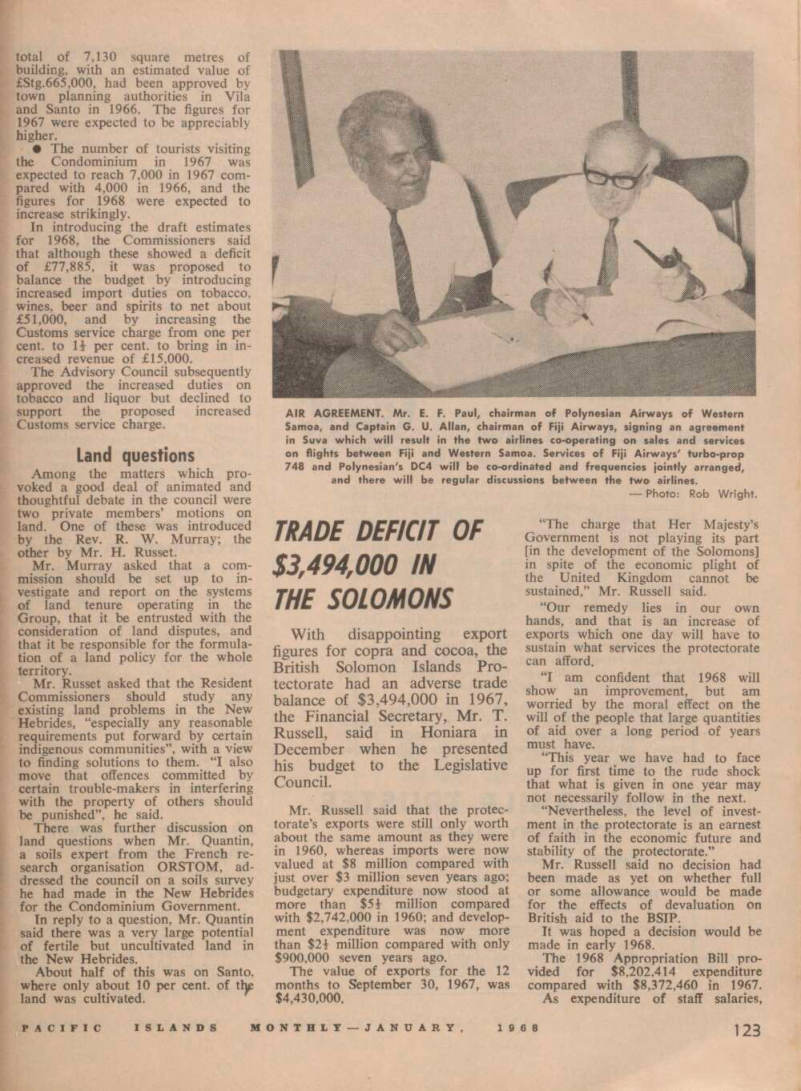
AIR AGREEMENT. Mr. E. F. Paul, chairman of Polynesian Airways of Western Samoa, and Captain G. U. Allan, chairman of Fiji Airways, signing an agreement in Suva which will result in the two airlines co-operating on sales and services on flights between Fiji and Western Samoa. Services of Fiji Airways' turbo-prop 748 and Polynesian's DC4 will be co-ordinated and frequencies jointly arranged, and there will be regular discussions between the two airlines.
- Photo: Rob Wright.
hitherto met from the budget, would be met directly from the British Government, a true comparison would be the same amount for 1968 compared with $7,349,750 in 1967, he said.
Reviewing the protectorate’s eco nomy, Mr. Russell said that the annual target figure of 31,000 tons of copra that had been set had not been achieved, and the territory was being hard put to produce 24,000 tons.
The speed of development in the cocoa industry was also disappoint ing, and the protectorate would be lucky if 50 tons were produced in
1967 compared with 95 tons in 1966.
The smaller crop was largely due to devastation of cocoa groves on Malaita by a cyclone in 1966.
However, the 1968 rice crop could exceed 2,000 tons, or two-thirds of the protectorate’s total imports.
Timber exports were expected to reach 2i million cubic feet in 1967, or double the 1966 production. The target for 1968 was 3i million cubic feet.
Mr. Russell said Lever’s Pacific Timbers Limited would transfer to Kolombangara from Gizo in 1968 and Bougainville Development Cor poration hoped to begin operations
on Vangunu. Three other timber companies were in active operation.
A final assessment would be made in 1968 whether to grow oil palm.
Such a scheme would need an in vestment of $5 million.
Mr. Russell said International Nickel Southern Explorations Limited had reported a discovery of “im portant quantities” of nickel and associated metals on Santa Ysabel and adjoining San Jorge where the company has been working for about three years.
International Nickel would mine and stockpile 50,000 tons from the nickel deposits, and studies would be made in 1968 which would help it to decide whether to proceed with a full-scale mining venture.
The company would spend $350,000 in addition to the $857,000 already spent on the project.
Mr. Russell said recent develop ments in secondary industry included a tobacco factory now in operation and producing 600 lb of processed tobacco a week, a rattan furniture factory producing 100 chairs a month, and the near completion of a $50,000 beche-de-mer factory.
The Joy Biscuit factory had recently exported up to 25 tons of biscuits a month.
First Japanese
investment in Samoa
A company official and three employees of a joint Japanese-West ern Samoa timber milling company arrived in Apia from Japan late November to prepare for a start to Samoan milling operations.
The mill will be established at Leufisa, close to Apia, on the pro perty of Galuvao Farani, former M.P. and one of the company’s shareholders. The mill will start with nine Japanese and 20 Samoan employees, and it is hoped to eventually employ 60 Samoans.
It will mill timber for building and furniture; the products being available locally and also for export to Japan.
Apia gets a town
market at last
A bone of contention for years, the lack of a town market in Apia, was rectified early in December when without much fanfare Minister of Works Lesatele Rapi announced the opening of 77 stalls in the former banana packing sheds at Savalalo.
Lesatele said that it was hoped to eliminate entirely the street-side selling of food products.
Oil strike off
Papuan coast
Drilling 10 miles off the Papuan coast and 200 miles north-west of Port Moresby, the $7 million floating drilling rig Glomar Conception made a natural gas strike on December 18.
The strike well, called Uramu No. 1, blew out and flowed gas while drilling was on at 6,165 feet, below 91 inch casing set at 6,144 feet.
Operator of the consortium running the oil rig, Phillips Aus tralian Oil Company, gave no indica tion of the flow rate.
The well was controlled and operations continued in high-density mud.
The strike brought a hint of promise to shareholders of Oil Search Limited, which holds a lease adjacent to the strike area. However, the company’s 50 per cent, shares did not react and stayed at about 42 cents in late December.
Oil Search, together with British Petroleum and Esso Exploration and Production Australia Inc., is to spend about $lO million looking for oil in Papua this year and in 1969 {PIM, Nov., 1967, p. 125).
In late December Esso was carry ing out a seismic survey on Oil Search’s Iviri lease section in the Gulf of Papua.
40th anniversary of
Islands firm
Breckwoldt and Co. Pty. Ltd., well-known Islands trading firm with eight branches in New Guinea, the Solomons and Western Samoa, celebrated its 40th anniversary recently with the publication of a handsome booklet in German and English on the history of the firm.
The company was founded in 1927 by Wilhelm Breckwoldt in Hamburg, Germany. Mr. Breckwoldt, a keen philatelist, became associated with the Pacific Islands from 1931 onwards because he liked the look of the “rare and unknown” postage stamps that came from there.
By sending off letters to darkest New Guinea and colourful Fiji, seek ing orders for consumer goods and such things as rubber belts, Mr.
Breckwoldt received a stack of promising replies and added hand somely to his stamp collection.
In 1932 he booked a passage to Rabaul on the English steamer Esperance Bay to meet his customers personally.
The result was enough orders to keep his Hamburg office busy for
a year. So Brewo beer and Brewo razor blades turned up in the Islands.
Branches of Breckwoldt and Company appeared in Suva and Rabaul in 1934, Papeete in 1936 and Apia in 1937. Mr. Breckwoldt made follow-up visits to the South Seas in the late 1930’5.
With no sources of supply in Europe during World War 11, Mr.
Breckwoldt’s business came almost to a standstill. But Mr. Breckwoldt set up branches in Kobe, Japan, and Shanghai, China, and things began to pick up again about 1948.
In 1950, the company was allowed to reopen in Rabaul; offices in Suva and Apia were restarted; and in the
early 1950’s inroads were made in the Far East, South-West and West Africa.
Breckwoldt’s won agencies for VW cars, Olympia typewriters, Con tinental tyres and tubes, Sanyo electrical equipment and Carrier air conditioners.
Now, the company has plans to transfer its head office from Rabaul to Port Moresby. It has other branches at Madang, Lae, Kieta, Honiara, Apia and Wewak.
General manager for the Pacific Islands, Mr. H. Hoertelmann, is directly responsible to Hamburg headquarters, not to the company’s four-year-old Sydney branch.