Pacific Shipping And Cruising Yachts
pp. 103-113 · Read in the full issue
Cruising Yachts
Further Delay
Expected On
Asau Wharf
The deep-water wharf at
Asau, Savaii, Western Samoa,
which was completed in October, 1966, and which, because of un foreseen difficulties in clearing a channel, has stood in virginal isolation ever since, will ap parently have to wait yet another few months before the first ship
ties alongside.
For the past two years Public Works men, assisted intermittently by New Zealand navy divers, have been trying to blast a channel through the coral of the lagoon and reef.
For some time it was expected that the wharf might be opened in June, 1968. Early in December, however, the Director of Works, Mr.
L. McQuitty, revised the estimate.
Navy divers working at Asau had to give up as the usual December swells caused a current outside the reef that made it impossible for them to continue blasting.
They have now returned to New Zealand and expect to return in April.
As a result, the wharf is not now expected to be in use until Sep tember, 1968.
Mr. McQuitty said that the $2,400,000 harbour project involving wharves at Asau and Apia will probably cost an additional $400,000.
He said, however, that this would include a 4,500 ft airstrip built on the reef at Asau from the dredging spoil. This was not included in original plans.
End Of The "Manu'a Tele"—
History Repeats Itself
The fourth attempt this century by the people of the Manu’a Islands of American Samoa to run their own shipping enterprise came to a miser able end in mid-November when their ageing inter-islands vessel Manu’a Tele was sold to the Ameri can Samoan Government for $9,461.41.
The ship is to be stripped of such valuable equipment as she still con tains, then towed out to sea and sunk.
The Manu’a Tele had been laid up in Pago Pago since November. 1965, when the local Marine Board ruled that she could not go to sea again until certain repairs were carried out.
The owners of the ship, the people of Manu’a, already owed the govern ment $9,461.41 for repairs and materials at that stage.
After they failed to wipe off their debt and to make the repairs ordered
by the Marine Board, the ship was put up for sale by public tender.
Three bids were received—the one from the government, which bid the figure of its outstanding debt; one from a local shipping operator for $500; and one from a sixth grade school class in San Francisco for $73.60.
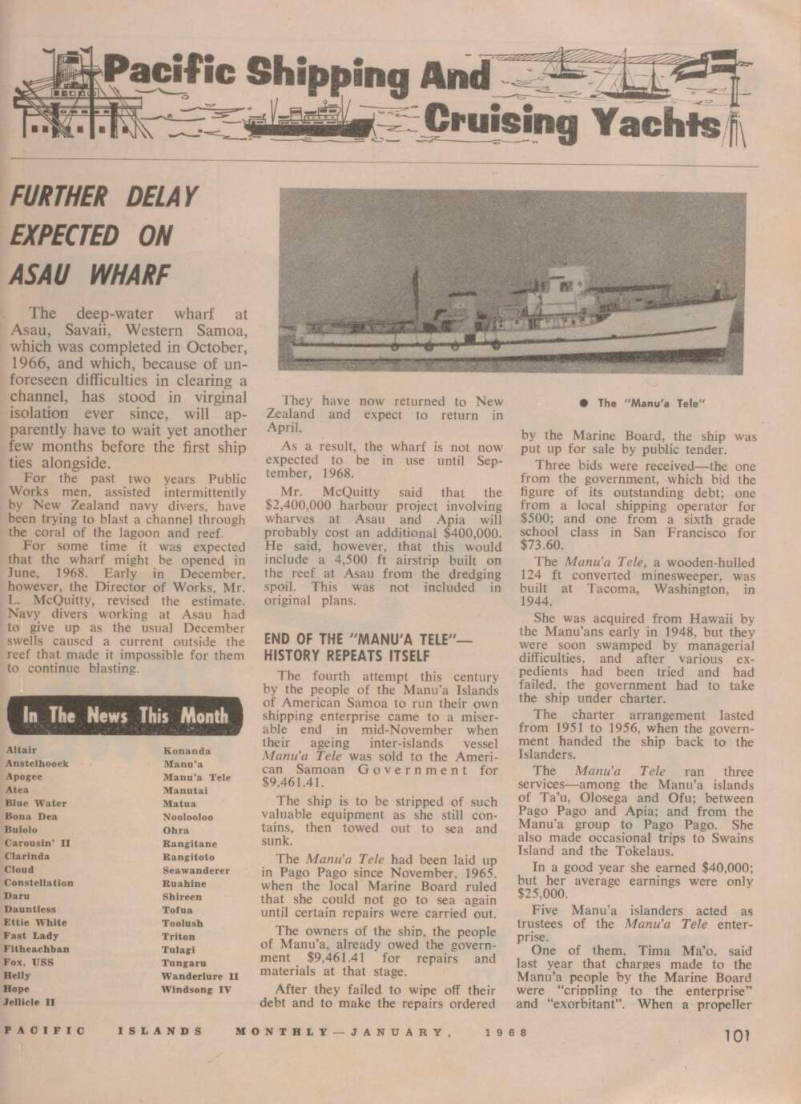
The Manu’a Tele, a wooden-hulled 124 ft converted minesweeper, was built at Tacoma, Washington, in 1944.
She was acquired from Hawaii by the Manu’ans early in 1948, but they were soon swamped by managerial difficulties, and after various ex pedients had been tried and had failed, the government had to take the ship under charter.
The charter arrangement lasted from 1951 to 1956, when the govern ment handed the ship back to the Islanders.
The Manu’a Tele ran three services—among the Manu’a islands of Ta’u, Olosega and Ofu; between Pago Pago and Apia; and from the Manu’a group to Pago Pago. She also made occasional trips to Swains Island and the Tokelaus.
In a good year she earned $40,000; but her average earnings were only $25,000.
Five Manu’a islanders acted as trustees of the Manu’a Tele enter prise.
One of them, Tima Ma’o, said last year that charges made to the Manu’a people by the Marine Board were “crippling to the enterprise” and “exorbitant”. When a propeller
• The "Manu'a Tele"
shaft was replaced, the bill was $3,000 for only 24 hours’ work, he said.
Ma’o said the Manu’a islanders had contributed many thousands of dollars to keep the Manu’a Tele going; and they were greatly dis ap poin t e d by the “unbending attitude” of the government, which had previously got the ship out of trouble with a $15,000 loan. The loan had been repaid in full within 12 months.
After the ship was laid up in Pago Pago, she became almost derelict.
Vandals stripped her of parts; and rust took over.
The Manu’ans first decided to go into the shipping business at the turn of the century when they saw out landers operating small schooners among the islands at a profit.
They formed the Manu’a Co operative Company in 1902 and bought William Blacklock’s schooner Ettie White.
However, five years later they had to replace the Ettie White and although they had not paid off their debt to Blacklock. they bought another schooner, the Altair, for $3,500.
The Altair was so dilapidated that they had to spend an additional $7,000 to make her seaworthy.
Even so, the Altair operated profitably for a while. She hauled copra from Manu’a to Pago Pago and took on charter business.
However, each inhabitant of Manu’a considered himself a joint owner of the ship, and it appeared to him preposterous that he should be required to pay for the trans portation of his goods or of himself and his family.
When the company failed to en force charges, the Governor acted as a trustee and put in his own manager. Although the Altair began to make money again, it was too
late because she was old and rotten and had to be replaced.
Another ship, called the Manua, was built in the US and arrived in Pago Pago in 1912. But she proved too big to operate and her engine caused a lot of trouble. She also involved her owners in a damage suit due to a collision in Apia harbour, and in 1915 she was cast aground in Apia by a hurricane.
With the management problem still unsolved, the Governor of the day.
Governor Stearns, concluded that the Manu’a people were “absolutely in capable of managing their own affairs in financial matters”.
He recommended either that their co-operative should be dissolved and the ship sold to an individual owner, or that the government should take her over and go into the shipping business.
“The co-operatives are an un limited annoyance to whatever official is charged with their super vision,” he said.
American Samoa’s historian.
Captain J. A. C. Gray, points out in his book Amerika Samoa that history repeated itself when the Manu’ans again bought and operated a ship— the Manu’a Tele.
Us Missile Warship
Visits Tonga
The first missile warship to call at Tonga, the USS Fox, arrived in Nukualofa from New Zealand on a three-day goodwill tour on December 9.
Officers and crew poured ashore at Nukualofa bringing back wartime memories of the time when Tonga was a staging camp for thousands of United States troops and for detachments of the United States Navy.
Schooner Runs
Into Lighthouse
The Fitheachban, 18-ton schooner, which operates day cruises from Lautoka to Qalito Island in the Mamanuca Islands of Fiji, hit the Vio Islands south-east lighthouse in Lautoka Harbour early on December 6 as she was about to put to sea.
It is understood that she developed a fault in the electrical steering device, and swung to starboard as it was passing the lighthouse.
The owner, Mr. A. D. Tregidga, who was in command, dived to examine the hull and reported that the hull sheathing was damaged.
The Fitheachban was sailed to Suva for slipping.
Boats From Auki
Ready In March
Four 26 ft T-class touring vessels and a 25 ft surfboat, built by 24 Pacific Islanders at a marine boat building school at Auki, Malaita, for the Solomon Islands Government, will be ready by March.
To have the ships built, the BSIP started a two-year shipbuilding course for Islanders in June, 1966, and has spent about $60,000 on the school and its equipment. The school is next to Auki’s small ships wharf.
Originally the school was run by the South Pacific Commission.
The BSIP recruited 18 Solomon Islanders, and two Islanders each from the New Hebrides, the GEIC and Niue.
David Pratt, 29, from Munda, Western Solomons, who showed ex ceptional promise, has been appointed assistant instructor and supervises when the instructor, Mr. Frank Faulkner, 38, is absent.
Mr. Faulkner, an Australian, spent 14 years in New Guinea before going to the Solomons to run the project.
He told PIM in December that all his students had done well and another scheme might be started when the present one ends in June this year.
Only local timber, such as u’ula and koila, was used to build the five ships.
The touring vessels will be used for administrative purposes through out the Solomons. The surfboat, believed to be the first built locally, will be used at Kira Kira.
Contract Extended For
Micronesian Line
The United States Trust Territory Government has extended its con tractual arrangement for logistic shipping service with Micronesian Line until August 31, 1968.
This will give the government time
to complete a detailed study of sea transportation requirements, The Trust Territory is presently exploring means of acquiring either new vessels or vessels of relatively recent vintage, with speeds of 16 to 18 knots, large booms and some containerisation space for transport ing cargo.
Means are being sought to acquire these vessels without seeking ap propriations from the US Congress in amounts that would curb the Trust Territory’s capital construction ex penditures for water and power, sewers, docks, hospitals and schools.
While this quest is going on, it was felt undesirable to enter into a
new contract for an extended period of time.
Micronesian Line will attempt to tighten its schedule and provide better service within the Trust Terri tory with its existing equipment. This may mean foregoing some calls at foreign ports such as Taipei and Manila.
Higher Freight Rates
For Union Steam
The Union Steam Ship Co. has increased freight rates for its ships operating between New Zealand and South Pacific Islands ports.
The lift is five per cent, but be cause of the revaluation of Fiji’s currency, freight rates in Fiji currency will be about 5\ per cent, lower than they were at the time New Zealand currency was devalued.
The USS Co., manager in Fiji, Mr. Jack St. Julian, said in December that the new rates were applied to recoup additional costs involved in the purchase, outside New Zealand, of fuel oil and ships’ stores, and higher stevedoring and port charges, etc.
The USS Co. operates the Tofua and the Matua between New Zealand, and Fiji, Tonga and Samoa.
Three New Zealand Liners
To Leave Pacific Run
The New Zealand Shipping Co. is to withdraw its three passenger cargo liners from the London-New Zealand service because of sub stantial losses, according to a report from London in December. The liners sail via Panama and make a call every two months at Tahiti northbound and southbound.
The liners are the Rangitane (21,867 tons), Ruahine (17,851) and Rangitoto (21,809).
They will be replaced by two Japanese-built, fast, refrigerated cargo liners each of 9,000 tons, which will go into service as the liners are phased out between May, 1968, and July, 1969, the report said.
Costly labour disputes were stated to be the reason for the withdrawal of the three liners from the run.
Ponape Trader
In Rabaul
In another attempt to open up trade between the United States Trust Territory and New Guinea, the 208ton island trader Tungaru made a week-long call at Rabaul in Decem ber to buy about $25,000 of goods, mainly kerosene, for trade at Ponape, Eastern Carolines.
Owner of the Tungaru , Mr. Carlos Etscheit, 67, of Ponape. told PIM
that the ship had left Ponape last July and had had a refit and engine overhaul at Fiji before going to Rabaul.
He said Rabaul was only 900 miles from Ponape—a five-day trip by sea —which was a lot cheaper than going northwards to Japan.
Mr. Etscheit has made periodical trips to Rabaul in the Tungaru over about four years and hopes to set up a regular service.
The Tungaru left Rabaul to return to Ponape on December 7.
Mr. Etscheit’s family has had links with Micronesia for more than 90 years.
His father, Dominique, left Europe
for Australia in 1874, hoping for a fortune from gold.
A year later he moved to the Marshall Islands, then owned by Spain, and set himself up as a shipper and trader, trading as far afield as the Philippines.
Among the colourful personalities he came into contact with in those days were “Bully” Hayes and New Guinea's Queen Emma.
In 1896 Mr. Etscheit, Sr., went to Europe to collect an uncle’s in heritance and to marry. He brought his wife back to the islands.
Three years later Germany bought the Marshalls, Carolines and Marianas from Spain. About the
same time, Mr. Etscheit, Sr., bought 1,250 acres on Ponape, which he promptly planted with coconuts.
Carlos Etscheit was born in 1900 and in 1905 he was sent to school in Europe, where he stayed for the next 19 years.
When the Micronesian islands were made a trusteeship of Japan after World War I, Mr. Etscheit, Sr., was sent back to Europe, where he died in 1924.
However, the 1,250 acres on Ponape had remained his property, and Mr. Etscheit, Jr., returned to claim them after his father’s death.
He married a Belgian girl, Simonne Frankard, in Europe in 1927 and brought her back to live at Ponape.
They had three daughters, Yvette, Monique and Renee.
Business picked up on Ponape in the 1930’s and Mr. Etscheit set up the Ponape Shipping Company, Carlos Etscheit Soap Company and the Carlos Etscheit Company.
Just before World War 11, the soap trade was particularly good.
During the war, the Japanese “interned” the Etscheits on their own plantation for 4i years.
When Ponape became a battle field, all the coconut trees on the plantation were destroyed.
After the war, with Micronesia under US control, Mr. Etscheit re sumed trading on Ponape and running ships, making an occasional trip to Nauru. He also cleared his plantation and planted more nuts.
He is one of the very few traders who has been allowed to stay under the United States trusteeship—a “loner”, trading in competition with the Islanders’ government-encouraged co-operatives.
This doesn’t seem to worry him
overmuch, but he admits he “doesn’t get around as fast as before”.
Mr. Etscheit’s wife died three years ago.
New Ship For Bp
In The New Hebrides
Burns Philp (New Hebrides) Ltd. has bought the 414-ton Dutch-built freighter Konanda from New Hebrides shipowner Captain Athol Rusden for $BO,OOO.
Captain Rusden bought the Konanda in late 1966 for £5tg.35,000 (. PIM, Feb., 1967, p. 101).
BP (NH) have been favourably embarrassed for several months
because the trading turnover on the Manutai, their only big inter-island trader in the New Hebrides, has exceeded that in their Vila store.
The Vila store is being rebuilt near Vila’s main jetty. It will have two floors the ground floor for retail and bulk operations and the top floor for offices.
When completed in August, it will have cost about $300,000.
The Manutai has a big trading store on board and makes over 20 regular calls throughout the New Hebrides buying produce and selling general trade goods.
BP will install a similar trade store
"Tungaru"
on board the Konanda and use her to complement the Manutai’s routes and cover several smaller calls the Manutai has had to miss lately.
Konanda’s master will be Captain E. W. Lamberty.
Seven People Rescued
From Reef
Seven Australians, including a young woman, were rescued from Osprey Reef, on the Great Barrier Reef north of Cairns, on December 17 by the Dutch freighter Anstel hooek.
The Australians left Port Moresby early in December in the 45 ft trimaran Cloud. A search began for them when they became overdue.
When found they had been on the reef for 10 days.
An RAAF Neptune bomber sighted them on Osprey Reef on December 16. The trimaran, with one pontoon submerged, was grounded on the reef.
The Neptune circled the boat as the Anstelhooek took the castaways off the reef.
The castaways included the owner skipper of the trimaran, Mr. H.
Chamberlain, of Port Moresby; Messrs. Ernest and John Lohberger, of Port Moresby; and Miss Carmel Ward, of Port Moresby.
Burns Philp Skipper
Leaves "Tulagi"
Captain Lloyd Davis, 39, master of the 2,700-ton Burns Philp passenger-freighter Tulagi, left the company after the Tulagi arrived in
Sydney in mid-December to take a shore job in Sydney.
Captain Davis joined Burns Philp in 1954 as third mate on the Malekula on the New Guinea run.
He served on the now defunct Singapore run on the Burnside and Brae side until 1961 before joining the Malaita, Tulagi and Malekula on Pacific Islands routes. He was made master of the Tulagi in late 1966.
Captain Davis will be temporarily
replaced by Captain J. Ealey, who had been in charge of the Bulolo during the recent absence on honey moon of Captain Brett Hilder, commodore of the BP fleet. • S. E. Tatham & Co. Pty. Ltd., export and shipping agents through out the Pacific since 1924, has ex tended its business and moved into new offices in Melbourne.
Captain Lamberty