his Pacific paradise
pp. 96-98 · Read in the full issue
Ex-Governor Lowe surveys his Pacific paradise
Americans may be divided on a lot of things these days, but of one thing they universally remain convinced. All Pacific Islands are paradises. It is no surprise then, that Richard Barrett Lowe has called his book about his experiences as Governor in American Samoa and, later, Guam, Problems in Paradise— the View from Government House.
Problems and paradise may be a contradiction in terms but the book itself is interesting enough. Interest ing for Americans, most of whom are still faintly surprised that the United States has any colonial pos sessions at all, and who like to know how it is done. And interesting for the rest of us who have been in the colonial business for a long, long time and are naturally intrigued to see our great and powerful American friends floundering in the same morass.
This is not to say that, in the long run, the Americans will be worse at this game than we have been; to the contrary. But in the meantime, we can be blase and cynical and surprised at nothing in colonial administration while the Americans are still finding out the hard way that, squeezed between political expediency back home in Washington (or Whitehall or Canberra), and indigene recalcitrance, colonial administration can be less than fun.
This air of surprise that there can be problems in paradise, especially when viewed from Government
House, comes out pretty strongly in Mr. Lowe’s book. He was appointed Governor of American Samoa in October, 1953, less than 2i years after the US Department of the Interior took over administration of the territory from the United States Navy which had administered it since 1900.
Between June, 1951 and October, 1953 there had been four governors and four acting governors. Even worse, American Samoa, which had had a Navy Base economy for 50 years suddenly found itself with no economy at all.
The total land area of the ter ritory is 76 square miles, a lot of it in the perpendicular, and by the time the Navy pulled out the Samoans had even got out of the habit of growing enough to feed themselves; in numbers, they had, moreover, increased from 5.600 in 1900 to 19,000 in 1951.
Off to Guam
In this state of political and economic chaos it says something for the Samoans’ innate sense of tradition and hospitality that on the arrival of Governor Lowe and his wife, that they brought out the bowl once more to prepare a Royal kava of welcome.
Probably to the Samoans’ surprise Governor Lowe stayed three years, and this fact alone went a long way towards stabilising a situation that appeared, at one time, to have got out of hand. It was during this time that the Van Camp tuna cannery was set up and Japanese methods of long-line fishing introduced. These revolutionised the economic outlook of the small territory and paved the way for more spectacular advance ments in televised education, tourism and the rebuilding of Pago Pago that have occurred in more recent years.
Lowe has some interesting things to say about his encounters with his opposite numbers in neighbouring British territories; his travels in the Pacific; the arrival of raft-drifter
Willis, and the newspaper furore it caused in 1954; the labour and other troubles of Swain’s Island; and how he was sued by an itinerant State sider who wanted to mechanise the American Samoa handicrafts industry.
In 1956 he accepted the Governor ship of Guam, which was a bigger territory, and he had a bigger salary and, all-round, much bigger problems.
Although American Samoa had at one time been a U.S. naval station, Guam still was, although administra tion was transferred to the Interior Department from Navy by Organic Act in 1950. The Navy was still a
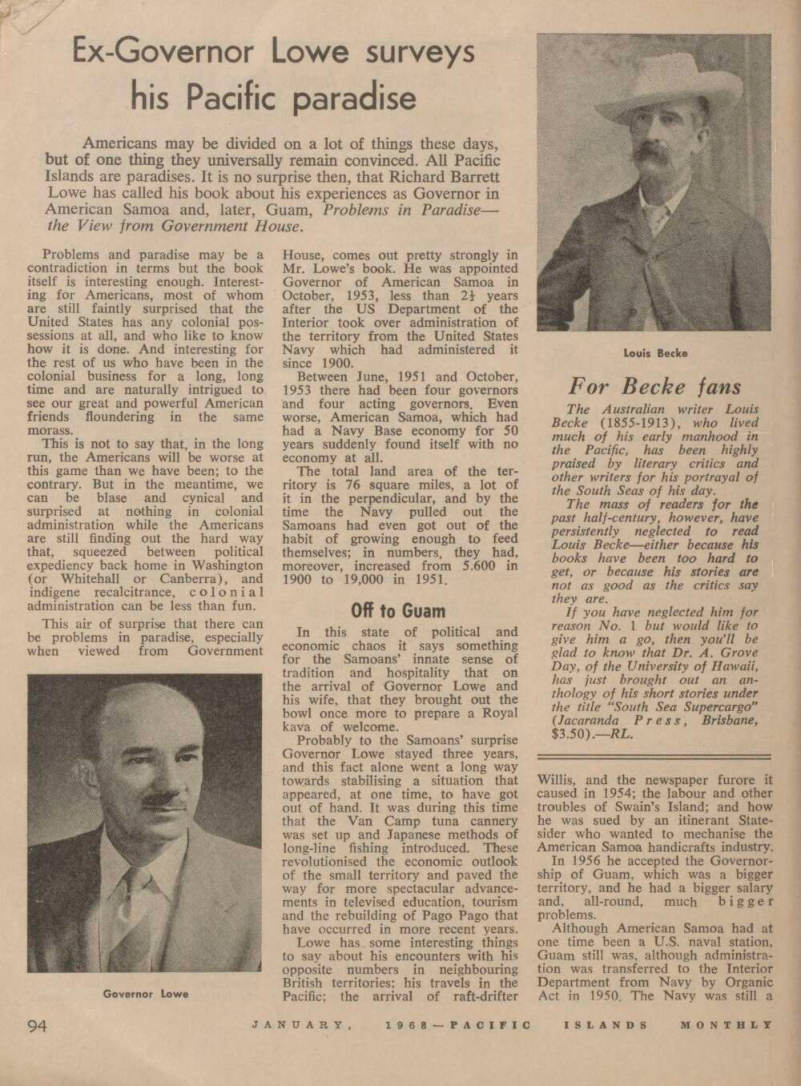
Governor Lowe
force to be reckoned with (and still is to this day), and a head-on clash between civilian Governor Lowe, and Rear Admiral William Eerdmann, the Commander of Naval Forces, Marianas, stationed on Guam, was one of Lowe’s main problems in this particular paradise. It probably was a factor in why Lowe chose to retire at the end of 1959.
Although local Guamanian politics were more complicated than those of American Samoa and more than capable of providing a minor hell for any administrator, to the out sider looking in at American ter ritorial administration, it seems that the American political system itself created most of the major problems.
British colonial administration had been based on career officers all down the line, including governor ships; although Australia and New Zealand have at times departed from this so far as governorships are con cerned, they have retained the idea of a trained bureaucracy or public service.
The American system
The United States has never at tempted anything of this sort, evidently basing its reasoning on a belief that anyone who can under stand a potato farmer in Idaho will be capable of understanding and governing a subsistence taro grower in Yap.
Jobs in territory administration are therefore often the result of political patronage —of whether an individual toes the Republican line when the Republicans are in power; or is a Democrat when a Democrat is in the White House.
Some of the reasons set out in his book by Governor Lowe as to why certain people got certain jobs seem to me quite incredible, and a vital factor in the political intrigues that followed.
Even more difficult for the gov
ernor on the spot, is the American system of budgeting—the sum that is considered necessary even if given Presidential approval, can be cut to shreds by a hostile Senate for reasons having no bearing on territorial wel fare.
Governor Rex Lee, who has just left American Samoa after half a dozen years there, was accused in the latter part of his governorship of being away from Pago Pago more often than he was there. The way Mr. Lowe tells it, he probably had darned good reason. It seems to be inherent in the system that any governor of a US territory would need to spend a large part of his time in Washington, either defend ing his own actions against intriguers; or trying to get grants for very necessary works and services through a maze of steel-hearted, gimlet-eyed Stateside politicians.
Folksy book
In the American way this is a folksy sort of book. A British retired Governor, writing his memoirs, would never let on, of course, that he hadn’t been born and raised in Government House. The Lowes, on the other hand, are quite frank about the fact that they had never been in that position before and are glad to visit with Sir Ronald and Lady Garvey at G.H., Suva, en route, and pick up a few points. It is also full of anecdotes on Government House living, American style, and snippets of amusing information about the places and people the Lowes en counter.
As far as we know, this is the first book written by an ex-Governor of a US Pacific territory, and for this reason alone it’s well worth reading.
PROBLEMS IN PARADISE; published by Pageant Press, 101 Fifth Avenue, New York, NY, 10003; $US6.95.
Solution to crossword puzzle, p. 89.